America’s grocers are doing something they have avoided for much of the past two years: cutting prices. Facing customers who have pared back spending to cope with stubborn costs, chains are rolling back shelf prices and leaning hard on value to keep shoppers coming through the door. The shift, underway across the industry this summer, reflects a consumer who is stretched thin — and government data explains why.
Food prices rose 3.1% over the year through May, according to the Bureau of Labor Statistics, with grocery prices up 2.7% and restaurant prices up 3.5%. Those increases sit atop years of accumulated inflation that has left the average cart far more expensive than before the pandemic. At the same time, the Bureau of Economic Analysis reported the personal savings rate fell to 3% in May, down from 4.5% a year earlier, a sign that households have less cushion to absorb rising bills.
The squeeze has several sources at once. Higher food costs, reductions in federal food-stamp programs, elevated gas prices tied to the conflict with Iran, and even the rise of weight-loss medications that curb appetite have combined to push shoppers to buy less. The result is an industry that has struggled for roughly 18 months as volumes soften, and retailers are now responding with the bluntest tool they have: lower prices.
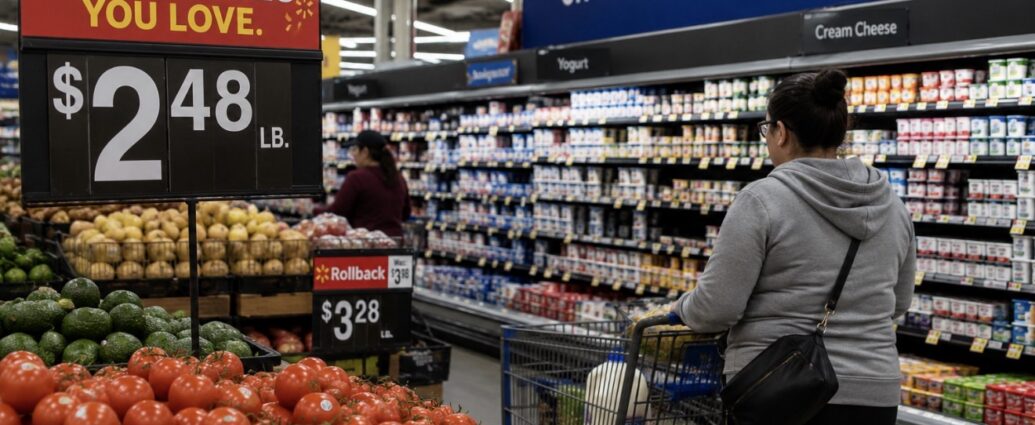
Large chains are leading the retreat. Walmart and Kroger have deployed price rollbacks and value positioning to protect store traffic and market share, betting that winning the trip matters more than the margin on any single item. Packaged-food makers are following suit, emphasizing affordability through promotions and smaller price increases rather than risk losing budget-conscious buyers to cheaper rivals.
Those rivals are increasingly the stores’ own brands. Private-label sales grew nearly three times as fast as national brands last year — 3.3% versus 1.2%, according to the Private Label Manufacturers Association — as shoppers swapped name brands for cheaper alternatives that now rival them on quality. Roughly a third of consumers report buying fewer groceries overall, and three in four say they have changed their shopping behavior because of higher prices, cutting impulse buys, clipping coupons, and hunting for deals.
The mood among the companies that stock those shelves is cautious. “I don’t see how anything will change until the disposable income of the consumer goes up or cost starts to go down in a big way,” said Dirk Van de Put, chief executive of Mondelez International, capturing a sentiment widely shared across the packaged-goods industry. His comment underscores the bind for brands: with customers unwilling to absorb more increases, growth now depends on either fatter paychecks or genuinely lower costs, neither of which is guaranteed.
Government policy is adding to the confusion at checkout. A proposed cut to the fruit-and-vegetable allowance in the Special Supplemental Nutrition Program for Women, Infants and Children, known as WIC, could reshape what lower-income families can buy, while state-by-state restrictions on using food benefits for soda and candy have created a patchwork of rules. A federal judge blocked an earlier federal attempt to impose such limits, prompting individual states to write their own — leaving retailers to sort out the differences register by register.
For grocers, the price cuts are a defensive bet with real risk. Every rollback trims margins that were already thin, and chains are wagering that higher volumes and loyal traffic will make up the difference. Some are turning to technology to sharpen the pitch, with artificial-intelligence tools increasingly used to personalize deals and reach shoppers before they ever enter the store.
Whether the strategy works depends on forces outside any grocer’s control. If gas prices keep climbing on the renewed Middle East conflict, the discretionary income shoppers might have spent on a nicer cut of meat or an extra bag of snacks will instead go into the tank. And with the personal savings rate already near multiyear lows, there is little room for error in the family budget.
The takeaway for consumers is a rare bit of good news in a hard stretch: the deals are getting better because stores need them to. For the industry, the harder truth is that lower prices are less a strategy than a necessity, forced by a shopper who has finally reached the limit of what she is willing to pay.
JBizNews Desk | New York
© JBizNews.com All Rights Reserved. Reproduction or distribution without written permission is prohibited.