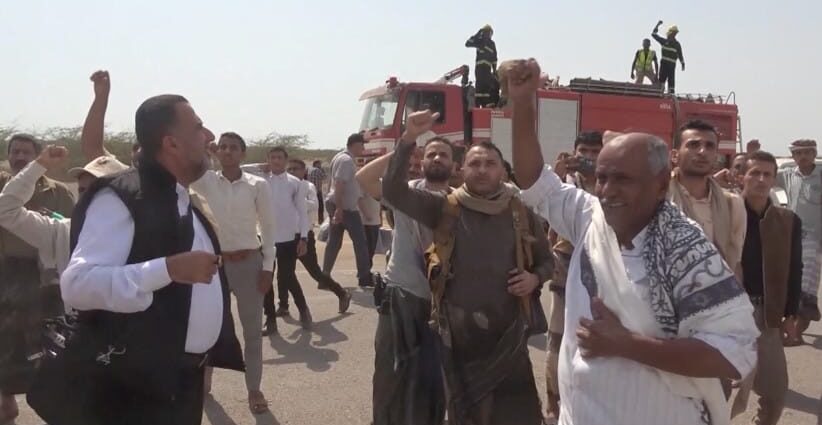
The attack on Sana’a International Airport during the attempted landing of an Iranian Mahan Air flight on Monday came as the Houthis grew increasingly emboldened in their violations of international law, according to statements by Yemen’s Saudi-backed government and international representatives at the United Nations Security Council on Monday.
The flight on Monday, which made international headlines after it prompted strikes on Sana’a, was eventually able to land in the Houthi-controlled Hodeida International Airport. It was notably not the first Iranian aircraft to visit the war-afflicted country in recent weeks. Officials condemned a seemingly connected Iranian flight in early July which is understood to have transported a group of Houthi representatives to Tehran, where they held high-level meetings during the days-long funeral procession of Ali Khamenei.
President Dr. Rashad Muhammad al-Alimi, chairman of the Presidential Leadership Council of Yemen, noted last week that an Iranian Revolutionary Guard aircraft had turned off its tracking system over Yemeni airspace, according to reports in Yemen’s state Saba News Agency. While investigations are ongoing into the craft’s cargo, Alimi said that initial information suggests the flight was carrying persons and equipment beneficial to the terrorist group.
According to Alimi, those aboard the vessel included military and security personnel, Iranian experts specializing in drones and missile system development, electronic and communications equipment, and technologies with potential applications in command and control systems, as well as Yemeni personnel who had undergone security training in Iran.
Though the Houthis initially claimed that the visit was humanitarian in nature, Alimi said that the use of a Mahan Air aircraft, owned by the Mol-al-Movahedin Foundation, a widely sanctioned economic entity linked to the Islamic Revolutionary Guard Corps, and the aircraft’s behavior suggested otherwise.
“The indicators are not limited to the nature of the passengers and cargo. Frequent interruptions in the aircraft’s tracking signals were detected while it was crossing Yemeni airspace, a behavior that contradicts the militias’ claims that it was a humanitarian flight. This necessitates an independent international investigation to uncover the circumstances and objectives,” he said.
UN special envoy calls for de-escalation
Addressing the Monday flight from Mahan Air, UN chief’s Special Envoy for Yemen Hans Grundberg asserted at the United Nations Security Council meeting that there needed to be swift de-escalation.
The Houthis fired missiles at Saudi Arabia after accusing the kingdom of bombing an airport under their control on Monday, breaking a four-year truce in the conflict between the kingdom and the Iran-aligned group.
Though Yemen’s Defense Ministry claimed responsibility for the strike on Monday, announcing that its armed forces had targeted the runway at Sana’a Airport to prevent an Iranian plane from landing, the Houthis have threatened to escalate the conflict beyond Yemen’s territory. The group issued a threat against airlines flying over Saudi airspace until the “siege” on Sana’a Airport was lifted.
🎥 ورود خلبان محاصرهشکن به فرودگاه امام
هواپیمای ایرانی که محاصره یمن را در میان بمباران فرودگاه الحدیده شکست، به تهران بازگشت و در فرودگاه امام به زمین نشست و خلبان و تیم پرواز آن وارد سالن فرودگاه شدند. https://t.co/kRlkyD7muN pic.twitter.com/Xb0qbctmRx
— خبرگزاری فارس (@FarsNews_Agency) July 13, 2026
Two US officials told Axios that Saudi Crown Prince Mohammed Bin Salman received US President Donald Trump’s support for military action against the Houthis.
Yemen ambassador warns Iranian flights are dangerous precedent
Yemen’s Ambassador Abdullah Ali Fadhel Al-Saad, who requested the UNSC meeting, said the recent Iranian flights constituted “a real test” of the principles of sovereignty and non-interference, arguing that the unauthorized flight constituted an “extremely dangerous precedent.”
“We are dealing here with a deliberate attempt to impose a fait accompli,” he warned.
US representative to the UN Tammy Bruce acknowledged that the Iranian flight on July 3 had been purposed with transporting Islamic Revolutionary Guard Corps personnel, including drone and missile experts in support of Houthi terrorism, Russian representative Ambassador Anna Evstigneeva claimed that the use of the Houthi-controlled airport remained essential for humanitarian operations.
The Russian representative, while acknowledging that the flight should have been coordinated beforehand, disregarded concerns and told the council that the flight was “strictly humanitarian.”
Notably, the Houthis detained an aircraft belonging to the International Committee of the Red Cross, according to one of the country’s ministers during the alleged Iranian humanitarian flight standoff on Monday.
Bruce noted that the Houthis’ leadership celebrated the flight as a “successful evasion” of international efforts to isolate them.
Yemen expert Inbal Nissim-Louvton, from the Open University and the Moshe Dayan Center at Tel Aviv University, told The Jerusalem Post that the fact that two Iranian flights were able to land in Houthi territory was a major development and that strikes would not be adequate in deterring further escalation and future violations.
Asserting that she wasn’t sure that the violation was something the Saudis could accept, and definitely not a situation that Israel could, Nissim-Louvton noted that the issue extends to the larger civil conflict in Yemen and was part of a wider narrative employed by the Houthis to achieve its own goals.
Houthi media in recent months has aired a number of documentaries and visuals blaming Saudi Arabia for Yemen’s ongoing financial crisis, depicting it as a foreign force depriving Yemen of access to its own natural resources in partnership with the US and Israel, she explained. The media campaign highlights how the Houthis are directing blame for absent civil servant salaries toward Riyadh rather than absorbing responsibility themselves.
The attacks on Saudi Arabia, she continued, are at least partially in response to the Houthis’ own domestic troubles. Nissim-Louvton noted that Saudi Arabia has previously paid off some of the Houthi civil servant debt, out of a desire to keep things quiet, and that was at least part of the reason behind the attack now.
“The Saudis said they were willing to pay the salaries of civil servants, but through a mechanism that would ensure the money went directly to their bank accounts, or that they received it in a way that the Houthis would not be able to get hold of the funds. The Houthis did not agree to that,” she reasoned. “This is still something ongoing, but there were many times when the Saudis eventually did pay in some form and were able to keep the Houthis quiet enough to allow Saudi Arabia to promote its own issues, including projects under MBS’s Vision 2030 and other initiatives. Some of those projects had to be delayed because they were unable to proceed. The Saudis have to remember that if they return to Yemen and renew the civil war, it will probably cost them much more than paying the salaries of those civil servants.”
Outside of domestic troubles, the Houthis have the capacity to escalate the Hormuz crisis by restricting the Bab al-Mandab Strait. A return to civil war now would likely mean involving regional actors, escalating the existing war, she said, adding more weight to Houthi demands at the negotiation table.