
The Knesset plenum passed on Tuesday the contentious bill that will temporarily freeze the arrests of haredi (ultra-Orthodox) draft evaders, with 58 lawmakers voting in favor and 54 against.
The passage of the bill in its final readings comes following severe legal warnings that the legislation is unbalanced, along with outcry from bereaved families and IDF veterans, amid the IDF’s severe manpower shortage.
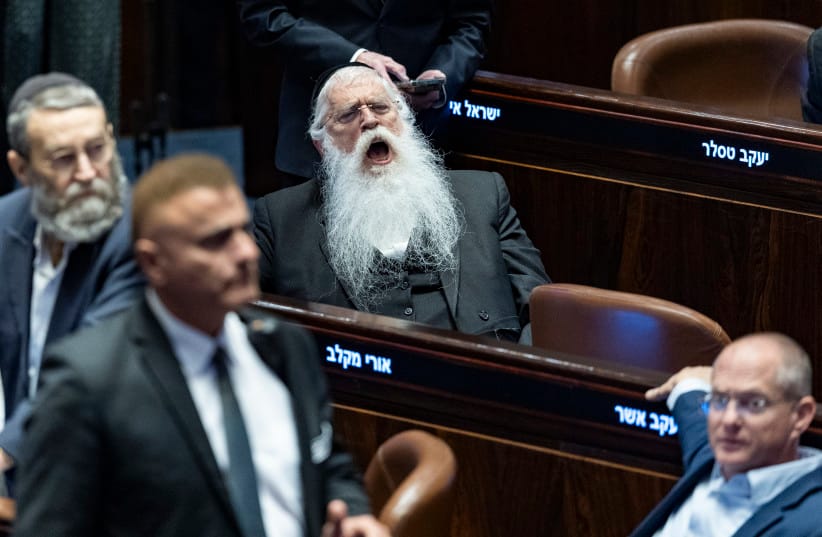
The plenum broke into clashes when Prime Minister Benjamin Netanyahu arrived ahead of the vote.
🇮🇱 “Shame!” chants as Netanyahu arrives to vote on a controversial bill granting broader immunity to ultra-Orthodox (Haredi) Jews from military service.
The draft exemption for the ultra-Orthodox community has been a long-standing, highly divisive issue in Israel.
Many secular… pic.twitter.com/iA33BeNmVj
— Mario Nawfal (@MarioNawfal) July 14, 2026
As Netanyahu entered the plenum, opposition lawmakers repeatedly shouted “disgrace” and “get out.” The prime minister left the chamber shortly afterward and did not return for the vote.
The legislation’s passage also comes after IDF Chief of Staff Lt.-Gen. Eyal Zamir warned on Monday that implementing such a law would create an array of national security problems.
He stated that he opposes the bill’s implementation “completely and unequivocally.”
צעקות “בושה” מספסלי האופוזיציה לעבר ראש הממשלה נתניהו שהגיע למליאה לקראת ההצבעה להצעת חוק להקפאת מעצרי העריקים https://t.co/zY7XXqW96g pic.twitter.com/AauNofB4RR
— ערוץ כנסת 99 (@KnessetT) July 14, 2026
Among the issues raised by Zamir was that such a law would decrease recruitment both from the haredi community and from the general Israeli population by delegitimizing the idea of the IDF as the “nation’s army” in which everyone is equally obligated to serve.
Eyal Zamir warns IDF could soon collapse due to manpower shortage
Zamir has warned in recent months that the IDF could soon collapse if no solution is found for the manpower shortage.
The bill proposes a temporary halt on draft evader arrests to remain in effect from the date the law is published until November 30.
The Israel Democracy Institute (IDI) has noted that the proposal could remain in effect beyond its stated expiration date because of the upcoming elections, which are scheduled for October 27.
Temporary legislation passed shortly before an election, which is due to expire during the election period, is automatically extended by roughly four months, as the Knesset does not function normally during that time.
As a result, the arrangement is likely to remain in force for at least six months.
Ahead of the vote, Knesset Legal Adviser Sagit Afik asked lawmakers to declare whether they have family members classified as draft evaders; haredi MKs whose relatives could benefit from the legislation may have a conflict of interest.
The haredi parties – Shas and United Torah Judaism – both provided lists of the lawmakers who had relatives classified as draft evaders.
The disclosure statement provided by the United Torah Judaism Party included the names of seven members of the party’s list.
This sparked outrage among opposition lawmakers in the plenum, who demanded that haredi MKs disclose exactly how many of their relatives had been classified as draft evaders.
A group of MKs from within Netanyahu’s coaltion voted against the bill, including MK Dan Illouz (Likud), MK Yuli Edelstein (Likud), and Deputy Foreign Minister Sharren Haskel (New-Hope United Right).
Haskel resigned from her position as deputy foreign minister immediately after the bill passed.
Defense Minister Israel Katz arrived at the plenum to vote in favor.
It had been unclear whether the Religious Zionist Party, led by Finance Minister Bezalel Smotrich, would support the bill.
Reported tensions between Smotrich’s party and the haredi parties
There had been reported tensions between Smotrich’s party and the haredi parties over which bills to advance first on the legislative agenda amid the coalition’s legislative blitz to pass its legislation during the Knesset’s last week before it goes into recess ahead of the elections.
Lawmakers from the Religious Zionist Party ultimatly voted in favor.
There had been earlier reports that an agreement was reached after negotiations, with both sides agreeing to support each other’s legislation in the plenum.
The bill’s proposal defines a yeshiva student as someone who studies Torah at a yeshiva regularly, for no less than 45 hours per week, or in a kollel for no less than 40 hours per week.
The proposal also stipulates that the defense minister will be responsible for compiling the list of yeshivas that would be relevant, according to criteria that will be established in regulations.
The government has presented its stance that the freeze of arrests would be beneficial, arguing that arresting yeshiva students who evade military service has undermined efforts to encourage broader enlistment among haredi men.
Opponents and the Knesset’s legal advisor have argued that the bill is unbalanced largely because it only calls for halting the arrests of draft evaders without including any sanctions on them.
The Knesset’s legal advisory warned in its opinion on Sunday that the legislation could effectively exempt haredim from IDF service, failing to advance “equality in sharing the burden.”
Afik also warned the panel ahead of the vote that the legislative process undertaken to advance the bill was an improper part of “an improper legislative process.”
Bill undergone significant changes from first reading
Critics argue that the bill has undergone significant changes from the version that passed its first reading years ago, following dozens of committee discussions that reshaped its original framework in the Foreign Affairs and Defense Committee.
“Out of this long and complex legislative process, one small section was taken, and everything else was deleted. In my view, this raises a claim far more serious than merely a ‘new subject,’” Afik said.
The Knesset legal advisor added that even though she was told there was a time constraint to pass the bill before the Knesset recess, she said that “a lack of time cannot justify an improper legislative process.”
The bill is part of a series of haredi-backed bills being advanced, amid numerous reports of agreements between the haredi parties and Prime Minister Benjamin Netanyahu to advance coalition legislation.
Haredi parties had boycotted votes on coalition legislation when their bills were not advancing quickly enough.
The plenum agenda this week has been packed with controversial coaltion bills, such as the bill to weaken the role of the attorney-general, along with legislation for a sweeping reform of Israel’s broadcasting sector.
The Knesset plenum also passed on Monday the contentious legislation advanced by the haredi parties that will enshrine Torah study as a fundamental value in the country’s Basic Law.
Critics argue the Basic Law: Torah Study bill encourages draft evasion and changes the status of yeshiva students who do not serve, enabling them to continue receiving state benefits even amid the IDF’s severe manpower shortage.
The IDF has repeatedly warned of an urgent manpower shortage after more than two years of war.
In April, the High Court of Justice ordered that the state take concrete steps to revoke key financial benefits from draft evaders and to move toward criminal enforcement against haredi men who evade military service.
Immediately after the bill’s passage, multiple petitions were sent to the High Court of Justice against the legislation, calling for it to be struck down.
The petitions were filed by the Movement for Quality Government in Israel, along with the opposition parties Yesh Atid and Yisrael Beytenu.
The Movement for Quality Government stated that “the coalition removed its final mask today and made it clear, loudly and unequivocally, that it discriminates between one person’s blood and another’s.”
Yisrael Beytenu leader MK Avigdor Liberman also condemned the legislation, calling it “one of the most shameful and irresponsible laws Israel has seen since its establishment.
Yonah Jeremy Bob contributed to this report.