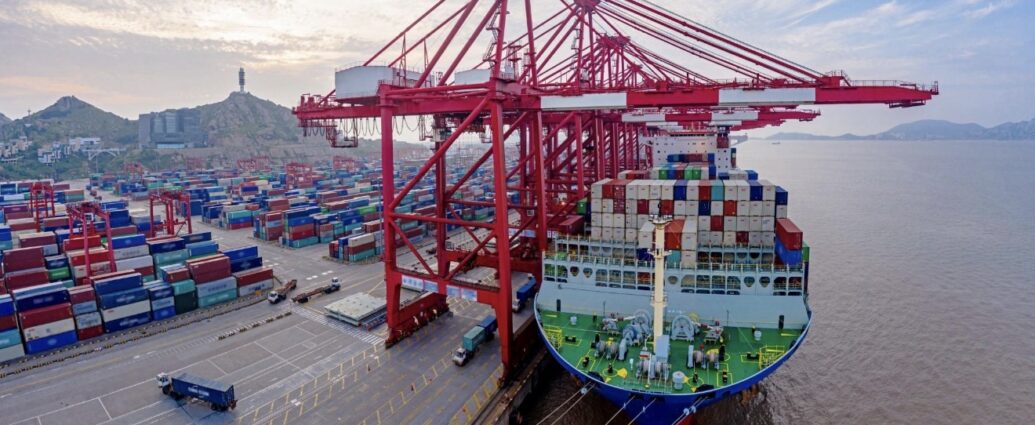
China’s export sector posted one of its strongest monthly performances in years, underscoring the country’s central role in supplying the rapidly expanding global artificial intelligence industry. According to trade data released by China’s General Administration of Customs on Tuesday, July 14, exports surged 27% from a year earlier in June, while imports climbed 36%, both exceeding economists’ expectations.
The stronger-than-expected results reflected robust worldwide demand for semiconductors, electronic components, artificial intelligence infrastructure, machinery and advanced manufactured goods. Reuters and the Associated Press reported that China’s trade surplus widened to approximately $125.6 billion, up from $105.4 billion in May, highlighting the continued strength of the country’s export engine despite ongoing domestic economic challenges.
The artificial intelligence boom has become one of the most significant drivers of global trade.
Technology companies around the world continue investing billions of dollars in data centers, high-performance computing systems, networking equipment and advanced electronics needed to support increasingly sophisticated artificial intelligence platforms. China remains deeply integrated into those global supply chains, manufacturing or assembling many of the components required to build that infrastructure.
Chinese customs data showed exports of integrated circuits, electronics and high-value technology products continued expanding at a rapid pace throughout the first half of the year.
The growth extends beyond artificial intelligence.
China also recorded strong overseas demand for electric vehicles, batteries, industrial machinery, renewable-energy equipment and consumer electronics, reinforcing the country’s position as one of the world’s leading manufacturing exporters.
Imports also rose sharply.
Rather than signaling stronger consumer spending alone, the increase reflected purchases of semiconductors, industrial components, energy products and raw materials used by Chinese manufacturers to produce goods destined for export markets.
That distinction is important.
China’s domestic economy continues facing significant headwinds, including weakness in the property sector, slower household spending and ongoing pressure on local governments. Exports have become an increasingly important source of economic growth as policymakers attempt to offset softer domestic demand.
The latest trade figures illustrate how foreign demand is helping stabilize China’s economy.
Artificial intelligence has emerged as a major catalyst.
Construction of new data centers throughout North America, Europe, the Middle East and Asia has increased demand for processors, memory, networking equipment, electrical components, cooling systems and other specialized products manufactured throughout China’s industrial base.
Many multinational companies continue relying on Chinese suppliers despite ongoing geopolitical tensions and efforts by Western governments to diversify supply chains.
That dependence continues generating political debate.
The United States and several allied nations have imposed tariffs, export controls and investment restrictions aimed at reducing reliance on Chinese manufacturing in strategic industries, particularly semiconductors and advanced technologies.
At the same time, Chinese manufacturers have expanded production in Southeast Asia, Mexico and other regions to maintain access to overseas markets while reducing the impact of trade restrictions.
Despite those efforts, China remains one of the world’s most important manufacturing hubs.
The June figures also suggest that global corporate spending remains healthy.
Businesses continue investing in technology, automation and artificial intelligence even as higher interest rates, geopolitical uncertainty and slowing economic growth affect other sectors of the global economy.
For shipping companies, ports and logistics providers, stronger Chinese exports represent continued demand for international freight services.
Container volumes have remained elevated as exporters move finished products to markets throughout North America, Europe and emerging economies.
Economists caution, however, that export-led growth carries risks.
Should global demand weaken, additional tariffs be imposed or geopolitical tensions escalate further, China’s manufacturing sector could face renewed pressure.
The country’s large trade surplus is also likely to attract increased scrutiny from trading partners concerned about industrial subsidies, excess production capacity and competitive imbalances.
Nevertheless, the latest data demonstrate that the global artificial intelligence investment cycle remains a powerful driver of international commerce.
The expansion extends well beyond technology companies themselves.
Mining firms supplying critical minerals, manufacturers producing industrial equipment, shipping companies transporting goods, utilities powering data centers and electronics manufacturers assembling advanced computing systems are all benefiting from the unprecedented investment.
For investors and business leaders, China’s latest trade report reinforces a broader economic reality.
Artificial intelligence is no longer simply transforming software companies—it is reshaping global manufacturing, international trade, supply chains and capital investment across virtually every major sector of the world economy.
JBizNews Desk | Beijing
© JBizNews.com All Rights Reserved. Reproduction or distribution without written permission is prohibited.