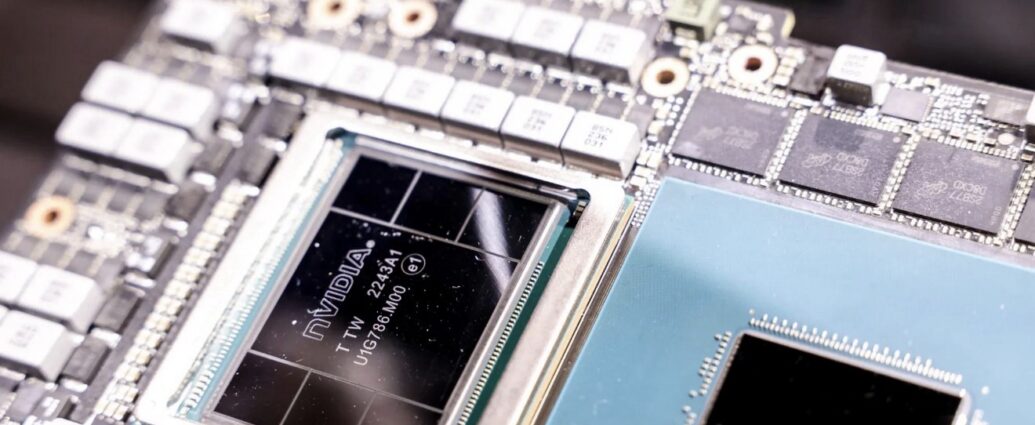
Nvidia Corporation has sharply reduced the number of Asian companies authorized to purchase its most advanced artificial intelligence processors, tightening controls designed to prevent restricted chips from reaching China through third countries.
According to guidance issued by the U.S. Department of Commerce and industry reporting published Tuesday, July 14, Nvidia has removed more than half of the Asian customers previously approved to buy its highest-end AI chips. The move follows updated U.S. export-control guidance issued May 31, requiring export licenses whenever the ultimate parent company of a purchaser is based in China or Macau, regardless of where the purchasing subsidiary operates.
The policy represents one of the company’s most aggressive compliance measures since Washington expanded restrictions on advanced semiconductor exports.
Rather than allowing broad access to approved distributors, Nvidia has implemented an internal “white list” of customers that satisfy enhanced compliance standards.
Companies seeking to purchase advanced AI processors must now undergo significantly more extensive due diligence.
Beyond reviewing corporate ownership records, Nvidia has reportedly expanded inspections to include data-center visits, contract reviews and interviews with end users to verify where its chips will ultimately be installed and operated.
The stricter procedures focus primarily on Singapore, Malaysia and Japan—three major technology and cloud-computing hubs that have drawn increased scrutiny because of concerns that restricted processors could be diverted into China.
Companies removed from Nvidia’s approved list, many of them smaller cloud-service providers, may reapply after documenting their ownership structures and intended use of the chips.
The tightening reflects the growing strategic importance of Nvidia’s products.
The company’s AI accelerators power many of the world’s largest artificial intelligence systems and remain among the most sought-after components in the global technology industry.
Demand continues to outpace supply as cloud providers, governments and corporations invest billions of dollars building AI infrastructure.
Yet Nvidia’s business in China has deteriorated sharply under expanding U.S. export controls.
Industry estimates project the company’s share of China’s AI-chip market will decline from approximately 66% in 2024 to about 8% during 2026, while domestic competitors led by Huawei Technologies are expected to capture roughly 80% of the market.
To preserve at least part of its Chinese business, Nvidia developed export-compliant processors including the H20 and H200, designed to satisfy U.S. performance restrictions while continuing to serve approved customers.
Earlier this year, U.S. regulators reportedly authorized a limited number of Chinese companies to purchase certain H200 processors.
However, shipments have remained delayed because of regulatory requirements inside China.
Meanwhile, U.S. authorities have continued investigating distributors suspected of rerouting restricted hardware through Southeast Asia.
Those investigations have intensified pressure on Nvidia to demonstrate that every shipment reaches its approved destination.
For Asian cloud providers and server manufacturers, the consequences are significant.
Companies temporarily removed from Nvidia’s approved customer list may experience delays constructing new artificial intelligence data centers while they complete additional compliance reviews.
Those delays could increase project costs and postpone deployment of advanced computing capacity throughout the region.
The impact extends across the broader semiconductor supply chain.
Manufacturers of servers, networking equipment, memory, cooling systems and electrical infrastructure all depend on continued shipments of advanced graphics processors to complete AI installations.
Any interruption can ripple throughout the industry’s increasingly interconnected supply chain.
For Nvidia, the challenge is balancing two competing priorities.
The company must satisfy increasingly stringent U.S. national-security requirements while continuing to serve global customers building the next generation of artificial intelligence infrastructure.
Every customer removed from the approved list reduces potential sales.
At the same time, maintaining strong compliance is essential to preserving Nvidia’s ability to sell its products in markets outside China.
The company’s new approval process reflects a broader transformation taking place throughout the semiconductor industry.
Export controls are no longer limited to regulating technology.
They increasingly determine who can purchase advanced computing power, where artificial intelligence systems can be built and how global technology supply chains operate.
For Nvidia, selling the world’s most advanced AI chips now requires something beyond engineering excellence.
It requires policing every step of the global distribution network.
JBizNews Desk | Santa Clara, California
© JBizNews.com All Rights Reserved. Reproduction or distribution without written permission is prohibited.