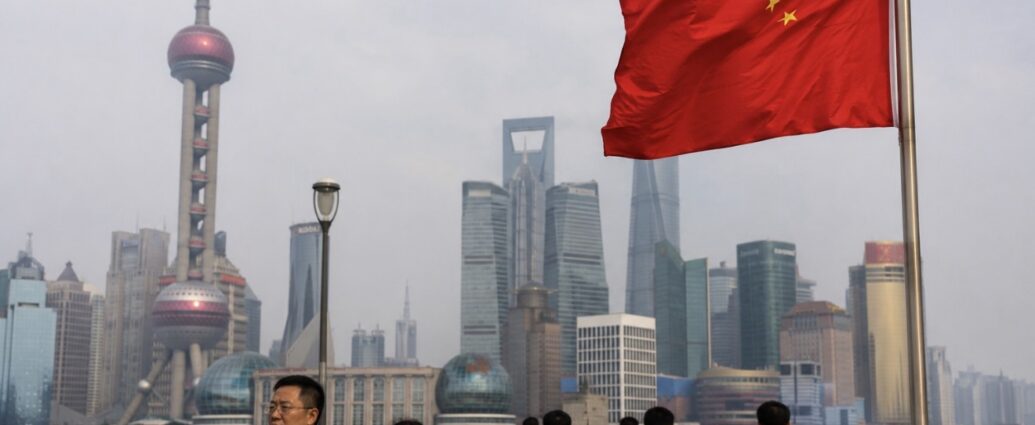
China’s economy expanded 4.3% during the April–June quarter compared with a year earlier, the country’s National Bureau of Statistics reported Wednesday in Beijing, marking the weakest quarterly growth since the fourth quarter of 2022, when China was still battling the COVID-19 pandemic.
The result fell short of the 4.5% growth forecast by economists surveyed by Reuters and represented a noticeable slowdown from the 5.0% pace recorded during the first quarter of 2026.
On a sequential basis, China’s economy grew 0.9% during the second quarter, down from 1.3% during the first three months of the year.
The weaker performance also came in below Beijing’s own full-year growth objective. Chinese leaders have set a 4.5% to 5.0% target for 2026—the country’s least ambitious annual growth goal in decades. Through the first half of the year, China’s economy has expanded 4.7%, according to official data.
The unusually candid assessment from the National Bureau of Statistics underscored growing concern inside Beijing. Rather than emphasizing stability, the agency described the imbalance between excess industrial production and weak domestic demand as “acute” and urged policymakers to strengthen counter-cyclical economic measures.
A Two-Speed Economy
The second-quarter report paints a picture of two very different Chinese economies.
Factories continue producing at a healthy pace.
Consumers remain reluctant to spend.
Industrial production rose 5.3% in June from a year earlier, exceeding economists’ expectations of 4.7% and accelerating from 4.5% growth in May.
Exports remained remarkably resilient despite continued disruptions to global shipping following tensions in the Middle East. Overseas shipments climbed 27% during June and 17.6% during the first six months of 2026, driven largely by semiconductors, computer equipment and green-energy technologies.
Domestic demand tells a far different story.
Retail sales increased just 1.0% during June. While that modest gain exceeded forecasts for a 0.1% decline and improved from May’s 0.6% contraction—the first monthly decline since late 2022—it remains historically weak for the world’s second-largest economy.
Investment continues to deteriorate even more rapidly.
Urban fixed-asset investment, including infrastructure and property development, fell 5.7% during the first half of 2026 compared with a year earlier. Economists had expected a smaller 4.9% decline, while the first five months of the year had shown a 4.1% contraction.
China’s troubled property sector remains the biggest drag.
Real estate investment plunged 18% during the first half of the year, worsening from the 16.2% decline reported through May.
What Economists Are Watching
Several economists pointed to collapsing domestic investment as the primary reason China’s headline growth continues slowing.
Andy Ji, Asian FX and rates analyst at ITC Markets in Shanghai, argued that strong manufacturing cannot fully offset collapsing domestic consumption and weakening investment, leaving policymakers with increasingly limited options beyond additional fiscal stimulus.
Fabien Yip, market analyst at IG in Sydney, said manufacturing continues carrying China’s economy while the consumer-led recovery Beijing had hoped for “hasn’t really played out yet.” She also noted the People’s Bank of China has discussed interest-rate flexibility but has yet to deliver meaningful easing.
Junyu Tan, North Asia economist at Coface in Hong Kong, believes June showed early signs of stabilization. Government trade-in subsidy programs helped lift retail spending, while investment declines moderated slightly. However, he warned stronger policy support will likely be required, including faster local government bond issuance and possible interest-rate reductions.
Not every economist sees immediate danger.
Zhiwei Zhang, chief economist at Pinpoint Asset Management, noted that China’s strong first quarter still leaves the country within reach of its annual growth objective. He believes exports continue outperforming expectations and said the Politburo meeting scheduled for late July will likely provide greater clarity regarding Beijing’s next round of economic policies.
Tianchen Xu, senior economist at the Economist Intelligence Unit, expects China to expand stimulus efforts during the third quarter, including possible interest-rate cuts. He said local governments have redirected significant funding toward debt restructuring, leaving fewer resources for new infrastructure projects, but expects public spending to accelerate later this year.
Why American Businesses Should Care
China’s slowing consumer economy has important implications for American companies.
Businesses that built long-term growth strategies around China’s expanding middle class—including automakers, luxury goods companies, hotel operators, food producers and consumer brands—face a much more difficult sales environment.
Weak Chinese demand also tends to reduce global prices for commodities such as crude oil, copper, soybeans and industrial machinery. Lower input costs benefit many American manufacturers while creating challenges for U.S. farmers, mining companies and energy producers that rely heavily on Asian demand.
Perhaps the greatest concern is excess manufacturing capacity.
When Chinese factories continue producing at high levels while domestic consumers spend less, surplus products increasingly flow into global markets at lower prices.
Capital Economics has warned that China’s manufacturing overcapacity remains deeply entrenched, leaving export growth as one of the country’s primary economic engines. That dynamic could intensify pricing pressure on American producers in industries including steel, solar panels, batteries and electric vehicles while increasing trade tensions between Washington and Beijing.
The International Monetary Fund recently raised its 2026 China growth forecast from 4.4% to 4.6%, citing continued strength in advanced manufacturing and exports, even as it trimmed its global growth forecast to 3.0%.
Economists surveyed by Reuters expect China’s economy to expand 4.6% this year before slowing further to approximately 4.4% in 2027.
JBizNews Desk | New York
© JBizNews.com All Rights Reserved. Reproduction or distribution without written permission is prohibited.