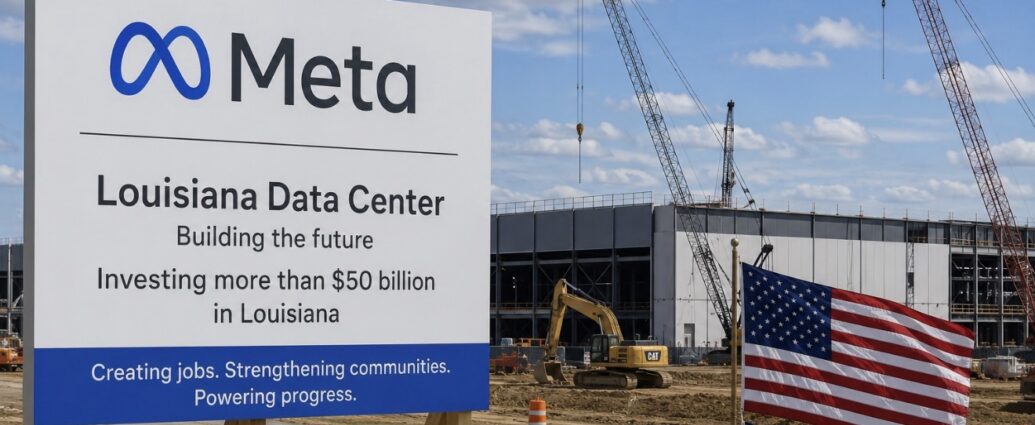
Meta Platforms said in a company blog post on Monday, July 13, that it will spend more than $50 billion on its Richland Parish, Louisiana data center campus, expanding the site to 5 gigawatts of computing capacity and making it the largest facility the company has ever built. The announcement came alongside a press event in Baton Rouge hosted by Louisiana Governor Jeff Landry, and was confirmed the same day by Louisiana Economic Development, the state agency that helped recruit the project.
The numbers have moved fast. When the project was first revealed in 2024, the price tag was roughly $10 billion. In October 2025, when Meta formed a joint venture with Blue Owl Capital to help finance and manage the build, the figure climbed to about $27 billion. The new commitment nearly doubles that again. The campus, home to the AI training cluster Meta calls Hyperion, will cover close to 10 million square feet across roughly 3,200 acres.
Landry framed it as a national story, not just a state one. “This commitment from Meta puts Louisiana at the center of America’s future in artificial intelligence,” he said in a statement, adding that the state has attracted more than $150 billion in new investment over two years. LED Secretary Susan B. Bourgeois said the decision by a global company to raise its investment roughly fivefold this quickly says something about how quickly Louisiana is moving.
What the money buys locally
Richland Parish is a rural community of about 20,000 people, and the money is already landing. Meta said Louisiana businesses have received more than $1.6 billion in contracts since construction started in December 2024. The expansion adds another $1 billion for local infrastructure — roads, water systems and wastewater. Once running, the site is expected to support more than 1,000 permanent jobs.
The tax revenue is showing up in paychecks. Richland Parish School District Superintendent Sheldon Jones said teachers in the parish received annual bonuses of more than $50,000 this year, up from $10,000 a year earlier, and that the money has helped the district recruit stronger candidates. A local coffee shop owner cited in the announcement said daily customer counts jumped from about 40 to roughly 130.
Meta is also giving $5 million to Louisiana Delta Community College for scholarships tied to data center careers. Starting with the high school class of 2026, every Richland Parish graduate qualifies for full tuition on any trade certificate connected to data center work. Louisiana was picked as one of four pilot sites for Meta’s America’s Workforce Academy, with partners including the University of Louisiana at Monroe.
The power question
The fight over data centers almost always comes down to electricity bills, and Meta spent much of its announcement on that point. The company said it pays the full cost of the energy, water and related infrastructure the site consumes so that households don’t absorb it.
Its agreement with Entergy Louisiana funds seven new natural gas plants, three grid-scale batteries, and potential nuclear work including boosting output at the Waterford 3 plant. Meta and the utility say the arrangement should deliver more than $2 billion in savings to Entergy Louisiana customers over 20 years, well above the $650 million estimated in the first agreement. Meta is adding $215 million to Entergy’s bill-assistance and efficiency programs and committing to fund up to 2.5 GW of renewable energy.
The state’s role is not small. In late 2024, Landry signed a 20-year sales tax exemption for data centers built before 2029 — a policy written in large part to land Meta.
The backlash is real
Not every community is signing up. The New Orleans city council recently passed a one-year ban on data center construction. New York State imposed its own moratorium. Senator Bernie Sanders has called for a federal moratorium on AI data centers, arguing the decisions reshaping the economy are being made by a handful of technology executives without public debate.
What Wall Street sees
Investors are split. Meta raised its 2026 capital spending guidance to a range of $125 billion to $145 billion, up from $115 billion to $135 billion, nearly doubling last year’s outlay. Free cash flow fell more than 19% in 2025, and Reality Labs lost $19.2 billion. Shares are down roughly 16% year to date even as first-quarter revenue grew 33% to $56.31 billion.
Analysts have been adjusting. JPMorgan cut its target to $725 from $825 on April 30. UBS trimmed to $766 from $865 while keeping a Buy. Citizens set $800 on July 10 with a market outperform rating. Rosenblatt sits highest at $1,015; Scotiabank lowest at $700. The consensus among 37 analysts is about $827. Morgan Stanley analyst Brian Nowak has been raising hyperscaler capex forecasts across the board.
Meta reports second-quarter results after the close later this month. The spending is no longer the question. The return is.
JBizNews Desk | New York © JBizNews.com All Rights Reserved. Reproduction or distribution without written permission is prohibited.