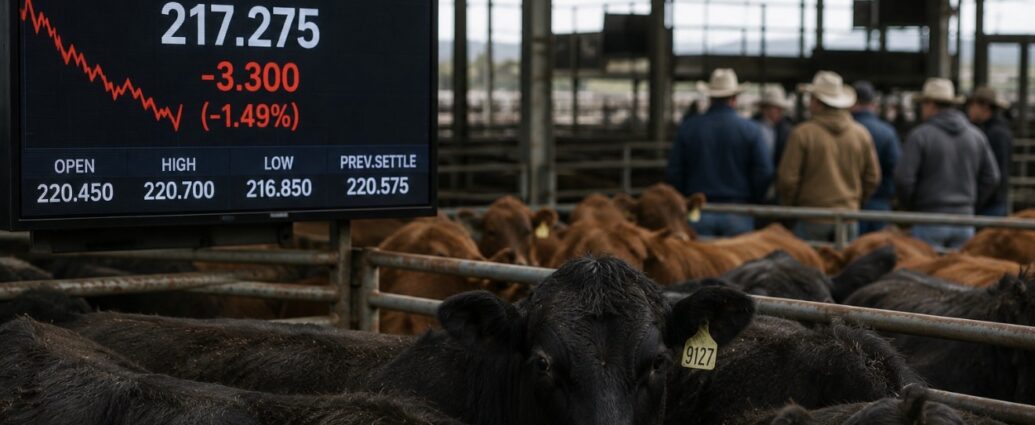
Live and feeder cattle futures dropped sharply on Tuesday, July 14, according to settlement data from CME Group, as ranchers and meatpackers in the physical cattle market each refused to make the first move. August live cattle settled at $231.42, down $3.30. October live cattle finished at $227.65, a loss of $2.97. August feeder cattle fell $5.55 to $348.80, and September feeders dropped $5.97 to $344.85.
Nothing dramatic happened on Tuesday. That was the problem.
The direct cash cattle trade — the actual buying and selling of finished animals between feedlots and packing plants — was silent for a second straight day. USDA market reporters logged no bids from packers and no asking prices from feedlots. Cattle feeders are waiting to see whether packers will pay up. Packers are waiting to see whether feeders will crack first. Traders in Chicago, with no cash price to anchor to, sold.
Showlists this week — the cattle feedlots are offering for sale — are mixed. They are higher in Texas, Nebraska, and Colorado, and lower in Kansas. More supply on offer in three of the four major feeding states gives packers little reason to hurry. The bulk of the week’s business is not expected to develop until Thursday or Friday.
Last week set an ugly reference point
The standoff is happening in the shadow of a brutal week. Live cattle sold in the South at $248 last week, $7 below the prior week. Dressed cattle in the North traded at $393, down $10. That is one of the steepest weekly cash breaks the fed cattle market has seen this year, and it stripped $4.02 off the August live cattle contract over five sessions.
Wholesale beef kept sliding on Tuesday. USDA reported Choice boxed beef down $1.66 at $373.95 and Select down 76 cents at $364.41, with light demand for moderate offerings. The Choice/Select spread narrowed to $9.54 — a sign grocers and restaurant buyers are reaching for the cheaper grade.
Estimated cattle slaughter came in at 111,000 head, up 1,000 from the week before but down nearly 8,000 from the same day last year. That single number captures the industry’s bind: there simply are not enough cattle.
Money is walking away from the trade
Speculative funds have been unwinding. The Commodity Futures Trading Commission’s Commitment of Traders report showed managed money cut 5,982 contracts from its net long position in live cattle futures and options, bringing it to 113,321 contracts as of July 7. In feeder cattle, funds trimmed 1,374 contracts to a net long of 13,690.
When a market this crowded on the long side starts leaking, the selling feeds on itself. Tuesday’s drop was described by floor traders as technical weakness — market language for prices falling because prices are falling.
The cash market underneath is not collapsing
Away from the futures screens, the country market held together. At the Oklahoma National Stockyards, feeder steers were mostly steady and feeder heifers were steady to $4 higher. Steer calves ran steady to $3 lower, while heifer calves were $2 to $5 higher. USDA graders called demand good across all classes. Receipts were down on the year. Medium and Large 1 feeder steers weighing 655 to 697 pounds brought $395 to $430.
Those are still extraordinary prices. Ranchers selling calves this summer are getting paid more than at almost any point in the industry’s history — even as the futures market tells them the future is worth less.
What this means for the businesses downstream
The American cattle herd stands at roughly 86.2 million head, the smallest since 1951, according to USDA’s January inventory report. Years of drought pushed ranchers to sell off breeding stock. The New World screwworm, now confirmed in cattle in Texas and a dog in New Mexico, has kept the Mexican border closed to live cattle imports and knocked out a supply valve worth roughly 1.5 million head a year.
Retail beef hit a record $9.64 per pound in April, up 13% from a year earlier, on USDA data. That cost lands on restaurant operators who cannot pass it through. Burger King parent Restaurant Brands International absorbed a 20% jump in beef costs last year. Texas Roadhouse reported commodity inflation of 9.5% in the fourth quarter and 6.2% in the first quarter of this year, with restaurant margins falling as a result.
A break in futures does not fix that. Feedlots that bought $400 calves are now watching the contracts they sell into fall $3 a day. Packers who have been losing money on every animal finally have room to breathe. And the grocery shopper standing in front of the meat case will not see a penny of Tuesday’s decline for months, if ever.
The market gets its answer Thursday, when the bids finally show up.
JBizNews Desk | Chicago © JBizNews.com All Rights Reserved. Reproduction or distribution without written permission is prohibited.