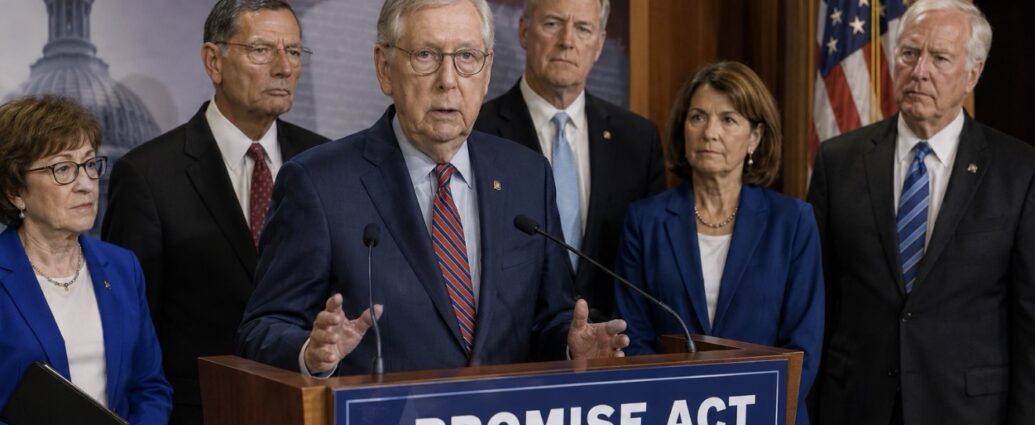
A bipartisan group of senators introduced legislation on Tuesday that would force Congress to hold an up-or-down vote on a plan to fix Social Security’s finances, with Sen. Dick Durbin, the Illinois Democrat and Democratic whip who co-authored the bill, saying in a statement that the longer lawmakers wait, the harder the program’s shortfall becomes to solve. The bill is named the Protecting Retirement Opportunities and Maintaining Income Security for Everyone Act — the PROMISE Act.
Durbin, who is retiring at the end of his term, is joined by Sen. Bill Cassidy of Louisiana, Sen. John Cornyn of Texas and Sen. Thom Tillis of North Carolina on the Republican side, Sen. Tim Kaine of Virginia on the Democratic side, and independent Sen. Angus King of Maine. Sen. Chris Coons, a Delaware Democrat, and Sen. Alan Armstrong, an Oklahoma Republican, signed on just before the bill was filed.
What the bill actually does
The PROMISE Act does not cut benefits, raise taxes or lift the retirement age. It builds a procedure. Under the bill, the Social Security Advisory Board — an independent, bipartisan panel that already exists — would collect public input and send Congress a base bill. That measure would then move under expedited floor rules, ending in a straight yes-or-no vote on a plan that keeps Social Security solvent for at least 50 years. A final bill would still need 60 votes in the Senate.
The legislation would also trigger a solvency review every 10 years, restarting the same fast-track process any time a shortfall is projected. A fact sheet released with the bill states plainly that it does not bypass regular order, does not predetermine a policy outcome and does not create a fiscal commission — three things that have killed similar efforts before.
The numbers behind it
The Social Security Board of Trustees annual report released in June found the retirement trust fund is on track to run short in 2032, a year earlier than the previous projection. At that point the program could pay only about 78% of scheduled retirement benefits — a roughly 22% cut arriving automatically, without a single vote in Congress. The 75-year funding gap widened to 4.42% of payroll from 3.82%, a jump that led the Committee for a Responsible Federal Budget to say the program’s outlook had substantially worsened. The group supports the PROMISE Act.
More than 71 million Americans collect a monthly Social Security check. The trustees attributed the deteriorating math to lower projected birth rates, reduced immigration and lower trust fund revenue tied to the cost of the tax and spending law President Donald Trump signed last summer.
Why employers should be watching
Social Security is funded by a 12.4% payroll tax, split evenly between employer and employee at 6.2% each. The self-employed pay both halves. For 2026, that tax applies to the first $184,500 of wages, up from $176,100 in 2025.
That cap is where the fight will land. Last month, Sen. Elizabeth Warren, a Massachusetts Democrat, and Sen. Bernie Moreno, an Ohio Republican, published a New York Times op-ed calling for the cap to be raised. Any increase lands directly on employers with high-wage staff — professional firms, medical practices, engineering shops — and on every owner filing as self-employed, who absorbs the full 12.4% alone. A business with ten employees earning above the cap pays more the moment the ceiling moves, with no change in headcount.
Americans for Tax Reform organized a detailed rebuttal to the bill with comments from dozens of conservatives. The group has beaten this kind of proposal before: a 2024 House effort to create a federal debt commission covering Social Security and Medicare collapsed after aggressive lobbying by the organization and its president, Grover Norquist.
A closing window
The last real reform came roughly 40 years ago, when the retirement age was raised from 65 to 67 on the recommendation of a commission led by Alan Greenspan. Since then, both parties have avoided the subject — Republicans resisting tax increases, Democrats resisting a higher retirement age.
Two of the bill’s sponsors are on the way out. Durbin is retiring, and Cassidy lost his primary. Cassidy told CNBC.com in June that he wants the issue settled before he leaves. He has floated creating a separate investment fund for Social Security, modeled on changes made to the federal Railroad Retirement system under President George W. Bush. Other proposals on the table include raising the retirement age or increasing taxes on high earners. The PROMISE Act would simply guarantee those ideas get a hearing and a vote.
The stakes reach beyond retirees. A 22% benefit cut in 2032 would pull tens of billions of dollars a year out of consumer spending, hitting grocery stores, pharmacies, landlords and every small business serving older customers. Some analysts have warned that an approaching depletion date, left unaddressed, could unsettle the bond market well before the deadline arrives.
JBizNews Desk | Washington, D.C. © JBizNews.com All Rights Reserved. Reproduction or distribution without written permission is prohibited.