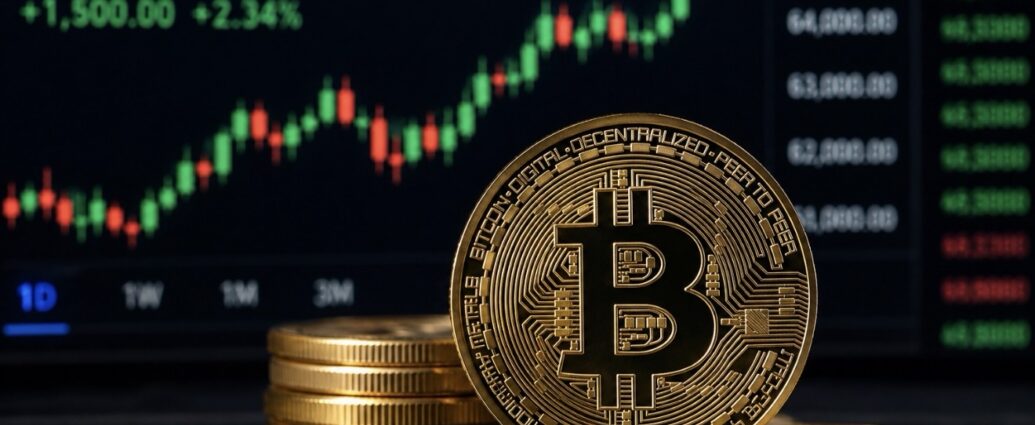
Bitcoin surged above $65,000 on Wednesday, July 15, after a series of softer-than-expected U.S. inflation reports prompted investors to sharply reduce expectations for another Federal Reserve interest-rate increase, fueling a broad rally across cryptocurrencies and other risk assets.
The world’s largest cryptocurrency climbed as high as $65,500 after the Bureau of Labor Statistics reported that producer prices fell 0.3 percent in June, reinforcing Tuesday’s unexpectedly weak Consumer Price Index report and strengthening the view that inflation continues to move in the Federal Reserve’s favor.
Ether also advanced about 5 percent to $1,873, while XRP and most other major cryptocurrencies posted solid gains as investors rotated back into risk assets.
Inflation Changed the Conversation
Markets had spent weeks positioning for the possibility of another Federal Reserve rate increase.
That outlook changed quickly.
Tuesday’s Consumer Price Index showed prices fell 0.4 percent in June, the largest monthly decline since April 2020, while annual inflation slowed to 3.5 percent, below economists’ expectations.
Wednesday’s Producer Price Index added further evidence that inflation pressures are easing, with wholesale prices falling 0.3 percent and core producer inflation increasing only 0.2 percent.
Later in the afternoon, the Federal Reserve’s Beige Book reported that price growth was the same or slower across all 12 Federal Reserve districts, providing another indication that inflation pressures are moderating across the country.
Together, the reports significantly strengthened investor confidence that the Federal Reserve may not need to tighten monetary policy as aggressively as markets had anticipated only days earlier.
Markets Responded Immediately
Interest-rate expectations shifted almost as soon as the data was released.
According to CME FedWatch, the probability of another Federal Reserve rate increase by September dropped to roughly 48 percent, down from nearly 70 percent just one week earlier.
The two-year Treasury yield fell about 7 basis points to 4.12 percent, the U.S. dollar weakened, and investors moved back into higher-risk assets including cryptocurrencies and technology stocks.
Earlier Wednesday, New York Federal Reserve President John Williams said there were encouraging reasons to believe inflation had peaked and projected a gradual return toward the Federal Reserve’s 2 percent target over the coming years.
Short Sellers Added Fuel
The rally accelerated as traders betting against Bitcoin were forced to cover losing positions.
Between $209 million and $230 million in leveraged cryptocurrency short positions were liquidated over two sessions, including approximately $107 million tied directly to Bitcoin.
Those forced purchases amplified an already strong move driven by improving economic data.
Institutional Money Remains Active
Institutional investors continued directing money into digital assets through spot exchange-traded funds.
BlackRock’s IBIT led Bitcoin ETF inflows, while Fidelity’s FBTC also attracted fresh capital. Spot Ether ETFs continued adding assets as institutional demand remained resilient despite recent market volatility.
Although ETF flows have alternated between inflows and outflows throughout July, institutional participation remains one of the strongest long-term supports for the cryptocurrency market.
Why This Rally Was Different
Perhaps the biggest takeaway is what didn’t drive Bitcoin higher.
Despite continuing geopolitical tensions and conflict in the Middle East, investors focused overwhelmingly on inflation, interest rates and Federal Reserve policy rather than global events.
That reflects how dramatically Bitcoin’s trading profile has evolved since the launch of U.S. spot Bitcoin ETFs.
Increasingly, Bitcoin trades alongside growth assets, responding to monetary policy, Treasury yields and liquidity conditions more than geopolitical headlines.
What Comes Next
Attention now turns to the Federal Open Market Committee meeting on July 28–29, where policymakers will determine whether recent inflation improvements justify pausing additional rate increases.
Markets will also closely watch the next Consumer Price Index report for confirmation that June’s improvement was not a one-month anomaly.
For businesses and investors alike, the message is becoming clearer.
If inflation continues cooling, financial conditions could gradually ease, supporting equities, cryptocurrencies and other growth-oriented assets.
If energy prices rebound or inflation begins accelerating again, markets could quickly reverse course.
For now, investors are increasingly betting that the Federal Reserve is approaching the end of its tightening cycle—and Wednesday’s surge in Bitcoin reflected that growing confidence.
JBizNews Desk | New York
© JBizNews.com All Rights Reserved. Reproduction or distribution without written permission is prohibited.