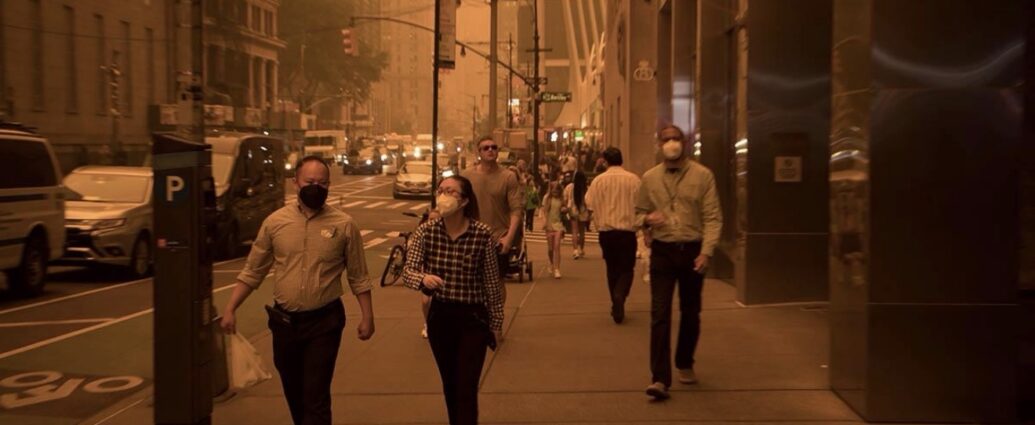
Residents across New York, New York City, Brooklyn, Queens, Staten Island, Long Island, Westchester County and much of Central and North Jersey opened their doors Wednesday, July 15, expecting another sweltering summer day. Instead, many were met with the unmistakable smell of smoke, burning eyes, scratchy throats and a gray haze that made it difficult to see across city skylines.
For many, the first question was simple: “Where is the fire?”
The answer surprised millions of people.
There is no major wildfire burning in New York or New Jersey.
The smoke blanketing the Northeast originated hundreds of miles away in Canada, where one of the country’s most active wildfire seasons in recent years continues to burn across large sections of Ontario, Manitoba and Saskatchewan. While many of those fires have been burning for days and, in some cases, weeks, the reason the smoke suddenly appeared across the Northeast on Wednesday had nothing to do with new fires starting. It was caused by a major shift in the weather.
Strong upper-level winds that had previously carried the smoke elsewhere changed direction, pushing an enormous plume southeast across the Great Lakes and directly into some of America’s largest population centers. Within hours, air quality deteriorated across New York, New Jersey, Connecticut, Pennsylvania, Massachusetts and other parts of the Northeast and Mid-Atlantic, leaving millions of people wondering why the air suddenly smelled like a campfire.
The fires themselves remain in Canada. The smoke does not.
Wildfire smoke rises thousands of feet into the atmosphere, where it can travel hundreds or even thousands of miles before descending back toward the ground. When those weather patterns align, communities far removed from the flames can experience air quality nearly as poor as areas much closer to the fires.
That is exactly what happened Wednesday.
The smoke carried billions of microscopic particles known as PM2.5—tiny pieces of ash, soot and burned vegetation small enough to travel deep into the lungs. Those particles are responsible for the burning eyes, coughing, sore throats, headaches and breathing discomfort reported throughout the region. For people with asthma, chronic lung disease, heart conditions, young children, older adults and pregnant women, the health risks are significantly greater.
Health officials urged residents to remain indoors whenever possible, keep windows and doors closed, run air-conditioning systems in recirculation mode and use high-efficiency air filtration where available. People who must spend extended periods outdoors were advised to wear properly fitted N95 or KN95 masks.
The smoke affected far more than New York City.
Conditions stretched across Manhattan, Brooklyn, Queens, the Bronx, Staten Island, Long Island and the Lower Hudson Valley before spreading throughout northern and central New Jersey, including Newark, Jersey City, Elizabeth, Edison, New Brunswick, Woodbridge, Freehold, Lakewood, Toms River, Princeton and surrounding communities. Similar conditions extended into Pennsylvania, Connecticut, Rhode Island, Massachusetts, Vermont, New Hampshire and Maine, while hazy skies were also reported farther south across portions of the Mid-Atlantic.
The flames themselves are not expected to spread into New York or New Jersey.
Unlike a hurricane, wildfire smoke can travel enormous distances without the fire ever approaching the affected area. The current threat crossing the border is the smoke—not the flames.
Canada continues deploying thousands of firefighters, aircraft, helicopters and specialized equipment in an effort to contain the largest fires and protect threatened communities. Many of the fires, however, are burning deep inside remote forests where there are few roads and limited access. In many locations, firefighters focus on protecting nearby towns and critical infrastructure rather than attempting to extinguish every fire immediately. Ultimately, widespread rainfall and changing weather patterns often become the deciding factor in bringing large wildfires under control.
For businesses across the Northeast, the economic effects begin long before any property is damaged.
Construction projects slow as crews require more frequent breaks. Roofing companies, landscapers, utility workers, delivery services, road construction teams and transportation operators lose productivity as unhealthy air combines with near-100-degree temperatures. Employers must balance deadlines with worker safety while complying with health guidance during periods of poor air quality.
Summer camps across the region have canceled or reduced outdoor activities, moving children into indoor facilities for much of the day. Recreational programs, athletic leagues and outdoor events have adjusted schedules or postponed activities as smoke levels fluctuate. Restaurants lose outdoor dining customers, parks become quieter and tourism suffers when skylines disappear behind heavy haze during the busiest weeks of the summer travel season.
The effects ripple across the broader economy. Consumers postpone shopping trips, outdoor entertainment and recreational activities. Electricity demand rises sharply as households keep windows closed and air-conditioning systems running throughout the day. Retailers selling portable air purifiers, HVAC filters, allergy medications and high-filtration masks often experience a surge in demand, while many other businesses see reduced customer traffic.
The financial impact is measured less by physical destruction than by lost productivity, delayed projects, increased operating costs and changes in consumer behavior. Thousands of businesses may each lose only a small portion of a day’s activity, but across one of the nation’s largest economic regions those losses accumulate quickly.
Forecasters expect smoky conditions to continue through at least Friday, with additional waves of smoke possible depending on changing wind patterns. Because Canada’s wildfire season typically extends well into late summer and early fall, additional smoke events remain possible even after this week’s conditions improve.
For millions of Americans, Wednesday served as a reminder that today’s economy—and today’s environment—do not stop at national borders. A wildfire burning hundreds of miles away in northern Canada can, within a matter of hours, become a public health emergency in Manhattan, a business disruption in Central New Jersey and an economic challenge for employers across the Northeast.
JBizNews Desk | New York
© JBizNews.com All Rights Reserved. Reproduction or distribution without written permission is prohibited.