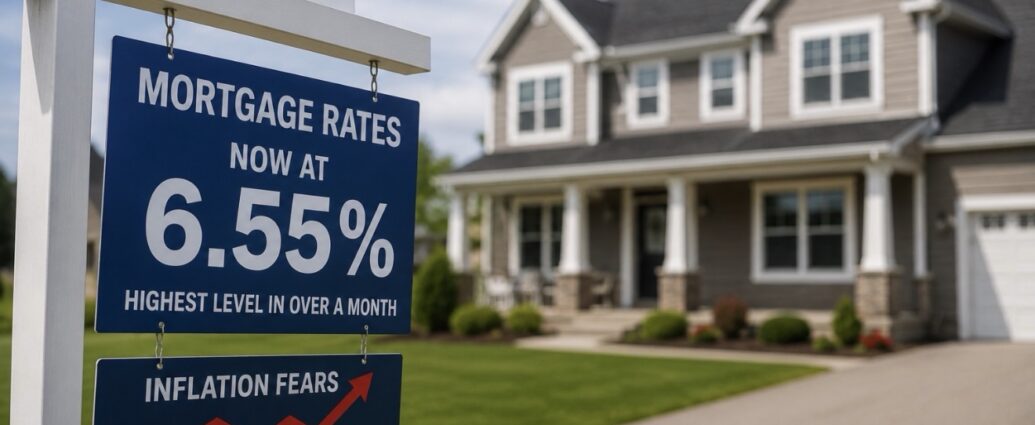
Freddie Mac reported in its weekly survey published Thursday that the average 30-year fixed mortgage rate climbed to 6.55%, up from 6.49% a week earlier. The 15-year fixed rose to 5.93% from 5.82%. It is the second consecutive week rates have moved up, and the direction traces to a place most homebuyers never think about: the Strait of Hormuz.
Freddie Mac noted that purchase application demand has weakened recently, but said affordability is more favorable and inventory continues to rise, leaving the backdrop for prospective buyers modestly improving.
How a war in the Gulf became a housing story
Mortgage rates follow the 10-year Treasury yield. The 10-year follows inflation expectations. And inflation expectations right now follow oil.
Rates fell to their lowest point since September 2022 in February. Then the U.S.-Iran war began on February 28, crude spiked, and rates jumped in March as inflation fears took hold. Brent traded above $114 at one point in March. Rates plateaued through the spring as the conflict dragged.
A ceasefire signed on June 17, paired with a deal to reopen the Strait of Hormuz, briefly looked like it would bring rates down. It did not last. The ceasefire collapsed in July, the U.S. resumed strikes, and rates ticked back up. West Texas Intermediate traded just below $80 a barrel Thursday; Brent held under $85 after a 12% run over three sessions. Treasury yields rose alongside them.
What forecasters had expected
Both Fannie Mae and the Mortgage Bankers Association had placed the 30-year fixed at 6.40% for the second quarter. Actual readings have run above that. Realtor.com chief economist Danielle Hale forecast last December that 2026 rates would fall to an average of 6.3% from 6.6%, with modest gains in sales, prices, and inventory, and declining rents.
Those forecasts assumed a normal year. They did not assume a war that closes the world’s most important oil chokepoint.
Other rates on the board
Daily lender surveys tell a similar story with different numbers. The average 30-year jumbo loan sits at 6.758%, down slightly from 6.770%. The 30-year FHA loan averages 5.940%, down from 5.961%. A separate daily reading showed the 30-year purchase rate up 3 basis points to 6.49%, the 15-year up 10 basis points to 5.96%, and the 5/1 adjustable-rate mortgage up 9 basis points to 6.74%.
The conforming loan limit set by the Federal Housing Finance Agency is $832,750 for 2026 across most of the country.
The Fed is not coming to the rescue
Traders are pricing in an 88% probability the Federal Reserve holds rates steady at this month’s meeting, according to CME’s FedWatch tool. That is the easy part. The harder part is the direction after that.
At the June meeting, the Fed’s dot plot showed nine of 18 officials now expect interest rates to increase in 2026 — not fall. Chairman Kevin Warsh declined to submit a rate forecast at all, while repeatedly emphasizing price stability in a tone the market read as hawkish.
That is a fundamental shift in the assumption underneath every 2026 housing forecast. Those forecasts were built on the expectation of Fed cuts. The Fed is now openly debating hikes.
What it means for buyers and the industry
The practical difference between 6.49% and 6.55% on a $400,000 loan is roughly $16 a month. That is not what breaks a deal. What breaks a deal is the pattern — buyers who have spent 18 months waiting for rates to fall are watching them rise again, and waiting has stopped looking like a strategy.
For homebuilders, realtors, and mortgage originators, the calculation is different. Refinance volume is the most rate-sensitive business in housing, and it moves on tenths of a point. Every upward tick in the 10-year Treasury closes a window that had briefly opened.
Inventory is rising and affordability is improving on the price side. Rates are the piece that will not cooperate, and for now they are hostage to a conflict 7,000 miles away.
JBizNews Desk | New York
© JBizNews.com All Rights Reserved. Reproduction or distribution without written permission is prohibited.