The Kurdistan Freedom Party (PAK) accused Iran of using white phosphorus in a drone attack on one of its bases on Sunday.
Iran has carried out numerous deadly attacks targeting Kurdish Iranian dissident groups. Many of these groups have bases and posts in the Kurdistan Region of Northern Iraq because they have been forced to leave Iran due to the oppression from the regime. PAK is one of the groups.
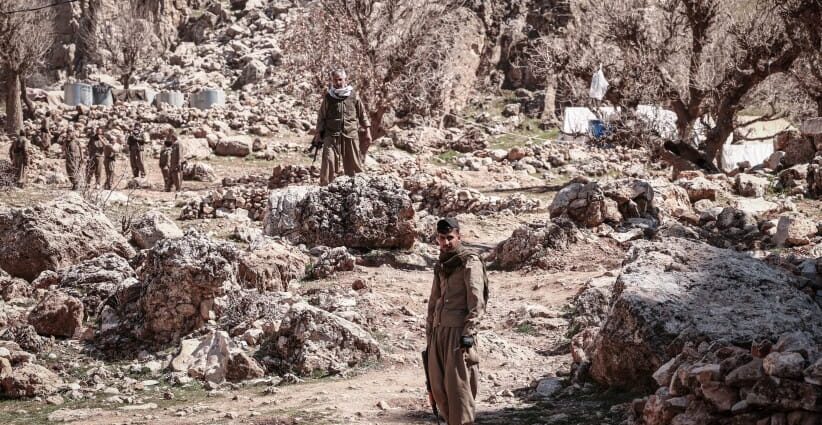
On Sunday, the PAK said that a drone attack carried out early in the morning had targeted a base of the PAK’s Kurdistan National Army (SMK). This is their unit of fighters.
“The Islamic Republic of Iran used munitions containing white phosphorus,” the group said. PAK is one of at least six different Kurdish Iranian opposition groups that are part of a coalition against the regime.
The other groups include PDKI, PJAK, two branches of the Komala party and a group called Khabat. PAK played a key role in the battle against ISIS. Their Kurdish Peshmerga fighters helped repel ISIS attacks on numerous front lines between 2014 and 2019.
A grave violation of international humanitarian law
On Sunday, the group said that, “based on eyewitness observations, medical examinations of nine wounded Peshmerga fighters, and the extensive fires caused at the targeted site, the munitions employed in the drone attack are believed to have contained white phosphorus.”
Hussein Yazdanpanah, the president of the PAK and also General Commander of the SMK, put out the statement. “This act is not only a grave crime but also a clear violation of the fundamental principles of international humanitarian law.
The use of munitions that inflict severe incendiary effects and cause widespread harm to people and the environment is incompatible with humanitarian principles and the international legal obligations of states,” the statement noted.
The World Health Organization noted that “white phosphorus is a chemical waxy solid substance typically appearing yellowish or colorless, and some have described its odor as resembling garlic.”
It noted that “it is often used by militaries to illuminate battlefields, to generate a smokescreen and as an incendiary. Once ignited, white phosphorus is very difficult to extinguish. It sticks to surfaces like skin and clothing.”
The PAK said that this crime should be addressed by the international community. “We call upon the Secretary-General of the United Nations, the United Nations Security Council, the United Nations Human Rights Council, the International Committee of the Red Cross, and all relevant international institutions to take the necessary legal measures to hold the Islamic Republic of Iran accountable,” he added.
He also called on the local authorities of the Kurdistan Region to protect the “security, rights, and environment of their citizens against Iran’s military aggression and cross-border attacks.”
The KRG does not have air defenses against drone attacks. In the last months, the Iranians and Iranian-backed militias have carried out more than 900 attacks on the region. This has resulted in destruction and death.
Nine Kurdish militants killed last week
In some cases, the US, which has a large consulate in Erbil and forces in the region, has been able to shoot down drones and missile threats. Over the last week, at least nine other Kurdish Iranian dissidents were killed in an Iranian attack on the Komala party in the KRG.
The PAK noted that “silence in the face of the use of prohibited weapons only paves the way for the repetition of such dangerous crimes. Defending human dignity, protecting civilians, and upholding international humanitarian law are shared responsibilities of all states and international institutions.”
Why is white phosphorus controversial?
White phosphorus is considered a controversial weapon, and its use has been reduced over the years by many militaries.
The WHO noted that “the use of white phosphorus may violate Protocol III (on the use of incendiary weapons) of the Convention on Certain Conventional Weapons (CCCW) in one specific instance: if it is used, on purpose, as an incendiary weapon directly against humans in a civilian setting.”
It can be used by militaries legally to illuminate a battlefield. “To establish an illegal use under the CCCW, an investigation into the intent behind the use of white phosphorus would be needed,” the WHO noted.
On July 20, Iran continued its attacks on Kurdish groups. “Iran launched fresh missile and drone strikes on bases belonging to the Iranian Kurdish opposition group Komala in the Kurdistan Region early Monday, the party said on Monday, just a day after nine of its members killed in an earlier attack were laid to rest,” Rudaw media noted.
“Amjad Hussein Panahi, head of communications for the group, said missiles struck the group’s headquarters in Alana valley in Erbil’s Choman district shortly after midnight before two drones targeted another base in Surdash camp near Sulaimani about an hour later.”
Regarding the attack on the PAK, the Hengaw Organization for Human Rights said it “expressed grave concern over reports that the Islamic Republic of Iran used prohibited chemical-incendiary munitions in the Kurdistan Region.
Hengaw called on the United Nations and the International Committee of the Red Cross to establish an independent international fact-finding mission to conduct an on-site investigation, examine those injured in the attack, and determine whether prohibited weapons were used.”
Hengaw is a human rights group that often focuses on Kurdish rights in Iran and abuses in Kurdish areas.