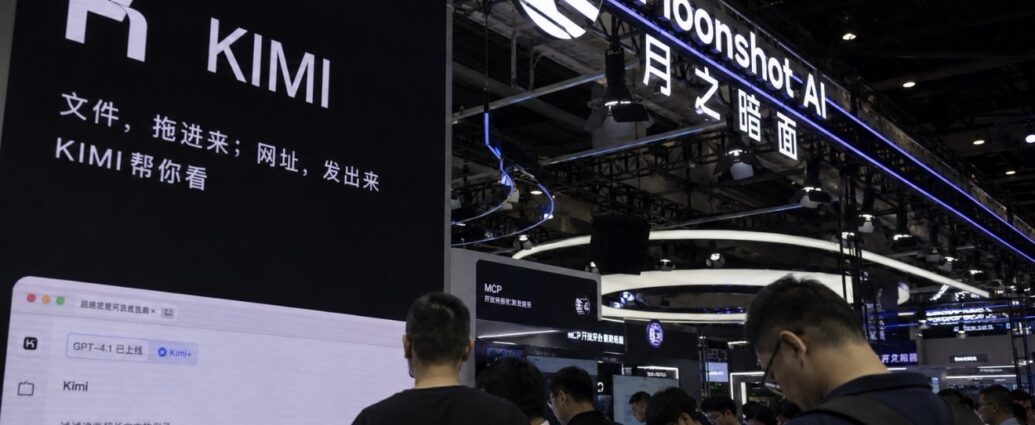
NEW YORK — A new wave of powerful, low-cost artificial intelligence models from China is reshaping the global AI race and reigniting a policy battle in Washington over whether advanced open-weight AI models should face tighter government oversight. The debate intensified ahead of the World AI Conference in Shanghai, where several Chinese developers unveiled increasingly capable systems designed to compete directly with America’s leading AI companies.
The latest releases have drawn attention not only for their technical performance but also for their distribution model. Unlike most frontier systems developed by U.S. companies, several Chinese models are being released with open weights, allowing businesses, researchers and governments to download, customize and operate them on their own infrastructure rather than relying on cloud-based subscriptions.
Moonshot AI led the latest wave with Kimi K3, a 2.8 trillion-parameter open-weight model that quickly climbed several independent benchmark leaderboards after its debut. On specialized coding evaluations, including Frontend Code Arena, the model ranked alongside or ahead of leading systems from Anthropic and OpenAI, demonstrating how rapidly Chinese developers have narrowed the performance gap in selected tasks. Alibaba also previewed Qwen 3.8, another frontier-scale model that the company says competes with the industry’s most advanced systems.
The announcements coincided with renewed pressure across technology stocks. The Nasdaq Composite and S&P 500 both retreated during the broader selloff, while semiconductor shares continued their recent decline. Nvidia lost ground during the session, briefly allowing Apple to reclaim the position as the world’s most valuable publicly traded company by market capitalization. Investors have increasingly questioned whether rapid advances in lower-cost AI models could reshape spending patterns across the industry, echoing concerns first sparked by China’s DeepSeek earlier in the AI race.
For America’s largest AI developers, the emergence of increasingly capable open-weight competitors has become both a business challenge and a policy issue.
Anthropic Chief Executive Dario Amodei has repeatedly warned that unrestricted distribution of highly capable frontier models could create significant cybersecurity and national security risks if advanced capabilities become widely available without sufficient safeguards. The company has recently proposed a framework that would allow the federal government to intervene when frontier AI systems fail independent safety evaluations before public release.
Supporters of open AI development argue that such proposals risk limiting competition rather than improving safety.
David Sacks, the White House’s senior adviser on artificial intelligence and cryptocurrency, has consistently argued that excessive regulation could cement the dominance of a handful of closed-model companies while slowing American innovation. He has warned against using regulatory uncertainty as a competitive advantage and has advocated maintaining a strong U.S. open-source AI ecosystem alongside appropriate national security protections.
The policy debate intensified after Dean Ball, OpenAI’s Head of Strategic Futures and a former White House AI policy adviser, commented publicly on the rapid progress of Chinese open-weight models. His remarks discussing potential U.S. regulatory responses generated widespread criticism online and fueled broader debate over whether Washington should attempt to slow adoption of Chinese-developed AI systems. Ball later clarified that he was describing possible policy scenarios rather than advocating new restrictions, while OpenAI stated that his personal comments did not represent company policy.
The episode highlighted broader divisions inside the administration. National security officials have spent the past year evaluating additional export controls, security guidance and other policy options involving advanced Chinese AI models. While federal agencies—including the Departments of Defense, Commerce, Energy and Transportation—have restricted or prohibited employee use of certain Chinese AI platforms over cybersecurity and data security concerns, the administration has not announced broader restrictions on open-weight AI models.
Officials have also discussed additional oversight mechanisms for the most advanced frontier AI systems, although no formal policy has been finalized amid ongoing debate over balancing innovation, competition and national security.
Meanwhile, America’s own open-model ecosystem continues to expand. Former OpenAI Chief Technology Officer Mira Murati’s Thinking Machines Lab has introduced its own open-weight model, Nvidia continues expanding its Nemotron family, and Nvidia-backed Reflection AI is expected to release its first model later this year. The growing competition reflects a broader shift in the AI industry as companies increasingly debate whether the future belongs to proprietary subscription-based models or open systems that can be deployed and customized by anyone.
The financial stakes remain enormous. Leading AI developers continue raising billions of dollars to finance increasingly expensive computing infrastructure, while supporters of open models argue that broader access will accelerate innovation and reduce costs across the global economy.
Moonshot AI has indicated it plans to release Kimi K3’s model weights on July 27, a move expected to make one of China’s most advanced AI systems widely available. Whether Washington ultimately responds with new policies—or instead doubles down on encouraging America’s own open AI ecosystem—remains one of the defining technology policy questions facing the United States.
JBizNews Desk | New York
© JBizNews.com All Rights Reserved. Reproduction or distribution without written permission is prohibited