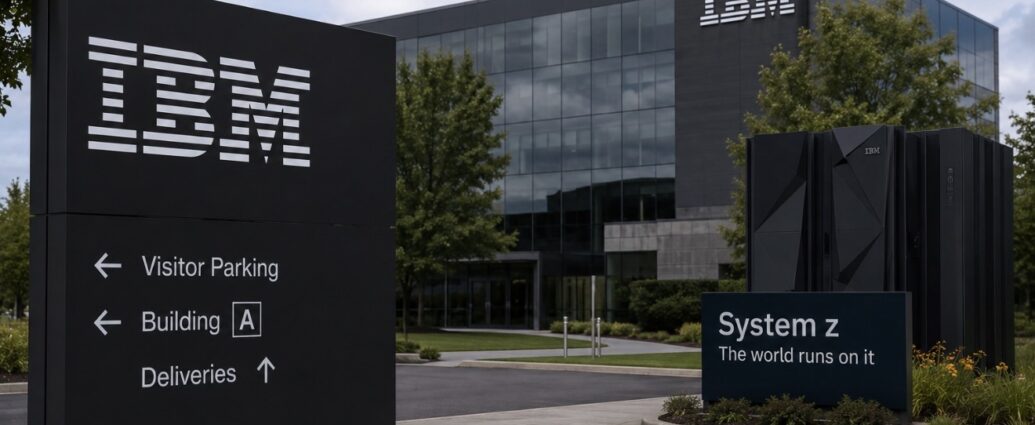
IBM blindsided investors with a rare profit warning, pre-announcing that its second-quarter revenue and earnings would fall short of Wall Street’s targets and sending the stock to one of its worst single-day drops in decades. The episode offered a revealing look at where corporate technology budgets are actually flowing in the AI buildout.
In a July 14 letter to investors, Chief Executive Arvind Krishna disclosed preliminary quarterly revenue of about $17.2 billion—up only 1% from a year earlier and well below the roughly $17.85 billion analysts expected—with non-GAAP earnings guided near $2.93 a share against expectations closer to $3.02. Shares tumbled roughly 25% on the day to around $217, wiping out a chunk of a company valued near $206 billion and marking a brutal reversal from a first quarter in which revenue had climbed 9%.
The soft spot was infrastructure, where revenue fell about 7% on lower sales of IBM’s Z mainframe systems and the related software, particularly its transaction-processing portfolio. That business had been a growth engine just a quarter earlier, when the launch of the new z17 mainframe drove infrastructure revenue up 15%. IBM had expected that momentum to fade as the rollout wrapped, but Krishna acknowledged the decline was sharper than anticipated—worse, he said, than the company’s own outlook.
The explanation is what caught attention. Krishna said that in the final weeks of June, enterprise customers redirected their capital spending toward servers, storage and memory, rushing to lock in supply-constrained infrastructure ahead of expected price increases. In other words, the same scramble for memory and storage capacity driving up costs across the technology industry pulled corporate dollars away from IBM’s mainframes and into hardware that supports AI workloads. He also pointed to industry-wide cybersecurity concerns distracting buyers and delaying decisions, and conceded that several large deals failed to close within the quarter—and that IBM did not respond quickly enough to the shift in customer priorities.
IBM was careful to frame the miss as timing rather than a structural break. The company said the z17 program remains nearly 130% ahead of its predecessor on a comparable basis—outpacing the z16, its strongest prior launch—with customers representing 85% of installed mainframe capacity maintaining or expanding their usage. Consulting signings continued to rise, helped by demand for generative-AI services. Alongside the warning, IBM unveiled Lightwell, a $5 billion initiative backed by more than 20,000 engineers to help organizations fix vulnerabilities in open-source software, which became broadly available July 8 with early adopters including Bank of America, Goldman Sachs, JPMorgan Chase and Visa.
The broader question is whether the shortfall is contained to IBM or a signal about enterprise IT spending overall. If the weakness reflects deals slipping by a quarter and a mainframe cycle that reaccelerates later in the year, the damage is manageable. If it reflects a durable reordering of budgets—where AI-related infrastructure crowds out traditional enterprise hardware and software—the implications extend well beyond Armonk to consulting and IT-services peers with similar exposure. Coming into the year, IBM had guided for constant-currency revenue growth above 5%, a target now under fresh scrutiny.
Investors will not have to wait long for a fuller accounting. IBM is scheduled to release its complete second-quarter results tomorrow, July 22, when management is expected to detail full-year expectations, the health of its deal pipeline, and the trajectory of the z17. Until then, the pre-announcement stands as a pointed reminder that even in an AI-driven spending boom, not every established technology franchise is capturing the windfall.
JBizNews Desk | Armonk, N.Y.
© JBizNews.com All Rights Reserved. Reproduction or distribution without written permission is prohibited.