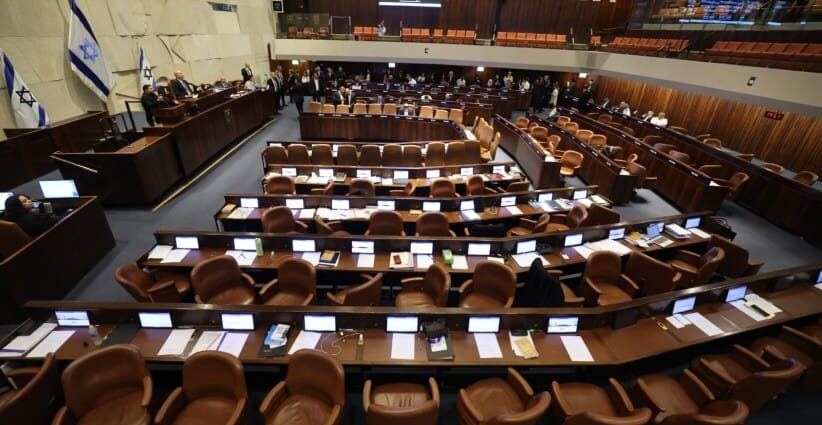
The Knesset told the High Court of Justice that even if Israel’s new system for appointing judges resulted in a lower professional standard among Supreme Court appointees, lawmakers could decide that the trade-off was justified by greater public trust and a more diverse judiciary.
The case concerns a law changing the nine-member Judicial Selection Committee, which appoints every judge in Israel.
Today, the committee includes three Supreme Court justices, two ministers, two MKs, and two representatives of the Israel Bar Association. Appointing a Supreme Court justice requires seven votes, forcing agreement between political and professional members.
Under the new law, the two Bar Association representatives would be replaced by two senior lawyers chosen separately by coalition and opposition MKs. Supreme Court appointments would require five votes, including support from both political blocs, but none of the three justices would have to agree.
Lower-court appointments would also require five votes, but would still need the support of at least one judge, one coalition-side member and one opposition-side member. The law is scheduled to take effect only when the next Knesset begins its term.
Worries that changes could weaken judicial independence
Critics, including Attorney-General Gali Baharav-Miara, argue that the changes would weaken judicial independence by making judges more dependent on politicians for appointment and promotion. The Knesset and government say neither the coalition nor opposition could appoint judges alone and that the changes would make the courts more representative of Israeli society.
Those concerns dominated the June 21 hearing before an expanded 11-justice panel.
Justice Alex Stein asked what a district court judge hoping to reach the Supreme Court would have to do under the new system, answering that the judge may need to “find favor in the eyes of politicians” and write rulings they liked.
Supreme Court President Isaac Amit warned that future justices could be publicly branded as the coalition’s or opposition’s choices, while Justice Yael Willner questioned whether the law’s fallback mechanism would encourage the political blocs to avoid compromise and wait until they could advance their own candidates.
The government and Knesset filings, dated Monday and Tuesday, respectively, were submitted after the court allowed the sides to supplement their arguments following the hearing. The court has issued a conditional order requiring them to explain why the law should not be struck down.
The central legal question is not simply whether the new system is wise or preferable, but whether it damages Israel’s democratic character so severely that the court may invalidate part of a Basic Law.
The Knesset argued that it did not.
“Even if we assume that the professional level of the judges appointed will decline,” it wrote, the amendment reflects the view that “it is appropriate to pay this price in exchange for increasing public confidence in the judicial system and appointing diverse judges.”
The Knesset stressed that this was a hypothetical argument, not an admission that the quality of appointments would fall.
It also said professional ability was not the only relevant consideration. The committee could consider how candidates treat litigants, how efficiently they work, their judicial approach, and the need for greater social and sectoral diversity.
The government similarly argued that considering a candidate’s worldview was not the same as demanding political loyalty.
A judge’s worldview could include their approach to individual rights, tradition, the role of the state and how readily courts should intervene in government decisions, it said. Those views may also affect how judges interpret laws or approach criminal sentencing.
The government rejected the justices’ concern that judges might tailor their rulings to improve their promotion prospects, saying that assumption was speculative and cast doubt on “the professional integrity and personal independence of Israel’s judges.”
Knesset has backup plan if committee can’t agree
It also described the committee vote as only the “final stretch” of a longer professional process involving qualifications, writing samples, recommendations, interviews and assessments. Changing who sits on the committee would not remove those professional checks, it argued.
The Knesset also defended a fallback procedure designed to fill Supreme Court vacancies if the committee remains unable to agree.
It could be activated only after two Supreme Court seats became vacant, at least a year had passed from the later of the first vacancy or the beginning of the new Knesset, and the committee had met but failed to appoint replacements.
The justice minister could then activate the procedure once during that Knesset’s term.
The coalition-side members would submit three candidates, and the rest of the committee would select one. The opposition-side members would submit another three candidates, and the other members would select a second.
If no candidate was chosen from a list within a month, however, the members who submitted that list could choose one themselves. If only one side submitted candidates, its candidate could eventually be appointed alone.
The justices questioned whether that arrangement would reduce the incentive to compromise, since each political bloc could eventually expect to advance one of its own candidates.
The Knesset acknowledged that the mechanism had disadvantages but said leaving Supreme Court seats empty for long periods would be worse.
“The sole justification for the existence of the deadlock mechanism, despite its disadvantages, is simple: The Knesset believed that its absence was a worse alternative,” it wrote.
The Knesset argued that predictions of paralysis or overtly political appointments were still unproven. Should those problems materialize, it said, the court could examine the law after seeing how it operated in practice.
“A law cannot be invalidated – certainly not a Basic Law – on the basis of unsubstantiated future assumptions,” it wrote.
The government separately reiterated this view. Allowing the court to place itself above the constitutional rules enacted by the Knesset would turn “the rule of law” into “the rule of judges,” it argued.
The government also criticized the tone of the June hearing, saying that the justices had referred to the politicization of appointments as an established fact without providing specific examples the government could address.
It said the comments reflected a “general spirit of demonization of elected officials.”
Even if the High Court has the authority to review Basic Laws, the government argued that the petitions are premature because the law will not take effect until the next Knesset. The incoming Knesset could retain, change, or repeal it before the new system begins operating.
Both the government and Knesset asked the court to dismiss the petitions.