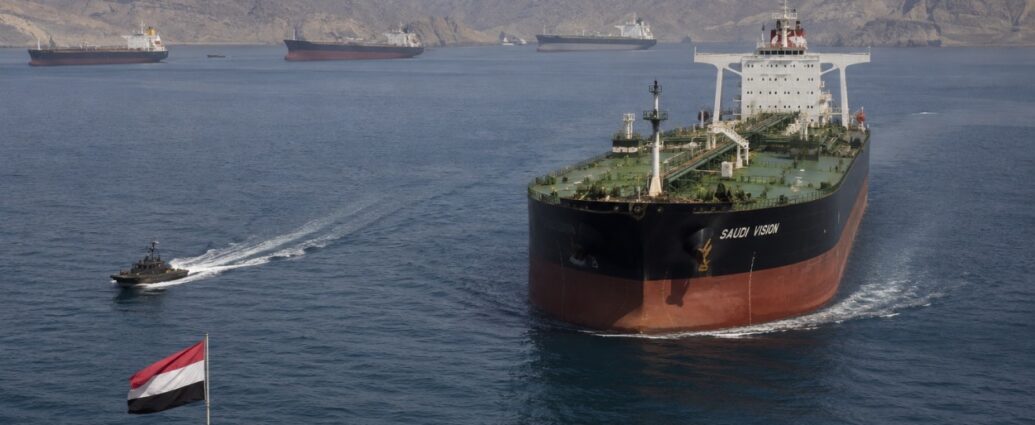
The global oil market is confronting a new supply risk as Iran-backed Houthi forces threaten Saudi Arabia’s Red Sea export route while prospects for ending the broader regional conflict continue to recede. The combination is forcing energy traders to price in the possibility that both of the Gulf’s critical shipping corridors could face sustained disruption at the same time.
For weeks, the Strait of Hormuz dominated market attention after commercial traffic through the waterway slowed to a near standstill. Tracking data showed only three commodity vessels transited the strait Tuesday, the fewest since early May, while no commercial movements were observed early Wednesday. Saudi Arabia had partially offset that disruption by redirecting crude west through its East-West pipeline to the Red Sea export terminal at Yanbu. That alternative route is now under pressure as well.
The Houthis this week declared an embargo on Saudi shipping through the Bab el-Mandeb Strait, the narrow passage linking the Red Sea with the Gulf of Aden and carrying roughly 12% of global seaborne oil trade. The announcement immediately altered shipping patterns. No crude tankers have been observed transiting the strait since the group issued its warning to shipowners, while at least six tankers bound for Yanbu have either reversed course or paused in the Arabian Sea as operators reassess security risks. At Yanbu, only two of seven crude-loading berths were occupied Wednesday morning. Saudi crude exports moving through the route have fallen 36% over the past two weeks, and the European Union’s naval mission in the Red Sea has advised commercial vessels to disable transponders while approaching Saudi ports because of heightened security concerns.
The problem for oil markets is no longer a single chokepoint. It is the prospect of two.
When one export corridor comes under pressure, Gulf producers can typically redirect shipments through the other. If both Hormuz and Bab el-Mandeb remain constrained, however, few large-scale alternatives remain. Analysts at Standard Chartered described the situation as a “two-chokepoint problem,” warning that vessels forced to reroute around the Cape of Good Hope could add nearly a month to transit times while driving freight rates, insurance premiums and delivery costs sharply higher.
Crude markets have already begun reflecting that risk. Brent crude has climbed roughly 25% this month to around $95 a barrel, while the average U.S. gasoline price has risen about 15 cents over the past week to nearly $4.00 a gallon. A prolonged disruption at Bab el-Mandeb alone could restrict access to an estimated 7% of global oil supply, and several market forecasts envision triple-digit crude prices should both waterways remain impaired for an extended period. While those scenarios remain far from certain, traders are increasingly assigning them meaningful probability.
The geopolitical premium persists because diplomacy has stalled.
The United States and Iran both indicated Wednesday that they remain unwilling to resume negotiations as renewed fighting entered its second week. U.S. forces carried out an 11th consecutive night of airstrikes, while Iran responded with missile and drone attacks targeting Jordan’s port city of Aqaba. President Donald Trump said Iran had suffered significant military losses following the deaths of four American service members during the past week and warned the United States would target Iranian bridges and power infrastructure if attacks on shipping through Hormuz continued. Iranian media reported that regional mediators are attempting to restore conditions that existed before the latest ceasefire collapsed in early July, underscoring how limited the current diplomatic expectations have become.
For energy markets, the military and diplomatic developments reinforce one another. A sustained threat to Bab el-Mandeb could draw additional U.S. military resources into the Red Sea while complicating efforts to safeguard shipping through Hormuz. At the same time, the absence of a credible diplomatic path removes the mechanism that would ordinarily allow geopolitical risk premiums to unwind.
Whether the Houthis can fully enforce their embargo remains uncertain. For now, however, the threat alone is forcing shipowners, insurers and energy traders to rethink routes that only weeks ago were considered reliable—keeping a significant geopolitical premium embedded in global energy markets.
JBizNews Desk | Dubai
© JBizNews.com All Rights Reserved. Reproduction or distribution without written permission is prohibited.