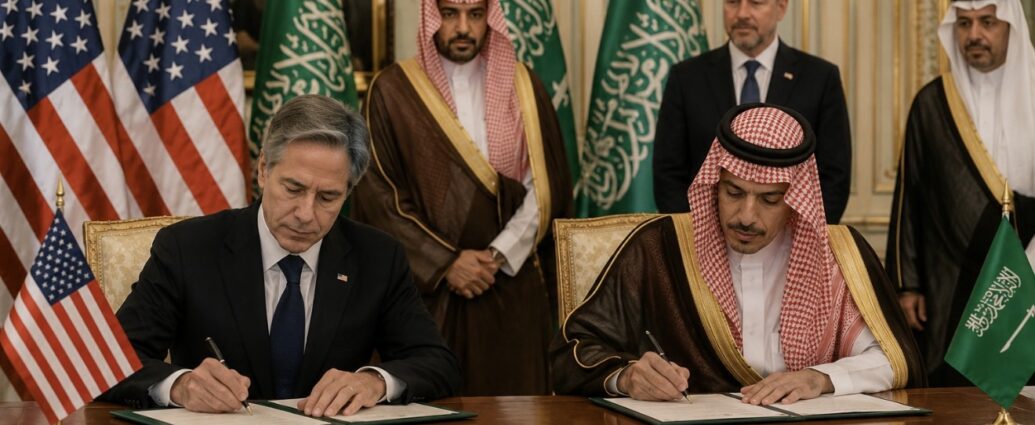
The United States signed a landmark civil nuclear cooperation agreement with Saudi Arabia on Wednesday, clearing the way for American companies to supply reactors, fuel, and technical expertise to the kingdom’s planned nuclear program in a partnership the government says will last decades and be worth billions of dollars.
Energy Secretary Chris Wright and Saudi Energy Minister Prince Abdulaziz bin Salman signed the pact along with an accompanying safeguards agreement, the Department of Energy announced. Known as a 123 agreement under the Atomic Energy Act, the deal would run for 30 years and lay the legal foundation for a long-term commercial relationship. Wright framed it as a step that strengthens commercial ties between the two nations while relying on American nuclear technology and scientists.
The commercial stakes for U.S. industry are the core of the story. The agreement gives American firms priority access to the Saudi nuclear energy program, meaning companies can supply the reactors, components, fuel services, and training that a program built from scratch will require. Industry analysts named Westinghouse, Bechtel, BWXT, and Centrus among the firms positioned to benefit. Westinghouse’s AP1000 reactor — the company is owned by Canadian uranium miner Cameco and infrastructure investor Brookfield — is viewed as central to any large-scale buildout.
The blunt logic for American companies is exposure to a market they would otherwise be locked out of entirely. Without a trade agreement of this kind, U.S. nuclear firms would have no path into the kingdom, and Saudi Arabia would almost certainly turn to competitors in France, Russia, or China for its technology and supplies. The deal is structured to give American companies a central role while shutting out those foreign rivals, converting a geopolitical relationship into a durable export pipeline for a sector Washington has been trying to revive.
What makes the appetite notable is that Saudi Arabia is not short on energy. Nearly 60 percent of its electricity comes from natural gas and roughly 40 percent from oil, according to the International Energy Agency. The push toward nuclear reflects the kingdom’s plans to free up more crude and gas for export while meeting surging domestic power demand — including the enormous electricity loads tied to artificial intelligence data centers, an increasingly common driver of nuclear interest worldwide.
The agreement now faces a mandatory congressional review period of 90 days, during which lawmakers can examine the terms. Congress could block the deal only if both the House and Senate pass disapproval resolutions, a high bar that gives the administration a strong position but leaves room for a fight.
That fight is likely, because the deal omits provisions that have anchored past U.S. nuclear agreements. According to an administration memo, it does not include the so-called “gold standard” language that would bar Saudi Arabia from enriching uranium or reprocessing spent fuel, nor does it require the kingdom to accept expanded oversight from the International Atomic Energy Agency. Critics warn those omissions could give Riyadh a pathway toward weapons capability. The concern is sharpened by past statements from Crown Prince Mohammed bin Salman that Saudi Arabia would pursue a nuclear weapon if Iran obtained one. Some lawmakers in both parties have signaled they want the same safeguards applied to Saudi Arabia that governed the earlier U.S. agreement with the United Arab Emirates.
The timing sits against a tense regional backdrop. The U.S.-Iran conflict that began at the end of February has left Saudi Arabia and other Gulf allies absorbing Iranian attacks, and the administration has cast the nuclear pact partly as a signal of American commitment to the security of its partners in the region. Backers argue that deepening the commercial and strategic relationship with Riyadh strengthens a key ally at a volatile moment; skeptics counter that expanding nuclear technology across the Middle East while Washington pressures Iran to curb its own program sends a contradictory message.
Talks over a Saudi nuclear deal have stretched across multiple administrations, previously tied to broader diplomatic goals including normalization between the kingdom and Israel. The version signed Wednesday moves forward largely on commercial and strategic terms, with the enrichment question left as the central point of contention heading into the congressional review.
For American nuclear firms, engineering contractors, and the fuel-services companies that support them, the agreement marks one of the largest potential export opportunities the sector has seen in years — if it survives the next 90 days on Capitol Hill.
JBizNews Desk | Washington, D.C.
© JBizNews.com All Rights Reserved. Reproduction or distribution without written permission is prohibited.