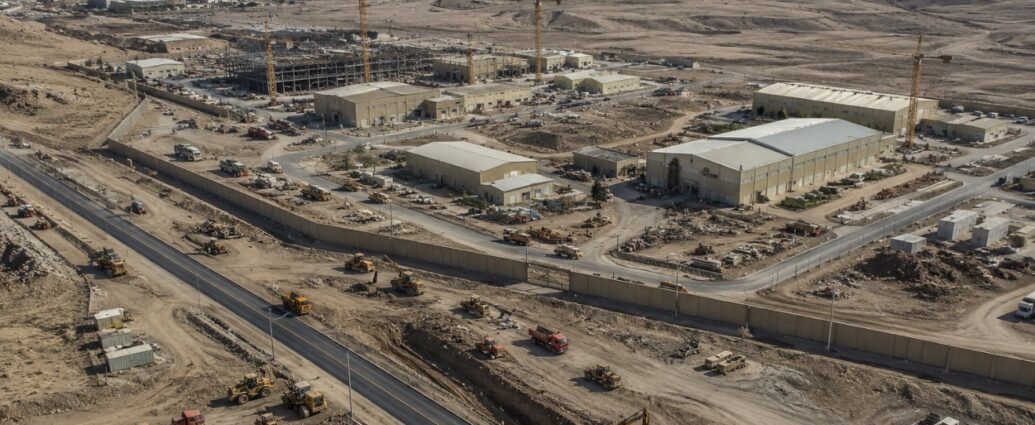
Satellite imagery reviewed Thursday, July 23, 2026, shows Iran rapidly repairing missile-base access roads, tunnel entrances, ports and weapons-production sites damaged during the U.S. and Israeli air campaign, raising doubts about how long the strikes can suppress Tehran’s military capabilities.
The rebuilding does not mean Iran has fully restored what it lost. Advanced machinery, air defenses and specialized missile-production equipment may take months to replace. But the speed of visible repairs suggests Iran can reopen key locations quickly enough to keep operating while forcing the United States and Israel to decide whether to strike the same sites again.
Destroying a facility once is not the same as keeping it disabled.
Near Kangavar in western Iran, March imagery showed airstrikes had damaged two tunnel entrances and an access road serving an underground missile complex. Within weeks, newer images showed a paved road leading toward freshly excavated entrances, indicating that Iran had restored access to part of the site.
At Bandar Anzali on the Caspian Sea, early July imagery showed reconstruction at a shipyard and port connected to the Islamic Revolutionary Guard Corps. Israel had previously said it struck warships, a command center and repair facilities there to disrupt a supply route between Iran and Russia.
Separate high-resolution images released this month showed significant repair activity at Taleghan 2 inside the Parchin military complex. Workers cleared debris, covered penetration holes, brought in cranes and reinforced parts of the hardened facility with concrete and rebar, according to the Institute for Science and International Security. The institute cautioned that visible reconstruction does not prove the site is operational.
That distinction matters. Satellite images can show roads, construction equipment and repaired entrances, but they cannot reveal whether machinery inside a tunnel works or how many missiles remain underground.
Still, Iran does not need to restore every damaged facility to create a strategic and economic problem.
A partly rebuilt missile network can still keep energy markets, shipping companies and governments under pressure.
Continued Iranian missile and drone attacks show that Tehran retained launchers, weapons and underground storage after the strikes. Israeli military estimates cited in current reporting say roughly 200 of Iran’s estimated 470 ballistic-missile launchers were destroyed and another 80 became unusable after tunnel entrances were struck. Iran’s continuing attacks indicate that the surviving network remains substantial.
For businesses, the concern reaches well beyond the battlefield. The longer Iran can absorb attacks and continue threatening the Strait of Hormuz, the longer companies face higher fuel prices, shipping insurance costs, rerouting expenses and supply-chain delays.
The cost imbalance is also difficult to ignore. Iran can clear rubble or repave a road far more cheaply than the United States and Israel can deploy aircraft, interceptors and precision-guided weapons to destroy it again. If repaired sites require repeated strikes, the campaign becomes a contest of endurance rather than a one-time effort.
Iran prepared for that contest over decades. Sanctions pushed the country to develop domestic supply chains, disperse production, stockpile parts and bury important military infrastructure underground. Those capabilities now appear to be helping Tehran repair visible damage while preserving enough capacity to continue fighting.
The air campaign still produced meaningful results. It destroyed equipment, interrupted production and forced Iran to spend money and manpower rebuilding instead of expanding. Some sensitive nuclear facilities also remain damaged or inaccessible, showing that Iran’s recovery is uneven rather than complete.
The unanswered question is whether the disruption lasts long enough to change Iran’s behavior.
Washington and Jerusalem now face a harder decision: repeatedly strike repaired facilities, tighten restrictions on replacement equipment and industrial components, or pursue an enforceable agreement that limits reconstruction and permits outside monitoring.
Iran appears to be betting that it can rebuild faster than its adversaries can sustain the pressure.
The effectiveness of the campaign will ultimately be measured not by how much was destroyed, but by how long Iran is prevented from putting it back into service.
JBizNews Desk | Jerusalem
© JBizNews.com All Rights Reserved. Reproduction or distribution without written permission is prohibited.