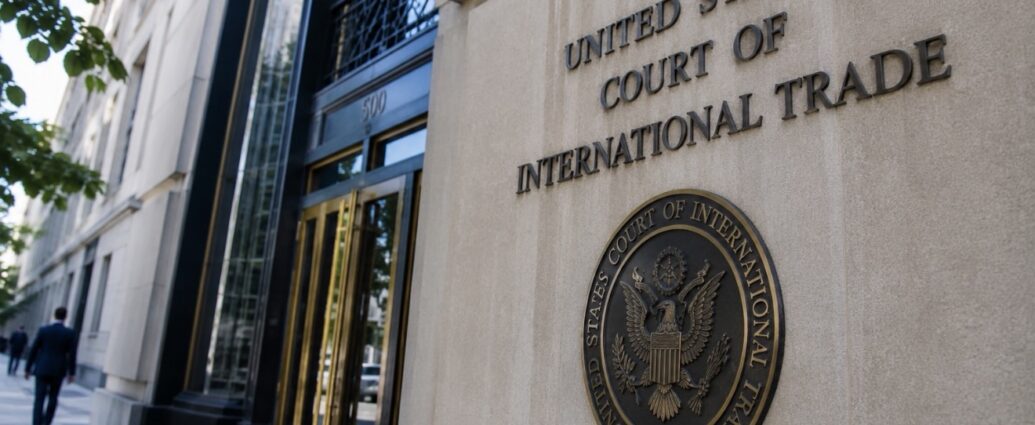
New York — A New York spice importer and a California watch retailer filed suit in the U.S. Court of International Trade on Friday, challenging the sweeping new tariffs the administration imposed on roughly 60 trading partners a day earlier.
Burlap & Barrel, a New York-based spice importer, and Collective Horology, a Ventura, California watch retailer, filed the complaint in the Manhattan-based trade court — the same court that has twice found the administration’s tariff programs unlawful. They are represented by the Liberty Justice Center, the group that prevailed at the Supreme Court against the earlier emergency-powers tariffs and also challenged the Section 122 round that followed.
The duties at issue were implemented under Section 301 of the Trade Act of 1974, with the administration citing the failure of those countries to prevent imports produced through forced labor. The tariffs cover approximately 99% of U.S. imports.
The timing is the heart of the dispute. On March 12, 2026 — less than three weeks after the Supreme Court held that the International Emergency Economic Powers Act does not authorize presidential tariffs — the U.S. Trade Representative opened 60 investigations into whether the identified economies effectively prohibit forced-labor imports. On July 23, only hours before the new duties took effect, USTR imposed tariffs on products from all 60.
The Court of International Trade found the Section 122 tariff unlawful in May, though an appeals court left it in place through its July 24 expiration. USTR finalized the Section 301 forced-labor duties, which took effect that same day.
The legal argument is narrow and statutory. Jeffrey Schwab, an attorney at the Liberty Justice Center representing the businesses, said Section 301 contains no authority to tax substantially all imports from substantially all countries at preestablished rates. Schwab described the filing as the third instance in which the administration has attempted to implement a global tariff policy without observing statutory limits.
Sara Albrecht, chairman and CEO of the Liberty Justice Center, said forced labor is morally indefensible but that an important objective does not permit the government to disregard the law, adding that allowing one global tariff to expire and immediately replacing it under a different statute does not change what the law requires.
The plaintiffs contend the administration applied near-uniform duties of 10% or 12.5% across the roughly 60 economies at the direction of the president, without demonstrating how each country’s specific conduct burdens American commerce. The complaint also invokes the major questions doctrine, which requires Congress to speak clearly when authorizing decisions of significant economic and political consequence, and argues in the alternative that if Section 301 does grant that authority, the delegation itself is constitutionally defective.
A second, separate lawsuit was filed by other small businesses making similar arguments — that the government did not adequately establish its case against each economy or explain how the duties would eliminate the practice they were levied to address.
The remedy sought is substantial. The suit asks the court to strike the tariffs down, block their collection, and order refunds with interest for the plaintiffs and other importers. The Liberty Justice Center is seeking to represent a nationwide class covering every business that has paid or will pay the duties — potentially thousands of importers.
For regional importers, the class allegation is the operative detail. Businesses that continue paying the duties while litigation proceeds may preserve refund claims if the tariffs are ultimately invalidated, provided entry documentation is retained and duties paid are properly recorded. Importers should be filing and archiving entry summaries carefully rather than treating the payments as sunk cost.
The administration has rejected the characterization that the new duties are a workaround. A senior administration official told reporters that addressing forced labor has been a longstanding presidential focus, and said the timing of implementation was intended to avoid complexity.
Research from the Federal Reserve Bank of New York, the Kiel Institute for the World Economy and the Yale Budget Lab has concluded that American consumers and businesses bear most of the cost of tariffs rather than foreign governments — a finding the White House disputes.
Burlap & Barrel’s involvement gives the case a local face. The company imports directly from smallholder farmers across dozens of countries, a sourcing model with little room to substitute origins in response to duty schedules.
JBizNews Desk | New York
© JBizNews.com All Rights Reserved. Reproduction or distribution without written permission is prohibited.