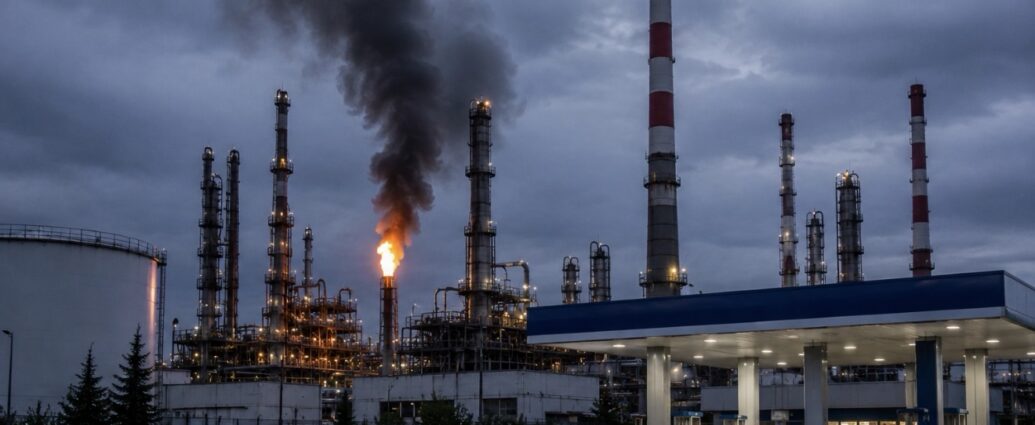
Russia will keep its ban on gasoline exports in place through the end of 2026, extending a restriction that had been scheduled to expire this Friday and signaling that Moscow does not expect its refining capacity to recover this year.
Deputy Prime Minister Alexander Novak said the extension applies to both producers and non-producers, and that the separate diesel export ban will be lifted as the market rebounds. He made the remarks to reporters in Omsk on Saturday, adding that diesel restrictions would be unwound in time to prevent refineries from accumulating a glut and being forced to cut processing volumes.
The original gasoline export ban took effect April 1 and had been set to run only until July 31. The diesel ban is newer, imposed July 8 as part of a package of emergency measures after sustained Ukrainian drone strikes on Russian refineries produced gasoline shortages and price spikes.
A production problem, not a policy choice
The export halt is a symptom rather than a strategy. By mid-June, Russia had lost roughly a quarter of its gasoline production compared with the same month a year earlier, after strikes shut down large refineries in the central part of the country. The government has attributed the disruptions to logistics changes, and now finds itself preparing to import diesel on top of gasoline — a reversal for a country that ranked among the world’s largest fuel exporters.
The domestic picture explains the urgency. Occupation authorities in Crimea suspended fuel sales to private individuals and businesses on June 21, restricting supply to state agencies responsible for essential services and security, with no timeline offered for restoration. Novorossiysk, Russia’s largest Black Sea oil export outlet, cut off gasoline sales to private motorists on July 3, issuing fuel cards for municipal use instead. Nearby Anapa capped purchases at 20 liters per car — enough for about a week, according to one resident quoted on local television — which trimmed station wait times from as long as four hours down to roughly half an hour.
By early July, Novaya Gazeta Europe estimated the shortage had reached at least 78 of Russia’s 83 internationally recognized regions, plus occupied Crimea and Sevastopol. Moscow has also signed a decree permitting certain refineries to drop output standards from Euro-5 to Euro-3 gasoline through the end of the year.
Why it matters outside Russia
Diesel is where the export ban lands hardest on global buyers. Russia is the world’s second-largest diesel exporter behind the United States, and outages at its refineries move global supply. The country accounted for roughly 11 percent of global diesel supply last year, according to figures compiled from analytics firm Vortexa.
Those volumes have already collapsed. Russian diesel and gasoil loadings ran at just 234,000 barrels per day over the first ten days of July, per Kpler data — down from 400,000 bpd in June and against a 2025 average near 817,000 bpd.
The timing compounded an existing squeeze. A fresh wave of U.S. strikes on Iran landed within hours of the diesel ban announcement, renewing concerns over vessel movements through the Strait of Hormuz and the damage already done to Middle Eastern exports. Global benchmark diesel prices jumped nearly 13 percent on the day of the announcement before retreating more than 3 percent the following morning.
The American exposure
U.S. inventories were thin heading into the disruption. Government data showed a draw of more than 4.5 million barrels in a single week, leaving diesel stocks at 97.8 million barrels as of July 3 — about 6 percent below the five-year seasonal average.
Diesel represents the largest share of global oil consumption, feeding industrial machinery, farm equipment, heavy freight and electricity generation, which is why price moves travel well beyond the pump. Western refinery closures and firm post-pandemic demand had already kept the market tight for years before this summer.
For tri-state businesses, the transmission runs through freight. Long-haul trucking and last-mile delivery costs move with distillate prices, and those costs reset into contracts on a lag — meaning shippers, grocers and distributors across New York, New Jersey and Connecticut may not feel the full effect until fall invoicing cycles.
Buyers who absorbed Russian diesel after Europe’s 2023 ban — Turkey, Brazil, and importers across Africa and the Middle East — face the sharpest near-term competition for replacement barrels, while Europe absorbs secondary pressure through elevated global benchmarks.
Novak gave no firm date for restoring diesel exports, tying it only to domestic market conditions.
JBizNews Desk | New York
© JBizNews.com All Rights Reserved. Reproduction or distribution without written permission is prohibited.