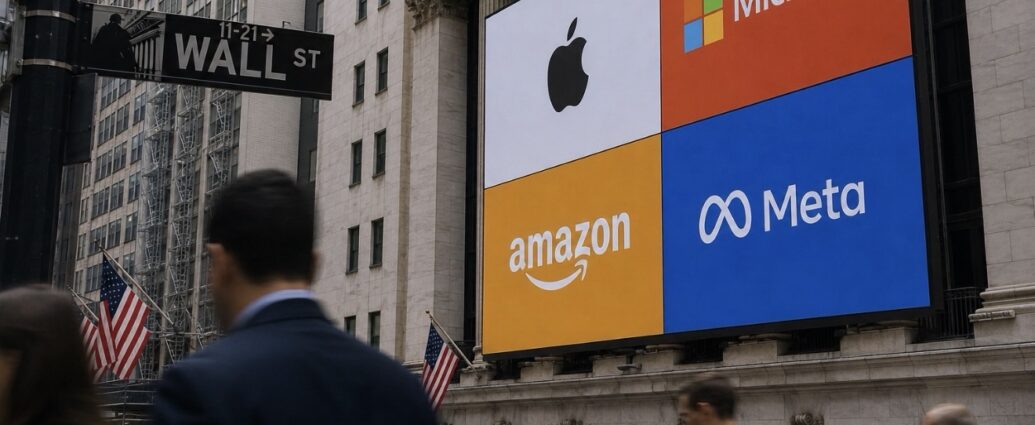
Four of the largest American companies open their books this week inside a 48-hour window that also contains a Federal Reserve decision, the first read on second-quarter growth, and the inflation gauge the central bank watches most closely. For any business carrying floating-rate debt or planning a capital purchase this fall, it is the most consequential stretch of the summer.
The calendar
Tuesday brings Coca-Cola, Boeing, Ford, Visa, United Parcel Service, Sherwin-Williams, Corning, Illinois Tool Works, Mondelez, Waste Management, Royal Caribbean, Seagate and Teradyne — a cross-section of American industry broad enough to read as an economy-wide temperature check.
Wednesday is the pivot. The Fed’s decision lands at 2 p.m. Eastern, with Chair Kevin Warsh taking questions at 2:30. After the close, Microsoft and Meta report, alongside Procter & Gamble, Qualcomm, Starbucks, General Dynamics, Lam Research and Arm.
Thursday delivers the advance estimate of second-quarter GDP and weekly jobless claims, then Apple and Amazon after the bell, with Mastercard, Bristol-Myers Squibb, Altria and Stryker. Personal consumption expenditures inflation and the employment cost index follow in the same stretch.
What the Fed is actually deciding
The target range for the federal funds rate stands at 3.50% to 3.75%, and the widely held expectation is that it stays there for a fourth consecutive meeting. This meeting carries no new economic projections and no dot plot, which means the entire signal comes from three places: the wording of the statement, how the committee voted, and what Warsh says about September.
Warsh, confirmed in May, is generally understood to favor higher rates over tolerating inflation. He has said little about where he thinks the current setting should be. That silence ends Wednesday afternoon.
The bind is genuine. Standing pat leaves the 10-year Treasury yield — which touched a year-to-date high near 4.7% last week — with room to press toward 5%, tightening conditions for every borrower in the country without the Fed lifting a finger. Raising rates instead lands squarely on the American companies financing the AI buildout, several of which have moved from funding construction out of cash flow to tapping debt and equity markets.
Why the earnings and the rate decision are the same story
Alphabet supplied the template last week. The company raised capital spending guidance to $195 billion to $205 billion for 2026, free cash flow turned negative, and the stock fell roughly 8% despite a revenue beat. Investors are no longer scoring AI spending as ambition; they are scoring it against returns.
That sets an uncomfortable bar for Microsoft, which will be asked to show Azure growth and Copilot commercialization sufficient to justify its own data-center outlay, and for Meta, which has been spending heavily with a stock down for the year. Amazon faces the same question about AWS capacity.
Apple sits in the opposite position, and Monday demonstrated why. Its capital expenditures have declined over the past three quarters rather than climbed, and that restraint helped push it past Nvidia to become the most valuable public company. Whether Thursday’s numbers vindicate that discipline is the week’s most interesting corporate question.
The two variables nobody at the Fed controls
Oil is the first. Brent broke $100 last week, then crude fell 8.68% on Monday to $82.62 as the US paused strikes on Iran and Tehran halted retaliation. Inflation’s path over the next two quarters depends heavily on which of those two prices holds.
Tariffs are the second. New US levies on imports from 60 economies took effect after a temporary 10% duty expired, running from 10% for the United Kingdom, India and the European Union to 12.5% for Japan, Korea and China, with generic drugs facing a 100% tariff within two years. Those costs arrive on the same income statements the Fed is trying to read.
What tri-state businesses should take from it
Three practical points.
First, if you carry a floating-rate line or an equipment loan repricing this quarter, Wednesday at 2 p.m. is the moment that matters — not the earnings that follow it.
Second, the 10-year yield governs commercial real estate financing and longer-term borrowing more directly than the fed funds rate does. A move toward 5% raises the cost of every deal being underwritten right now, regardless of what the Fed announces.
Third, Tuesday’s industrial reports — Ford, Boeing, UPS, Sherwin-Williams — will tell you more about your own order book than the technology numbers will. Freight volumes, coatings demand and auto financing are the beat of the real economy.
By Friday, we will know whether inflation is cooling, whether growth held, and whether the largest companies in America can still justify what they are spending.
JBizNews Desk | New York
© JBizNews.com All Rights Reserved. Reproduction or distribution without written permission is prohibited.