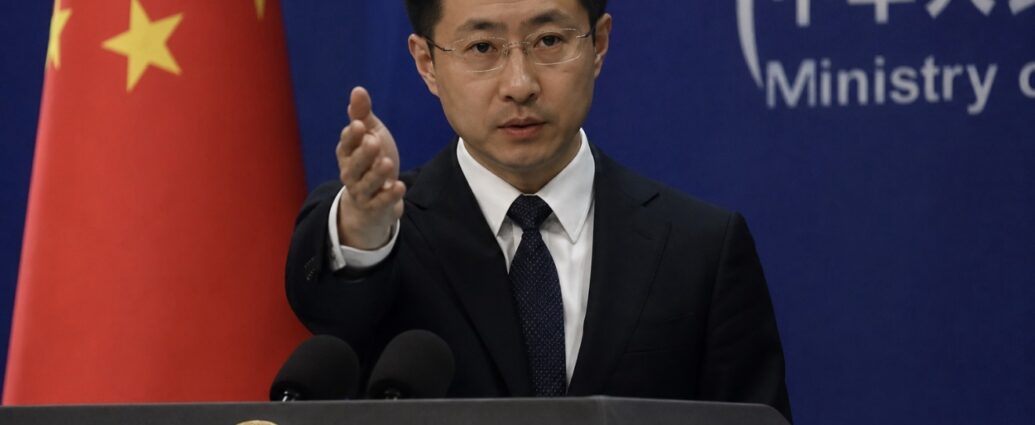
NEW YORK — China warned Monday that it will take “all necessary measures” if the United States imposes sanctions on Chinese artificial intelligence companies over allegations they improperly trained their AI models using American technology, escalating another front in the growing technology rivalry between the world’s two largest economies.
In a statement, China’s Ministry of Commerce accused Washington of pursuing “AI hegemonism,” rejected allegations of intellectual property theft and argued that the U.S. has failed to present evidence supporting its claims. Beijing also maintained that model distillation—a technique used to improve AI systems—is a widely accepted practice employed throughout the global artificial intelligence industry, including by American developers.
The dispute began after senior U.S. officials publicly raised the prospect of new restrictions.
Treasury Secretary Scott Bessent said last week that the administration was closely examining recently released Chinese open-source AI models for evidence of what officials describe as large-scale extraction of capabilities from leading American systems.
Attention has centered on Moonshot AI’s Kimi K3 model, released July 16, which quickly drew attention for strong benchmark performance. U.S. officials are reportedly reviewing whether the model may have been trained using outputs from Anthropic’s Fable 5 or other advanced American AI systems without authorization.
The central disagreement is not whether model distillation exists, but where legitimate engineering ends and intellectual property infringement begins.
Distillation is a common machine-learning technique in which a smaller or newer model learns from the outputs of a larger, more capable system. Researchers and commercial AI developers around the world routinely use variations of the process. U.S. officials argue the concern is not the technique itself but whether it has been employed at a scale or in a manner that improperly reproduces proprietary capabilities.
China disputes that distinction, arguing Washington has not established a clear legal or technical standard separating acceptable development practices from unlawful copying. Beijing also maintains that several Chinese AI models now compete globally based on their own research and engineering advances.
Neither government has publicly released evidence that has been accepted by the other side, leaving the dispute unresolved while political tensions continue to rise.
Any future sanctions would extend well beyond one AI company.
Among the options reportedly under consideration is placing Chinese firms on the U.S. Entity List, a move that could significantly restrict access to American semiconductors, cloud-computing services, software tools and other technologies. Such restrictions would also affect U.S. companies that provide products or services to any newly designated firms.
Monday’s warning also arrived during a difficult trading session for the semiconductor industry. Investors were already reacting to China’s advances in domestic chip manufacturing and memory production, developments that pressured shares of Nvidia, AMD and several major semiconductor equipment companies.
Taken together, the latest events underscore a broader shift. Rather than competing solely through product launches, Washington and Beijing are increasingly using export controls, investment restrictions, sanctions and regulatory actions as strategic tools in the global AI race.
For businesses across New York, New Jersey and Connecticut, the immediate issue is understanding which AI models are already embedded inside their operations.
Many companies now rely on inexpensive open-weight AI models through third-party software vendors without knowing which underlying systems power their applications. Marketing agencies, logistics companies, financial firms, manufacturers and software developers may be using Chinese-developed models indirectly through cloud platforms or commercial software subscriptions.
That creates a potential compliance issue if future sanctions are imposed. Businesses should confirm which AI models their vendors use, review contracts addressing regulatory changes and identify alternative U.S. or European AI providers that could replace restricted models if necessary. Preparing those contingency plans now is significantly easier than responding after new restrictions take effect.
No sanctions have been announced, and Beijing’s statement responds to actions Washington has not yet taken. Even so, the direction of U.S.-China technology policy has become increasingly restrictive, making supply-chain visibility and AI governance important business priorities for companies adopting artificial intelligence across their operations.
JBizNews Desk | New York
© JBizNews.com All Rights Reserved. Reproduction or distribution without written permission is prohibited.