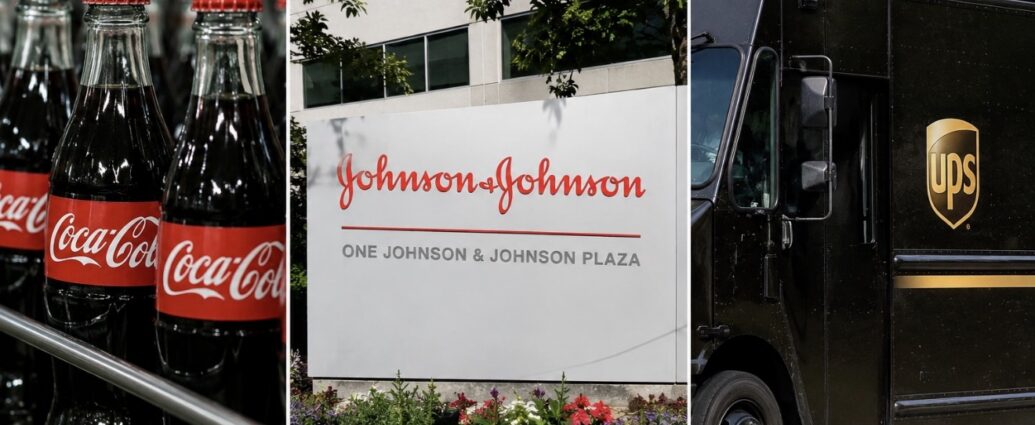
Three of America’s largest companies delivered very different signals Tuesday about the condition of the economy. Coca-Cola raised its full-year forecast as global beverage demand strengthened, UPS said its business had begun to stabilize after completing a major pullback from Amazon volume, and Johnson & Johnson proposed a $5.5 billion resolution intended to bring roughly 76,000 ovarian talc claims to an end.
Coca-Cola provided the clearest sign that consumers are still spending despite higher prices and pressure on household budgets. Second-quarter revenue rose 7% to $13.4 billion, helped by a 5% increase in worldwide unit volume and a 2% improvement from pricing and product mix. Earnings climbed 16% to $1.03 a share, while operating margin widened to 34.9% from 34.1% a year earlier.
North American volume increased 3%, supported by the company’s core soda brands as well as juice, dairy and plant-based beverages. Pricing contributed another 4% in the region, showing that customers continued buying even as the company charged more across parts of its portfolio.
Strength extended well beyond the United States. Asia-Pacific volume rose 8%, Europe, the Middle East and Africa gained 4%, and Latin America increased 3%. Coca-Cola Zero Sugar grew 16% globally, while sports drinks, water and tea also advanced.
Those gains prompted management to lift its 2026 outlook. Organic revenue is now expected to grow about 5%, compared with the previous range of 4% to 5%, while comparable earnings are projected to rise 9% to 10%. Free cash flow is expected to reach roughly $12.4 billion, giving the company additional room for dividends, investment and marketing.
UPS reached its improvement through a very different route.
After spending more than a year shrinking its exposure to lower-margin Amazon packages and reconfiguring its delivery network, the company reported $22.8 billion in second-quarter revenue and adjusted earnings of $1.76 a share. Domestic revenue rose 6%, international revenue increased 12.5%, and supply-chain revenue climbed 7.8%.
Fewer packages moved through the U.S. network, but UPS earned more from each one. Domestic revenue per piece increased 9.3%, while international revenue per piece jumped 18.9%, allowing the company to generate stronger adjusted operating profit even as overall volume remained under pressure.
Management now expects approximately $91.2 billion in full-year revenue, up from its earlier forecast of $89.7 billion. Adjusted operating profit is projected at about $8.65 billion, with adjusted earnings of roughly $7.22 a share.
Reaching that point required substantial cuts. UPS recorded $891 million in after-tax restructuring charges during the quarter, largely tied to employee separations and network changes connected to its completed Amazon pullback. GAAP earnings fell to 71 cents a share, illustrating how expensive the transition has been even as the underlying business improves.
For retailers, manufacturers and small businesses, the recovery carries mixed implications. A financially stronger UPS may offer more reliable service and a healthier network, but the company’s emphasis on earning more per shipment suggests customers should not expect aggressive pricing simply because package volume has softened.
Johnson & Johnson’s announcement involved neither consumer demand nor freight activity, yet it could remove one of the largest legal uncertainties hanging over any major U.S. corporation.
Under the proposed agreement announced Monday, the company would commit $5.5 billion to resolve the remaining ovarian talc cases in federal and state courts. At least 95% of eligible claimants must participate before the resolution can proceed, with an initial payment of no more than $3 billion expected in 2027 and additional payments beginning in 2028.
Roughly 76,000 claims remain. Johnson & Johnson continues to deny that its talc products caused cancer and said it agreed to the proposal after favorable court developments strengthened its position in the litigation.
A successful resolution would provide greater certainty around future legal expenses while allowing management to focus more fully on pharmaceuticals and medical technology. Failure to reach the participation threshold would leave the company defending the cases individually, extending a dispute that has lasted about 15 years.
Viewed together, the three developments show how differently large companies are navigating the same economy. Coca-Cola is raising expectations because customers continue buying at higher prices. UPS is improving by carrying fewer low-margin packages and charging more for the shipments it keeps. Johnson & Johnson is seeking to exchange a known multibillion-dollar cost for an end to years of legal uncertainty.
None of the announcements suggests an economy moving uniformly in one direction. Consumer demand remains resilient, freight operators are still restructuring around slower volume, and corporate balance sheets continue absorbing costs created long before the current quarter began.
JBizNews Desk | Wall Street
© JBizNews.com All Rights Reserved. Reproduction or distribution without written permission is prohibited.