
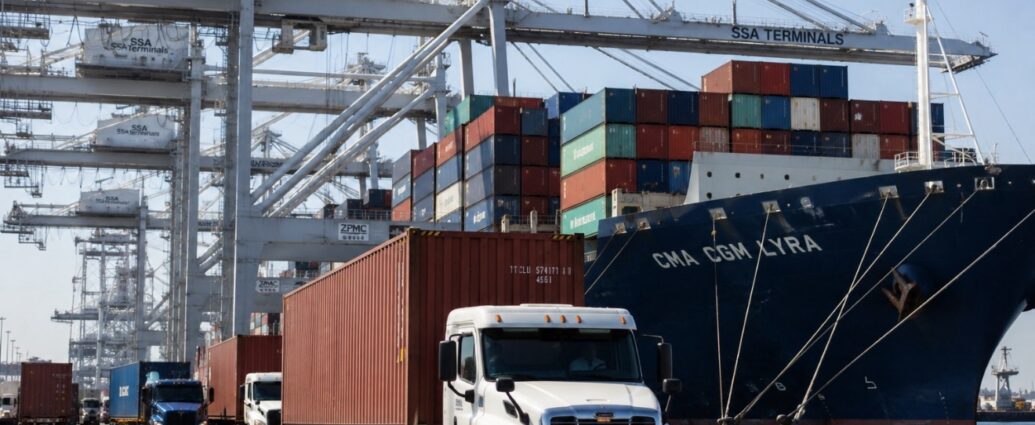
America’s trade deficit narrowed in June, but the improvement came largely because businesses imported fewer goods rather than from stronger export growth, according to advance trade data released Tuesday by the U.S. Census Bureau. While the smaller deficit may appear encouraging, the underlying figures suggest many companies remain cautious as they navigate higher tariffs, elevated borrowing costs and continued uncertainty surrounding global trade.
The advance report showed the U.S. goods trade deficit narrowing by $4.4 billion to $101.5 billion in June. Exports declined $3.8 billion to $204.7 billion, while imports fell an even larger $8.2 billion to $306.2 billion, producing the smaller overall trade gap.
For businesses, the decline in imports may reflect more than changing trade balances.
Many importers accelerated purchases earlier this year ahead of expected tariff increases, allowing companies to rely on existing inventories rather than placing new overseas orders. Others continue delaying purchases while monitoring trade policy, shipping costs and geopolitical developments.
The report suggests businesses remain careful about inventory management.
Wholesale inventories increased only 0.3% during June, while retail inventories were essentially unchanged, indicating companies are balancing customer demand against concerns that economic growth could slow during the second half of the year.
Manufacturers also continue adapting their supply chains.
Higher tariffs and shifting trade policies have encouraged some companies to diversify suppliers, relocate production or increase domestic sourcing. Those adjustments require significant planning and investment, particularly for businesses that have relied on global manufacturing networks for decades.
For ports, transportation companies and logistics providers, lower import activity can affect shipping volumes, warehouse utilization and trucking demand.
While cargo flows remain above historical averages in many regions, fluctuations in import patterns continue creating operational challenges throughout the supply chain.
The report also carries implications for American manufacturers.
Reduced imports can create opportunities for domestic producers if businesses shift purchasing toward U.S.-made products. At the same time, many manufacturers depend on imported raw materials and components, meaning reduced imports can also reflect weaker industrial demand.
Financial markets closely monitor trade data because exports and imports contribute directly to overall economic growth.
Economists will incorporate Tuesday’s figures into estimates for second-quarter Gross Domestic Product, although the advance report represents only one component of broader economic activity.
Trade policy remains another important factor.
Businesses continue evaluating how tariffs, customs procedures and changing international trade relationships may affect purchasing decisions, production costs and future investment.
For retailers, maintaining the right inventory levels has become increasingly important.
Ordering too much merchandise can leave companies with excess stock if consumer demand weakens, while ordering too little risks product shortages and lost sales.
The latest trade figures illustrate the balancing act many businesses now face as they attempt to manage costs, maintain inventory and respond to an increasingly unpredictable global trading environment.
For the broader business community, Tuesday’s report suggests the narrowing trade deficit reflects caution as much as strength. Companies continue spending and investing, but many are doing so more selectively while waiting for greater clarity on trade policy, tariffs and the direction of the U.S. economy.
JBizNews Desk | New York
© JBizNews.com All Rights Reserved. Reproduction or distribution without written permission is prohibited.




