Markets lean toward another hold, but the chairman’s refusal to signal has turned a routine meeting into a guess
The Federal Market Committee opened its two-day policy meeting Tuesday and will announce its rate decision Wednesday at 2 p.m. Eastern, with the benchmark rate currently sitting in a range of 3.5% to 3.75%. A hold would be the fifth straight meeting without a change. What makes this one different is that nobody outside the Eccles Building is confident that is what will happen.
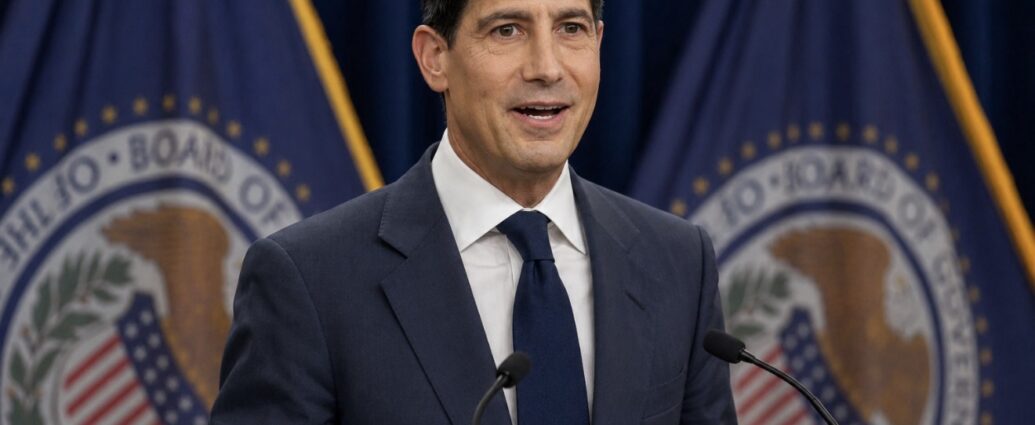
Ordinarily the outcome is settled well before the committee sits down. Officials give speeches, reporters get guided, and the market prices the result to near certainty. That machinery has been dismantled. Chairman Kevin Warsh, confirmed in May, has made a deliberate policy of saying less — no forward guidance, and at the June meeting he declined to submit economic projections of his own. The result is that a decision affecting every business loan, credit line, and mortgage in the country now rests on reading one man who has stopped offering material to read.
Two weeks ago the picture looked settled toward a hold. June inflation came in cooler than expected, which pushed the argument over a possible increase out to September. Then the U.S.-Iran ceasefire collapsed, energy prices jumped, and traders started pricing a July move partly because other traders were. Crude is up roughly 20% over the course of July even after this week’s pullback, with West Texas Intermediate sliding about 8% Monday to just over $82 a barrel and Brent down 9.5% to roughly $87.50 as fighting paused for a third consecutive night. As of Tuesday, bond traders put the odds of a hold at about 68% and a hike at about 32%.
Three things are worth watching Wednesday afternoon.
The vote. If the committee holds, the dissents matter more than the decision. At the June meeting, roughly half of the eighteen policymakers who submitted projections indicated support for raising rates before the end of the year — Warsh was not among the submitters. A dissent or two against a hold would confirm that a real faction inside the committee wants to move. Previous chairmen defused those situations by adjusting the language of the statement or hinting that action was coming at the next meeting. Warsh has said he wants to retire those tools. Without them, internal disagreement has fewer places to hide.
The reasoning. If the Fed does raise, the explanation will drive the market reaction more than the move itself. Framed as an answer to five years of inflation running above the 2% target, it reads as the first of a series, and long-term yields could actually fall on the view that the central bank is finally serious. Framed as a one-time response to an oil shock, it signals almost nothing about what comes next. There is a further complication: Warsh has said the Fed can do little in the short run about supply shocks like energy, and has argued that the artificial-intelligence buildout may eventually push prices down on its own. Neither argument builds an obvious case for tightening right now.
The politics. The White House spent much of the past year arguing that rates were too high and inflation was contained. A hike delivered by the president’s own nominee would say the opposite in the plainest possible terms, and would end any suggestion that the chairman is taking direction from the administration. That is precisely why some analysts believe a move would be more about establishing independence than about the June data — and why others think it would be a mistake. New York Fed President John Williams, vice chair of the rate-setting committee, made the counterargument earlier this month: credibility built over decades is maintained by making the best decision the data supports, not by using monetary policy to demonstrate resolve.
For business owners in the tri-state area, the practical stakes are narrower than the drama suggests. A quarter-point either way does not change a payroll. But the pattern does. Small firms have absorbed two years of tariff costs, and since late February have been paying more for fuel, freight, and marine insurance as a result of the Iran conflict. Operators who lack the margin to carry higher input costs indefinitely need to know whether credit gets more expensive from here or stays put through the fall. A hold with visible dissent tells them tightening is coming and gives them a window to lock in terms. A hike tells them the window already closed.
Warsh will hold a press conference at 2:30 p.m. Whatever the committee decides, the more consequential information is likely to come in that half hour — not from what he announces, but from how much he is willing to explain.
JBizNews Desk | Wall Street
© JBizNews.com All Rights Reserved. Reproduction or distribution without written permission is prohibited.