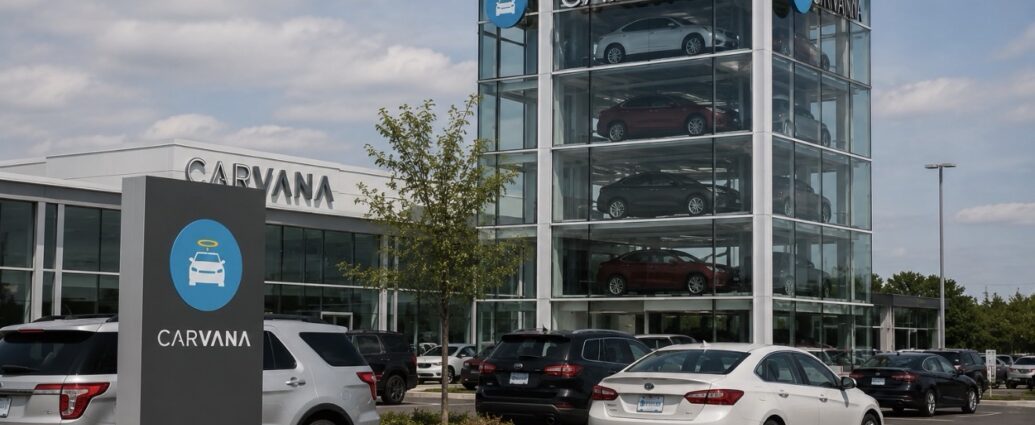
Phoenix retailer posts $7.38 billion quarter and record net income; full-year earnings guidance lands under what the market wanted
Carvana Co. sold 197,325 vehicles in the second quarter, a 38 percent increase over the same period last year, and posted record quarterly net income of $513 million and record adjusted EBITDA of $769 million. The stock fell anyway. Shares dropped 15.9 percent in after-hours trading to roughly $56.
Revenue came in at $7.38 billion, up 52 percent year over year and well above the $6.86 billion analysts had projected. Net income rose $205 million from a year earlier. The company reported a net income margin of 7.0 percent and an adjusted EBITDA margin of 10.4 percent.
What moved the stock
Carvana guided full-year 2026 adjusted EBITDA to a range of $2.7 billion to $3.0 billion, a midpoint of $2.85 billion. Analysts had been modeling closer to $2.99 billion. Some forecasts ran considerably higher — Deutsche Bank at $3.0 billion to $3.2 billion, Morgan Stanley at $4.45 billion.
The second issue was margin direction. Operating margin came in at 9.2 percent, down from 10.6 percent in the same quarter a year ago. Gross profit per unit declined even as volume rose. Carvana is selling substantially more cars and earning somewhat less on each one.
The full-year outlook still represents a sizable increase over the $2.24 billion the company delivered in 2025. The reaction reflects how much growth was already priced in rather than a deterioration in the business.
The volume story is real
Retail units sold rose by 54,045 vehicles from the year-ago quarter. Revenue per unit came in around $37,380, up 10.7 percent — meaning Carvana is moving both more cars and more expensive cars.
Chief Executive Ernie Garcia called it the company’s tenth consecutive quarter of industry-leading growth and profitability, crediting the decade of foundation-building that preceded it. In a letter to shareholders, the company reiterated its target of three million cars a year and a 13.5 percent adjusted EBITDA margin sometime between 2030 and 2035.
Carvana expects retail units sold to increase again in the third quarter compared with the second.
For context on the trajectory: Carvana closed 2025 with 596,641 retail units and $20.3 billion in revenue for the full year. At the current quarterly run rate the company is on pace to clear 750,000 units this year.
What it signals about the used-car market
Carvana’s numbers are the cleanest read available on used-vehicle demand, and they say demand held up through the spring. Volume up 38 percent with average selling prices up nearly 11 percent is not the profile of a consumer pulling back on big-ticket purchases.
But the per-unit profit compression is worth noting for dealers across the tri-state area. When the largest online player is buying inventory aggressively enough to grow units 38 percent, it bids up acquisition costs at auction for everyone else. Independent lots and franchise used departments competing for the same wholesale supply face that pressure directly, and Carvana’s own thinning margin per car suggests the acquisition side is where the squeeze is showing.
The company’s model depends on continued used-car demand, stable vehicle pricing and efficient inventory turnover. Tariff-related trade uncertainty, interest rate sensitivity and shifts in consumer spending all bear on future results, as does the company’s substantial debt load.
That last item is the one to watch. Carvana carries meaningful leverage from its earlier expansion and its 2023 debt restructuring. Rising volume services that debt comfortably; a used-car pricing correction would not.
The bigger read
There is a pattern forming across this earnings week. Companies are delivering on the operating numbers and getting punished on the forward look. Meta beat on revenue and fell 11 percent. Carvana beat on revenue and earnings and fell 15 percent. In both cases the guidance, not the quarter, was the trigger.
For business owners tracking the consumer, the useful signal from Carvana is not the stock move — it is that Americans bought 197,000 used cars from a single online retailer in three months at an average of more than $37,000 apiece. Whatever the market thinks of the guidance, that is a consumer still willing to finance a substantial purchase.
Management was scheduled to discuss the results with investors on a call Wednesday evening.
JBizNews Desk | Phoenix
© JBizNews.com All Rights Reserved. Reproduction or distribution without written permission is prohibited.