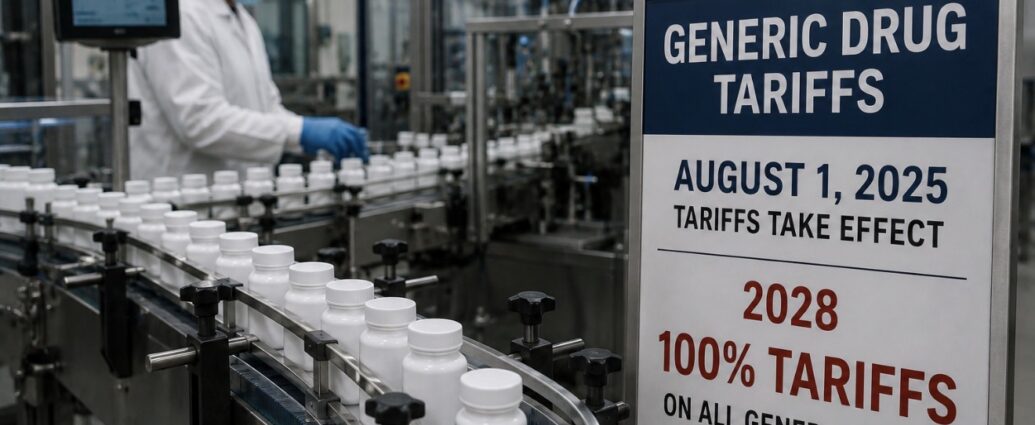
Two-year runway to reshore production begins Saturday; generics account for 90% of U.S. prescriptions, and more than half come from India
The two-year transition period before tariffs hit imported generic medicines begins Saturday, August 1, under a timeline President Trump announced last week — the first specific schedule the administration has set for a category of drugs it had previously exempted.
In a Truth Social post on Tuesday, July 21, Trump said imported generic drugs would carry a zero percent tariff during a two-year transition starting August 1, 2026, then face a 100 percent rate for one year beginning in August 2028, rising to 200 percent thereafter. He described the duties as a penalty for companies that decline to build plant and equipment in the United States within the allotted time, and provided no detail on how that penalty would be assessed.
A White House official told Politico the administration intends to use Section 232 of the Trade Expansion Act of 1962, following a Commerce Department investigation that found pharmaceutical imports threaten to impair national security. No official policy implementing the tariffs has been released.
How much of the medicine cabinet this covers
Generic medications account for 90 percent of prescriptions filled in the United States, according to the Food and Drug Administration. These are the antibiotics, painkillers and cholesterol drugs most Americans actually take, manufactured with the same active ingredients as brand-name products at a fraction of the cost.
The supply chain is concentrated abroad. India now supplies more than 50 percent of the generic prescriptions filled in the U.S., according to a 2025 report by the Senate Committee on Aging. The U.S. also depends heavily on China, which provides 95 percent of imported ibuprofen, 70 percent of acetaminophen and as much as 45 percent of penicillin imports, per figures from the Coalition for a Prosperous America.
The branded tariffs are already landing
The generics timeline sits on top of a policy already in motion. Trump signed an executive order on April 2 imposing a 100 percent Section 232 tariff on patented pharmaceuticals and their ingredients, effective in 120 days for large companies and 180 days for smaller ones. Manufacturers with approved plans to open U.S. facilities face 20 percent instead. Drugs from the European Union, Japan, South Korea, Switzerland and Liechtenstein face 15 percent, with a lower unspecified rate for the United Kingdom under a separate agreement.
Branded drugs become subject to rates as high as 100 percent at the end of this month. Trump said that branded policy remains unchanged.
More than a dozen major drugmakers, including Eli Lilly, Pfizer and Novo Nordisk, have struck deals with the administration to lower prices on new and existing medicines under its most-favored-nation policy, which ties U.S. prices to cheaper prices abroad and exempts those companies from tariffs for three years.
Whether two years is enough
That is the central question, and the answer from people who build pharmaceutical plants is not encouraging. Constructing and validating new U.S. manufacturing capacity typically takes considerably longer than the two-year runway on offer, which leaves the announcement adding uncertainty to an industry already running on thin margins and sets up 2028 as a pivotal year for drug affordability and supply chain stability.
The Association for Accessible Medicines, which represents generic drugmakers, said it needs to understand the specifics and urged the administration to address existing barriers to expanding domestic production. Public Citizen, which filed comments in the Commerce investigation, said reducing overreliance on a few sources is a legitimate goal but that the administration has not supplied the detail needed to evaluate the plan.
What the industry numbers already show
The generics business was under pressure before any tariff took effect. Teva Pharmaceutical Industries, one of the largest suppliers of generic medicines to the American market, reported Wednesday that its U.S. revenue fell 5 percent year over year to $1.70 billion, with the overall decline driven mainly by lower generic revenue, primarily generic Revlimid.
Teva’s response has been to move upmarket. Its three key branded products grew a combined 43 percent year over year in local currency, clearing $1 billion in the quarter, and its biosimilars portfolio is tracking toward $800 million in revenue by 2027. That is a company reallocating toward higher-margin products, which is a rational answer to margin pressure — and it does not add domestic generic capacity.
What tri-state employers should do now
For any business that self-insures or funds a health plan, the exposure is straightforward. Generic drugs are the cheap component of pharmacy spend, and a tariff on 90 percent of prescriptions filled would work through to plan costs. Two years is enough time to build that scenario into multi-year benefit projections, and it should be built in — quietly, before renewal season, rather than in 2028.
Pharmacies and independent drug retailers should be reading the same clock on the inventory and sourcing side. Distributors will move first, and terms will tighten before duties do.
The legal path is not settled
Legislation introduced this year, the Congressional Trade Powers Reform Act of 2026, would require the president to obtain congressional approval for tariffs imposed under Section 301, Section 201 and Section 232 — the authority invoked here — and would eliminate the Section 122 and Section 338 authorities entirely.
Two years of runway is also two years of litigation and legislation. The clock that starts Saturday is the administration’s; whether it runs to 2028 is a separate question.
JBizNews Desk | Washington, D.C.
© JBizNews.com All Rights Reserved. Reproduction or distribution without written permission is prohibited.