
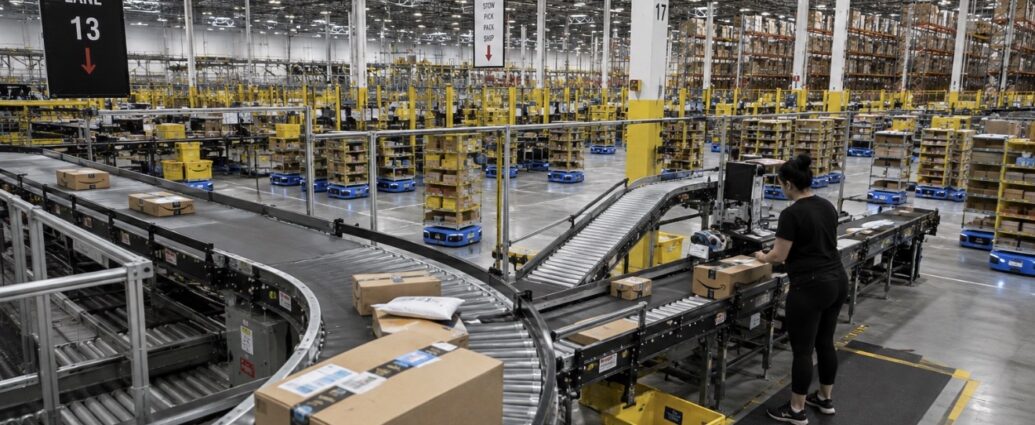
The U.S. industrial real estate boom is entering a new phase. After years of racing to build more warehouses, developers and tenants are increasingly investing in facilities that move products faster rather than simply storing more of them.
The shift reflects a broader change in supply chains. Companies are no longer measuring success by how much inventory they can hold. They are measuring how quickly goods move from factories to consumers while minimizing labor, transportation costs and delivery times.
That evolution is changing what businesses demand from industrial real estate.
Distribution centers built only a few years ago are already being redesigned with higher ceilings, expanded robotics, automated picking systems, artificial intelligence, advanced conveyor networks and greater electrical capacity. Warehouses are becoming technology hubs rather than storage buildings.
The economics explain why.
Labor remains one of the largest operating expenses inside modern distribution facilities. Automation allows companies to process more orders with fewer workers while improving speed and accuracy. As same-day and next-day delivery become competitive expectations, efficiency inside the warehouse increasingly determines profitability outside it.
Location is changing as well.
Companies continue seeking sites closer to major population centers, ports, rail hubs and interstate highways. Proximity reduces transportation costs, shortens delivery windows and lowers the inventory businesses must carry. In many cases, logistics efficiency is becoming more valuable than lower real estate costs farther from customers.
The ripple effects extend throughout the economy.
Industrial developers are constructing facilities with significantly greater power requirements to support automation and robotics. Electrical equipment manufacturers, warehouse technology providers, conveyor manufacturers, robotics companies and software developers are all benefiting as logistics becomes increasingly automated.
Transportation companies are adapting alongside them.
Rather than operating as separate businesses, trucking firms, railroads, ports, warehouses and technology providers are becoming more integrated. Real-time inventory tracking, predictive demand forecasting and automated fulfillment are creating supply chains that function as coordinated networks instead of independent facilities.
For investors, the opportunity extends beyond industrial real estate.
Companies supplying warehouse automation, industrial software, robotics, sensors, barcode systems, packaging equipment and logistics technology are increasingly tied to the same long-term investment cycle. The next generation of warehouse spending may create as much demand for technology as it does for concrete and steel.
The broader business story is that logistics has become a competitive advantage rather than a support function.
Businesses once competed by manufacturing products more cheaply. Increasingly, they compete by delivering products more efficiently. As supply chains continue evolving, the most valuable warehouse may not be the largest one—it may be the one capable of moving inventory through its doors faster than anyone else.
That shift is quietly redefining one of the fastest-growing segments of the American economy.
JBizNews Desk | New York
© JBizNews.com All Rights Reserved.
Reproduction or distribution without written permission is prohibited.




