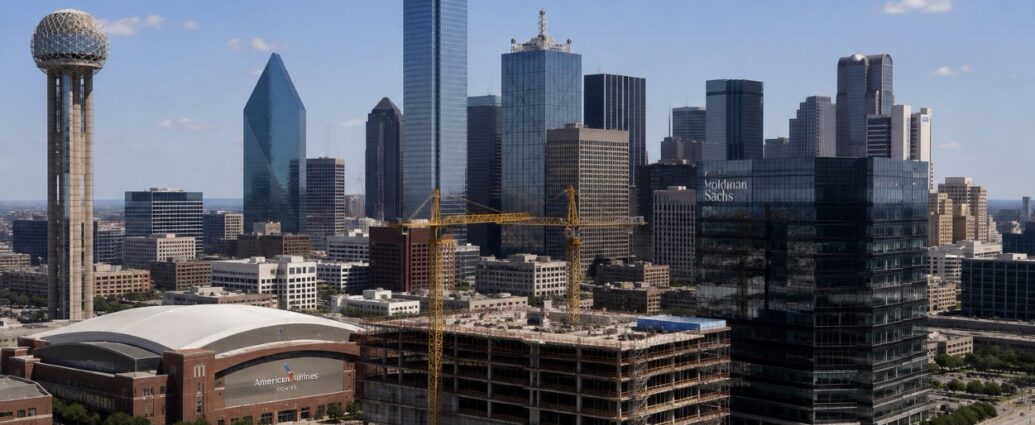
Goldman Sachs is spending roughly $700 million on a Dallas campus that will become its largest office in the country outside Manhattan, the clearest physical marker yet of a financial buildout that Texas officials are betting can pull real business away from New York.
The 800,000-square-foot complex, still under construction on a site ringed by highways, office towers and a sports arena, is slated to open in 2028 with room to eventually employ more than 5,000 workers. Local officials and the bankers they have recruited have taken to calling the district “Y’all Street.”
Aasem Khalil, the Goldman partner who runs the Dallas office, describes the campus as sitting at the center of that district and notes that JPMorgan Chase and Morgan Stanley — both New York-headquartered — either have Dallas offices or are weighing them. Khalil, a lifelong New Yorker, relocated for the firm a decade ago.
The economics behind the move are straightforward, and they have shifted. Wall Street firms have staffed offices outside New York for decades to hold down costs on back-office functions; Goldman first opened in Dallas in 1968. What has changed is the client base. Banks now have reason to place senior producers in Texas because the companies and wealthy families they want to serve are moving there. Texas holds more Fortune 500 headquarters than any other state, ahead of both California and New York, and it is the fastest-growing state in the country, with North Texas on pace to hit 9 million residents next year.
For New York, the honest read is that this is expansion rather than exodus. Khalil called the region’s growth the natural evolution of the industry and said he does not see it as zero-sum. Goldman is not pulling back from New York, and most other firms adding Texas capacity are doing so alongside their existing operations rather than in place of them.
The competitive pressure is real anyway, and it now has an institution attached to it. The Texas Stock Exchange marked the completion of its full production trading rollout with a bell ceremony at its Dallas headquarters on July 31, capping a phased launch of all national market system symbols on its platform. The exchange built a custom order-matching engine in 18 months and opened with more than 50 member firms, the widest day-one participation for an exchange launch in fifty years. Its backers raised $275 million, which the exchange says is the largest sum ever assembled to start a national exchange.
The Dallas-based venture is the first major new American stock exchange in decades and is aiming squarely at corporate listings currently held by the New York Stock Exchange and Nasdaq. Its investors include BlackRock, Goldman Sachs and Charles Schwab. Corporate listings are slated to begin later this year, with initial public offerings starting in 2027. The exchange frames its market as the “Boom Belt” — Texas and the broader South — which it pegs at $8.9 trillion in annualized output, larger than any national economy other than the United States itself.
Chairman and Chief Executive James H. Lee has framed the effort as reversing a long decline in the number of American public companies by lowering the cost of going and staying public, saying real competition for U.S. corporate listings has finally arrived.
Its permanent home will be the Bank of America Tower in Uptown Dallas, set to be the tallest building in that submarket when finished, housing executive offices, a broadcast studio and a Texas business museum. Both the New York Stock Exchange and Nasdaq have already opened their own Texas operations to accommodate dual listings.
That last detail is the tell. The incumbent exchanges did not wait to see whether the Texas challenge would materialize; they planted flags there themselves.
For business owners in the tri-state area, the practical consequences run in a few directions. Companies weighing where to place regional operations now have a credible capital-markets ecosystem in Dallas rather than just cheaper square footage. Firms considering a public listing in 2027 or later will have a third venue competing for their business, which tends to press listing fees downward regardless of which exchange wins. And commercial landlords in Manhattan face a leasing market where the marginal expansion decision by a major bank increasingly lands in Texas.
Ray Perryman, who heads the Waco-based research firm The Perryman Group, argues that geography still matters even in an electronic market, because investors tend to trade the companies nearest them — and Texas has both a fast-growing investor base and the Fortune 500 headquarters to supply the listings.
Whether that translates into New York losing ground or simply sharing it is the open question. The construction cranes in Dallas are not waiting for the answer.
JBizNews Desk | Dallas
© JBizNews.com All Rights Reserved.
Reproduction or distribution without written permission is prohibited.