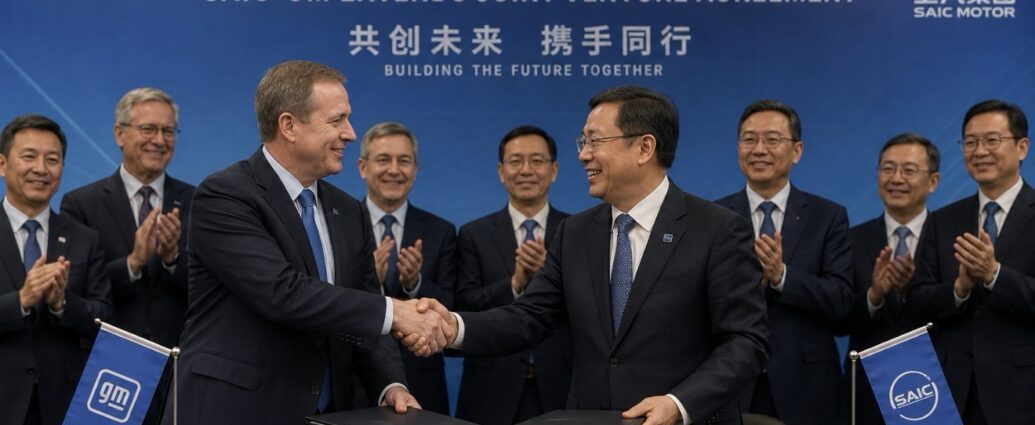
General Motors has renewed its Chinese joint venture with SAIC Motor for another two decades, announcing the extension Tuesday night for a partnership that had been set to expire next year. The Detroit automaker signed the deal a full year ahead of schedule, carrying the 50-50 arrangement first struck in 1997 through 2047. GM did not disclose the financial terms.
The timing is the story as much as the substance. The extension lands amid heightened friction between Washington and Beijing, including proposals in the United States to bar Chinese brands and vehicles from the domestic market. GM is committing to another twenty years inside China at the same moment American policymakers are working to shut Chinese automakers out of the United States — a split-screen that captures how differently the two governments and the companies caught between them are reading the relationship.
For GM, the calculation is straightforward arithmetic. China is the automaker’s second-largest market behind the United States and the largest auto market in the world. Walking away would mean surrendering a business the company spent nearly thirty years building. The joint venture has delivered more than 20 million vehicles since its founding, and at its peak the China operation contributed as much as $2 billion a year to GM’s bottom line and stood as the company’s largest market for more than a decade.
That peak is well behind it. GM sold roughly 3.9 million vehicles in China in 2016. Last year the figure was 1.9 million — a 51% collapse from the high-water mark, driven by the rise of domestic rivals such as BYD and a rapid consumer shift toward electric vehicles that legacy Western brands were slow to meet. The response was a lengthy restructuring that included plant closures and the elimination of several models, carrying more than $5 billion in charges.
The renewal comes because that surgery appears to have worked. The China operation returned to profitability, posting $248 million in equity income during the first half of 2026. It is a fraction of what China once delivered to Detroit, but it is black ink, and it was enough to justify a twenty-year commitment.
The venture that emerges looks materially different from the one being replaced. GM will concentrate on Cadillac and Buick inside China and stop selling the Chevrolet brand there. The terms also let GM use China as an export hub, shipping Buicks and Cadillacs to the Middle East, Africa, South America, Mexico and other Asian markets. Those vehicles are pointedly not bound for American dealerships.
More vehicle development work moves to China under the deal, aligning products with local consumer preferences — an acknowledgment that the era of exporting American-designed cars to Chinese buyers is finished. Both companies retain 50% ownership, continue jointly developing models through design and engineering operations based in China, and continue splitting profits.
On the product side, the venture plans to launch at least 30 electric or hybrid models by 2030, led by the locally developed Buick Electra sub-brand. GM pointed to the Electra brand’s Xiao Yao architecture as a source of competitive advantage in the market.John Roth, GM senior vice president and president of GM China, said the agreement reflects shared confidence in the venture and its long-term potential, adding that the company sees real opportunity to compete in select international markets including the Middle East, Africa, South America, Mexico and Asia-Pacific.
GM is not alone in this bet. Honda and Volkswagen have made similar moves to renew Chinese partnerships despite steep losses in market share and profitability there, and Volkswagen extended its own SAIC venture through 2040 in late 2024. Others, notably Stellantis, have exited their Chinese joint ventures entirely.
The headwinds have not disappeared. China’s auto sector remains locked in a prolonged price war with significant oversupply, leaving gasoline-vehicle plants underutilized. SAIC has moved to fixed pricing on certain models, including the Cadillac CT5 sedan, to stabilize competition and rein in heavy dealer discounting.GM maintains a second joint venture with SAIC and Guangxi Automobile Group, known as SGMW, which carries no end date and was not part of this week’s announcement.
For American manufacturers watching from the sidelines, the deal is a case study in what staying in China now requires: local development, local brands, local supply chains, and an export strategy routed around rather than through the United States. GM has decided that arrangement is worth twenty more years. Whether Washington ultimately allows it to remain that clean is the open question.
JBizNews Desk | Detroit
© JBizNews.com All Rights Reserved. Reproduction or distribution without written permission is prohibited.