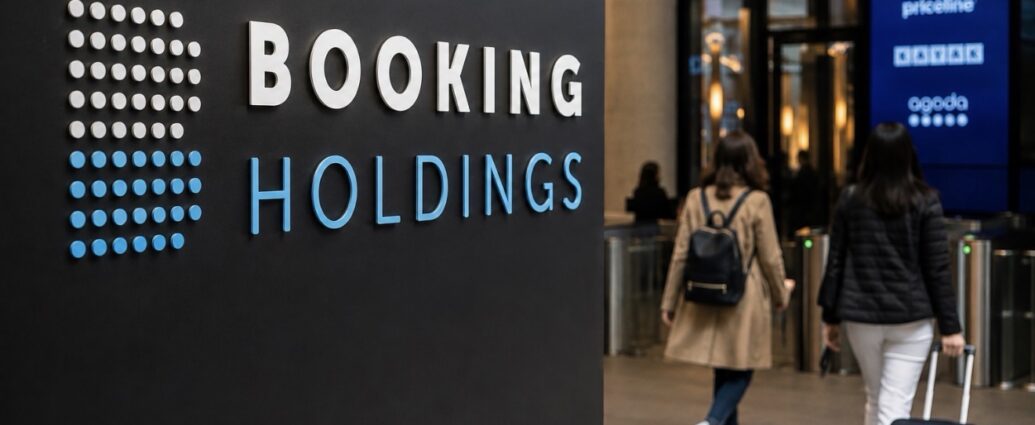
Booking Holdings told investors this week that elevated airfares and thinned-out flight schedules will keep weighing on international travel through the third quarter, even as the online travel giant beat expectations across every major line of its second-quarter results.
The Norwalk, Connecticut company said its outlook assumes the indirect effects of the Middle East conflict — higher flight ticket prices, reduced flight capacity on certain routes, and softer long-haul international demand — will persist through the current quarter. It continues to expect pressure on inbound travel to the region, while demand from travelers booking within the Middle East has largely returned to normal.
Chief Executive Glenn Fogel said travel demand held up remarkably well even with airfares and capacity constraints pressing on long-haul routes, and the numbers back that up — the drag is showing up in where people go, not whether they go.
The Quarter Itself Was Strong
Adjusted earnings came in at $2.54 a share against consensus near $2.43 to $2.45, with revenue up 8.1% year over year to $7.35 billion, ahead of the $7.19 billion analysts expected. Adjusted EBITDA reached roughly $2.6 billion, a 9% increase, and adjusted earnings per share climbed 15%, helped by buybacks that pulled the share count down 6%.
Shareholders got the largest quarterly return in company history. Booking sent back $4.1 billion in the quarter, including $3.7 billion in repurchases, bringing first-half buybacks to $7.4 billion. The board also declared a quarterly dividend of $0.42 a share, payable September 30 to holders of record on September 11, with $14.5 billion still authorized for repurchases as of June 30.
Management raised the target for annual savings from its transformation program to $650 million from $550 million, with most of the additional $100 million expected to land in 2027.
Domestic Holds, International Sags
The split in the results is the real story for anyone watching consumer travel spending.
Domestic room nights grew at high-single-digit rates worldwide, while international room nights rose only slightly under continued pressure on long-haul trips. The U.S. market posted high-single-digit growth; Europe, Asia and the rest of the world each grew at mid-single-digit rates.
That is a familiar pattern when airfares spike. Travelers do not cancel the trip — they shorten the flight. Weekend drives, regional hops and domestic hotel stays absorb demand that would otherwise have gone transatlantic or transpacific.
Booking trimmed its full-year gross bookings outlook, attributing the change mainly to weaker growth in flight ticket sales. For the full year, the company still projects gross bookings, revenue and adjusted EBITDA to grow at high-single-digit rates on a reported basis, with adjusted earnings per share rising in the low-to-mid-teens. On a constant-currency basis, management said the outlook matches its original plan despite months of conflict-related disruption.
Fares May Not Come Back Down
The airfare pressure Booking is describing is not solely a war-driven phenomenon, and that matters for how long the drag lasts.
Carriers are still flying tighter schedules than before the pandemic in some markets — fewer routes, reduced frequency, and in certain cases aircraft or staffing limits — while leaning harder on dynamic pricing that adjusts fares in real time. Airlines are also releasing fewer discounted seats and holding the lowest fare classes for shorter windows, so the cheap inventory sells out faster.
The structural shift runs deeper still. Delta has told investors that cheaper fuel will not necessarily translate into cheaper tickets, citing premium demand, tighter capacity and shrinking budget competition. Ultra-low-cost carriers have pulled roughly 30% of their capacity out of the industry, leaving fewer inexpensive seats and giving the largest airlines room to hold fares where they are.
For Booking, that means the headwind may outlast the conflict that triggered it.
AI in the Cost Line
One bright spot came from the company’s technology spending. Booking reported a double-digit reduction in customer service cost per booking from its AI initiatives, along with improved developer productivity, while customer satisfaction scores held up. Management also flagged ongoing search-engine pressure across consumer internet as a headwind to direct traffic, though it represents a small share of overall room nights.
The company’s mobile app share reached the high 50% range on a trailing twelve-month basis, up from the mid-50s a year earlier.
Shares traded around $194 this week, within a 52-week range of $150.14 to $231.80.
JBizNews Desk | New York
© JBizNews.com All Rights Reserved. Reproduction or distribution without written permission is prohibited.