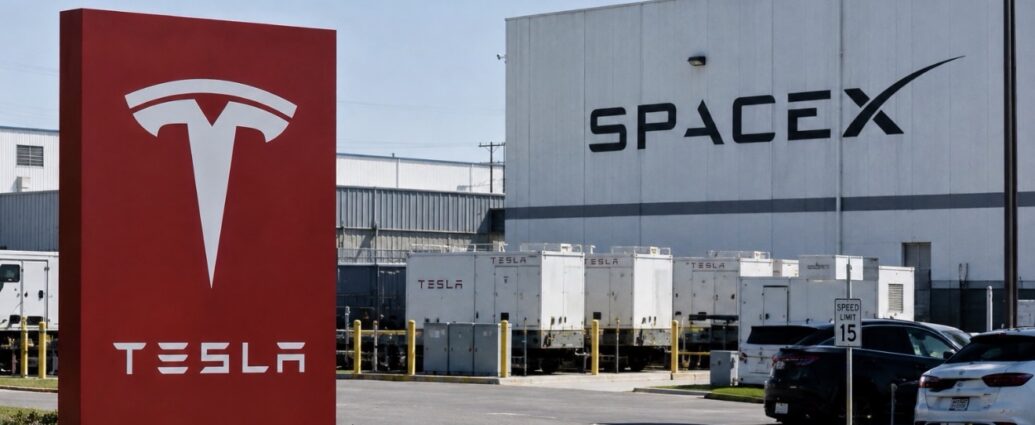
An artificial intelligence data center does not draw electricity in a steady stream. It gulps. When thousands of chips start a training run at the same instant, demand spikes; when the run pauses, it collapses. Those swings can trip generators and trigger penalty charges from the local utility. The fix SpaceX is buying is a wall of industrial batteries that sits between the grid and the computers, absorbing power when the machines ease off and releasing it the moment they surge — and it is buying those batteries from Tesla.SpaceX spent $295 million on Tesla Megapack battery units in the second quarter, bringing its total for the year to $329 million, according to the company’s latest earnings filing. First-quarter purchases had come to just $34 million, meaning procurement accelerated sharply over the spring.The batteries are going into the Colossus data centers in the Greater Memphis area.
Elon Musk is chief executive and largest shareholder of SpaceX while also running Tesla, and his AI venture xAI merged into SpaceX earlier this year, after xAI itself acquired the social platform X in 2025. That corporate reshuffling is why a rocket company is now one of Tesla’s larger energy customers.
The relationship predates the merger. xAI had already bought $430 million worth of Megapacks for its facilities before becoming part of SpaceX — which means the appetite for storage did not appear out of nowhere when the two companies combined. It simply moved onto a bigger balance sheet.
What the hardware actually does
Megapacks are built for utility-scale and commercial installations, and Tesla’s newer Megablock design bundles four Megapacks around a single transformer. They use lithium-ion cells and are marketed as blackout insurance, storing energy from any source — gas, solar, wind — and releasing it on demand. Each unit holds up to 3.9 megawatt-hours and can discharge up to 1.9 megawatts.
For a facility packed with high-performance chips, the units do two jobs at once. They deliver near-instant backup if the outside supply fails, and they smooth the demand curve of training and running AI models, flattening the spikes that would otherwise strain the local utility or overwhelm on-site generators — lowering operating costs while keeping performance steady.
The Memphis power problem
The battery purchases sit alongside a messier power story on the ground. At the Colossus and Colossus 2 sites in Greater Memphis, the company has also installed and operated dozens of natural gas-burning turbines to generate its own electricity. Emissions and noise from those turbines have drawn an uproar from residents and helped feed a broader national backlash against data center developers. Reporting on the filing noted that the turbine fleet has included unpermitted units at a Mississippi location near the Colossus campus.
Batteries do not replace generation — they only shift it in time. But they reduce how often the loudest, dirtiest equipment has to fire up to catch a momentary spike, which is one reason storage has become standard equipment on new AI campuses rather than an optional extra.
A related-party arrangement
Musk’s automaker and his aerospace venture have a long track record of transactions with one another, sharing resources and personnel. The Megapack orders are the largest recent example, but not the only one: the same filing disclosed $131 million spent on Tesla Cybertrucks at retail price as of December 2025.
For Tesla, the orders land in the part of the business investors have been watching most closely. Energy storage has become the company’s fastest-growing segment, and a captive buyer building out AI capacity is a reliable source of volume. It is also a competitive market. Rival makers of grid-scale storage systems include China’s Sungrow, BYD and CATL, Korea’s LG, and Fluence in the United States, according to research from Wood Mackenzie.
The takeaway for American business
The numbers point to something broader than one company’s shopping list. Power availability has become the binding constraint on AI expansion — arguably more binding than chip supply, since a data center with computers and no firm electricity is an expensive warehouse. Companies that can secure generation, storage and grid interconnection are the ones able to build.
That is opening a substantial domestic manufacturing opportunity in batteries, transformers, turbines and switchgear, and it is putting pressure on utilities and regulators to move faster on interconnection queues. It is also producing real friction in the communities that host these campuses, as Memphis is demonstrating. Both trends are likely to intensify through the rest of the year.
JBizNews Desk | New York
© JBizNews.com All Rights Reserved. Reproduction or distribution without written permission is prohibited.