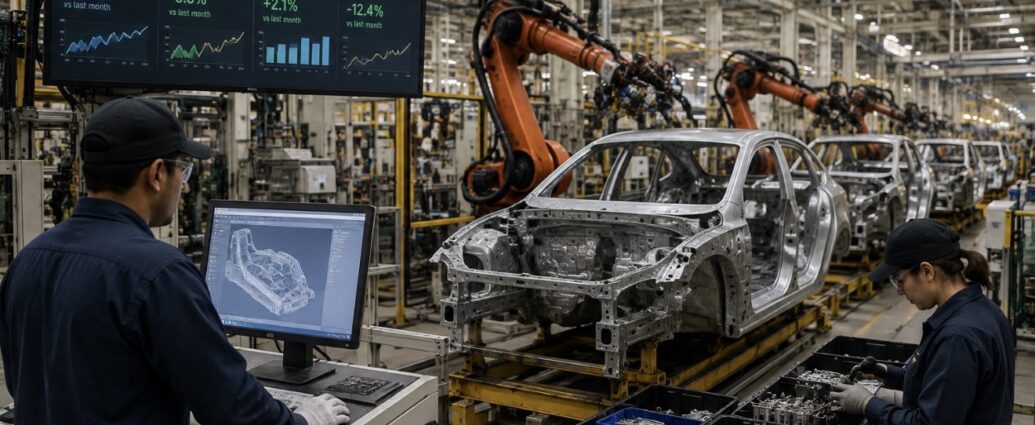
U.S. businesses became more productive in the second quarter while labor costs rose more slowly than expected, a combination that could help companies protect margins without adding workers at the pace normally associated with economic growth.
Nonfarm business productivity increased at a 1.4% annualized rate from April through June, the Labor Department reported Thursday, more than double the 0.6% economists had expected. Productivity was 2.2% higher than a year earlier, extending a broader improvement that has accelerated as companies invest in automation, software and artificial intelligence.
The significance is in the cost side of the report. Unit labor costs rose just 1.3% during the quarter, below the 2.1% economists expected, while hourly compensation increased 2.7%. Businesses were therefore able to pay workers more without seeing labor costs rise at the same rate because each hour of work produced more output.
For employers, higher productivity is one of the few ways to improve margins without raising prices, cutting wages or reducing headcount.
The numbers help explain a labor market that has become unusually resistant to layoffs even as hiring slows. Companies are producing more with their existing staffs, reducing the need to add workers aggressively while also giving employers less reason to cut experienced employees.
Initial unemployment claims reinforced that picture Thursday. New claims rose by just 1,000 to 199,000 last week, remaining at historically low levels even as job openings and hiring have cooled.
Artificial intelligence may be starting to play a role, although economists cannot yet isolate how much of the productivity improvement comes directly from AI. Businesses have spent heavily on software, data centers and automation with the expectation that workers can eventually produce more without equivalent increases in labor hours.
The benefit is not flowing evenly to employees. Labor compensation accounted for 52.9% of nominal output in the second quarter, down from 53.7% in the first quarter and the lowest share in the government series dating to 1947. A growing portion of the gains from higher productivity is therefore accruing to companies and investors rather than being immediately reflected in worker compensation.
For the Federal Reserve, stronger productivity is potentially important because it allows wages and economic output to grow without automatically creating the same inflation pressure. But it does not eliminate the problem: nonlabor costs, including energy, equipment and other inputs, remain elevated.
The larger business question is whether companies can continue producing more with roughly the same workforce. If they can, the U.S. economy could keep expanding even with slower hiring — but workers may increasingly find that economic growth no longer translates directly into more job openings.
JBizNews Desk | Washington
© JBizNews.com All Rights Reserved.
Reproduction or distribution without written permission is prohibited.