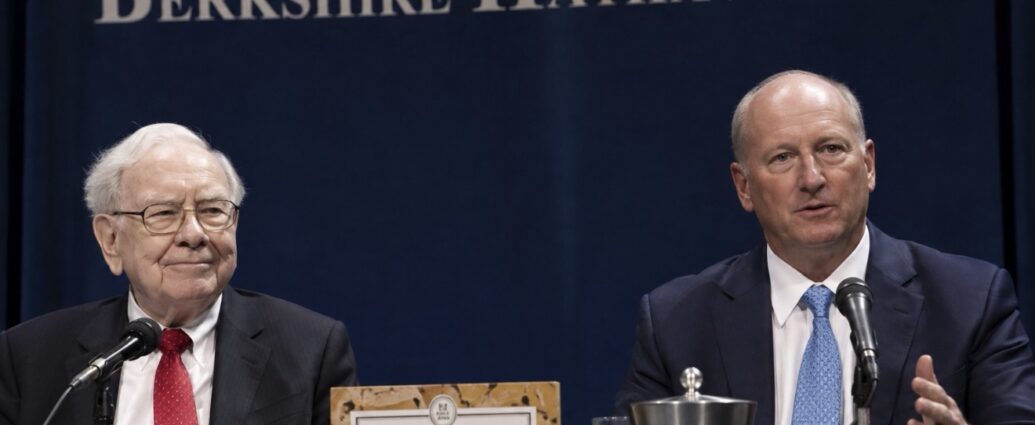
Berkshire Hathaway’s second-quarter report shows the clearest shift yet under Greg Abel: the company’s enormous cash pile is finally moving.
Berkshire ended June with $365.5 billion in cash and Treasury holdings, down from nearly $400 billion at the end of March. That roughly $34 billion drop marks the first meaningful drawdown of the mountain of money Warren Buffett spent years building while refusing to chase expensive deals.
Abel, who took over as chief executive in January after Buffett stepped back from day-to-day leadership, deployed the money across stocks, buybacks and acquisitions.
Berkshire bought roughly $10 billion of Alphabet shares, making Google’s parent one of the conglomerate’s largest holdings. Net stock purchases across the portfolio totaled about $19.8 billion for the quarter.
The company also spent roughly $4.5 billion repurchasing its own shares, its biggest quarterly buyback in five years.
That figure matters because Berkshire does not run a conventional buyback program. It only repurchases shares when management believes the stock is trading below the company’s intrinsic value, and it does not commit to spending a fixed amount.
Abel had said in March that Berkshire had resumed buying back its own stock after more than two years on the sidelines, but first-quarter repurchases totaled only about $234 million.
The second quarter showed a much bigger commitment.
Most of the repurchases took place in June.
Investors still do not know everything Berkshire bought. The quarterly filing indicates the company added more than $21 billion of commercial, industrial and other stocks, but the full list will not be disclosed until a separate portfolio filing later this month.
Profit More Than Doubles
Berkshire reported net income of $25.67 billion, or $17,868 per Class A share, more than double the $12.37 billion earned a year earlier.
That number, however, is heavily influenced by movements in Berkshire’s massive stock portfolio.
Accounting rules require the company to include unrealized investment gains and losses in reported earnings, which can cause large quarterly swings even when Berkshire’s operating businesses have changed little.
The year-earlier quarter also included a $3.8 billion writedown tied to Berkshire’s Kraft investment.
Operating earnings provide a cleaner view of how the businesses themselves performed.
By that measure, Berkshire earned $12.98 billion, up from $11.16 billion a year earlier.
Manufacturing, service and retail businesses generated $4.47 billion in earnings, up from $3.60 billion.
BNSF Railway earned $1.56 billion, compared with $1.47 billion a year earlier. Fuel costs rose sharply, but stronger volumes and improved operating efficiency helped offset the increase.
Berkshire Hathaway Energy earned $891 million, up from $702 million. Retail electricity demand increased 3.1%, including gains at MidAmerican Energy and NV Energy.
GEICO Becomes the Weak Spot
Insurance was the biggest drag on the quarter.
Underwriting earnings across Berkshire’s insurance operations fell 13.1% to $1.73 billion, while insurance investment income declined to $3.06 billion from $3.37 billion.
The sharpest deterioration came at GEICO.
Pre-tax underwriting profit fell 45.4% to $994 million from $1.82 billion a year earlier.
GEICO’s combined ratio — a key measure of claims and expenses against premiums collected — worsened 7.7 percentage points to 91.2%.
The reason was simple: more claims, and more expensive claims.
Bodily-injury claim frequency rose roughly 5% to 7% in the first half of the year, while the average cost of those claims increased about 10% to 12%.
In practical terms, GEICO is seeing both more accidents and higher settlement costs.
Foreign-exchange movements also helped Berkshire’s year-over-year comparison. The company recorded $326 million in currency gains during the quarter versus $877 million in losses a year earlier.
Berkshire Is Spending Again
The more important story may be what is happening to Berkshire’s balance sheet.
For years, Buffett accumulated cash while repeatedly saying he could not find enough large investments at prices he liked.
That pattern is now changing.
Berkshire has also moved billions into acquisitions, including OxyChem and homebuilder Taylor Morrison.
The Taylor Morrison transaction closed July 24 for roughly $6.8 billion in cash.
Even after the stock purchases, buybacks and acquisitions, Berkshire still holds $365.5 billion in cash and short-term investments.
The cash pile remains enormous.
But for the first time in years, the defining story at Berkshire is no longer how much money it refuses to spend.
Under Abel, it is how quickly some of that money is beginning to move.
JBizNews Desk | Omaha, Nebraska
© JBizNews.com All Rights Reserved. Reproduction or distribution without written permission is prohibited.