
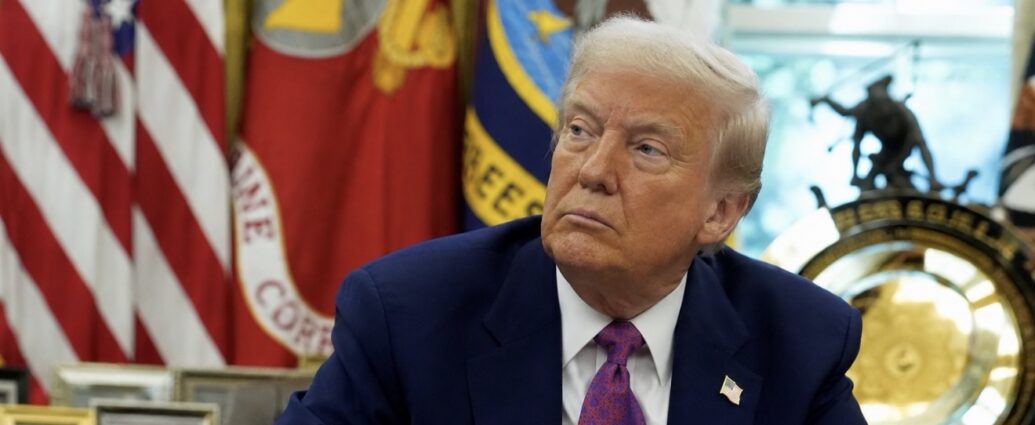
President Trump has decided to stop bombing Iran and start starving it of money instead. He said Sunday that Washington will let its naval blockade and sanctions do the work of forcing Tehran to a deal, rather than launching another round of airstrikes. Traders read that as a signal the war is not ending soon — and on Monday oil jumped roughly 5%.
“We are just watching Iran with its huge inflation and the fact they have no money,” Trump said in an interview with Axios, adding that the blockade is deepening Tehran’s financial problems. “We are low keying it.” He also said the United States is “only semi-negotiating” with Iran over the Strait of Hormuz — a step back from his statement last week that the two sides were in talks.
The market reaction was immediate. West Texas Intermediate settled at $82.13 a barrel, up about 5%, and Brent crude finished around 5% higher at $87.72. That erases most of last week’s slide, when both benchmarks fell more than 7% after Treasury Secretary Scott Bessent told CNBC that an agreement to reopen Hormuz to free ship movement could come soon. No agreement has been announced, and both capitals have hardened their positions since.
The strategy Trump is returning to is the one he ran in his first term and revived in February 2025: cut off Iran’s oil sales, lock it out of the international banking system, and wait. What is different now is the blockade. A US naval cordon in place since April has stopped all crude exports from Kharg Island, Iran’s main oil terminal, with no tanker departures recorded for 11 straight days. Central Command said it has turned away 55 commercial vessels, disabled two and boarded two others.
The pressure is landing. Iran’s exchange rate has weakened nearly 50-fold since 2018, food prices are up more than 34-fold, and roughly 16 million people have dropped below the poverty line. The country also shed about 630,000 industrial jobs between the spring of 2025 and the spring of 2026, erasing eight years of employment gains. Inflation ran above 48% last October and above 42% in December.
Whether that pain translates into Iranian concessions is the open question, and so far the answer has been no. Foreign Minister Abbas Araghchi said Tehran is not holding direct talks with Washington and repeated that reopening Hormuz requires the US to lift the blockade and pay compensation for war damage. A senior Iranian security official said the waterway stays closed until those conditions are met, and Tehran also wants sanctions relief. In a further sign Tehran intends to hold out, Mohsen Rezaee — a former Revolutionary Guard commander who has argued for full Iranian control of the strait — was elevated to the country’s top security post.
For American businesses and drivers, the cost of the standoff is measured at the pump and in freight bills. Gasoline nationally is close to $4 a gallon and has risen more than 30% since the war began, which started with US and Israeli strikes on February 28. One estimate puts the additional fuel cost to the average American household at about $527 as of August 4, projected to reach roughly $650 by the end of summer.
The cushion the country has been leaning on is thinning. Crude held in the Strategic Petroleum Reserve has fallen below 300 million barrels, the lowest level since January 1983. Before the war, roughly a fifth of the world’s oil and natural gas moved through Hormuz, and the market has avoided a worse squeeze mainly because Chinese demand has been soft and emergency reserves have been released — buffers that are now close to exhausted.
Regional violence is keeping a floor under prices regardless of what happens in negotiations. A tanker operated by Abu Dhabi National Oil Co. was attacked near the strait over the weekend, and European diesel prices spiked after a strike on a Saudi refinery near the Red Sea. Houthi forces claimed responsibility for the attack on the Jizan facility. One forecast has Brent staying volatile in an $80-to-$90 range unless something breaks the current standoff.
That is the practical meaning of “low keying it” for American companies: fuel, freight and insurance costs stay where they are, and the calendar for relief is set in Tehran, not Washington.
JBizNews Desk | New York
© JBizNews.com All Rights Reserved. Reproduction or distribution without written permission is prohibited.




