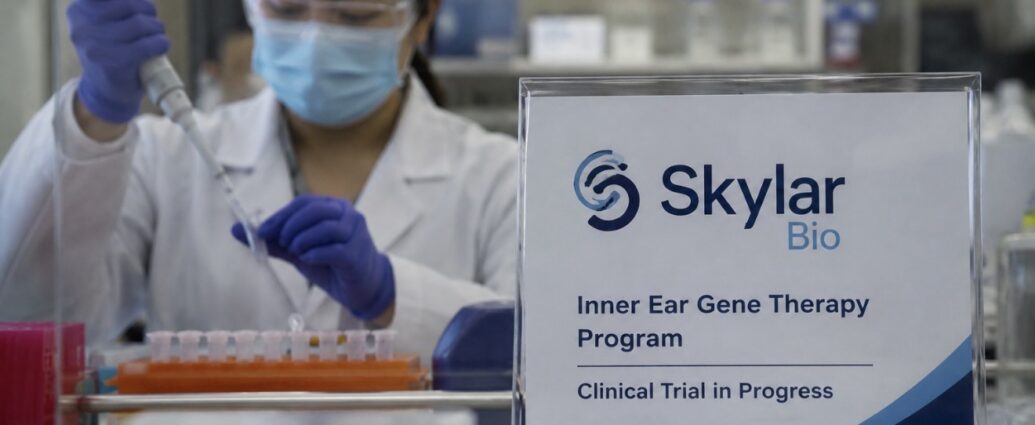
A Cambridge, Massachusetts biotech has put an experimental gene therapy into a deaf child’s inner ear for the first time, aiming at the single most common genetic cause of deafness in the world.
Skylark Bio came out of stealth Tuesday to announce it has dosed the first patient in its trial of SKY-GJB2, a one-time treatment for children born deaf because of mutations in the GJB2 gene.
Here is what the mutation does. The GJB2 gene tells the body how to build a protein called connexin 26, which sits between cells in the inner ear and lets them pass signals to one another. When the gene is broken, the protein does not work, and sound never gets converted into a signal the brain can use. Mutations in GJB2 are the most common cause of inherited, non-syndromic hearing loss worldwide, and the resulting deafness is usually present at birth.
The therapy is an attempt to fix that at the source. SKY-GJB2 uses an engineered adeno-associated virus to carry a working copy of the GJB2 gene directly into the affected cells of the inner ear, treating the genetic cause rather than compensating for it the way a cochlear implant does. In the trial, called SONIX, each child receives a single infusion into one ear through a purpose-built one-time-use device, the SKY-CAT.
The trial
SONIX is enrolling ten children: six between nine months and two years old, and four between two and seven. Participants must carry two pathogenic variants in GJB2 and have hearing loss of at least 85 decibels in the treated ear. The primary focus is safety of both the therapy and the delivery device, with hearing improvement measured alongside it.
The company is small and recently capitalized. Skylark has raised about $40.9 million across a single round, and is led by chief executive Jodi A. Cook, with Shawn Harriman as chief scientific officer. In June it signed a manufacturing and development partnership with Forge Biologics to produce the AAV vector under cGMP conditions for the clinical program. A second program, SKY-PEN, targets SLC26A4-related hearing loss, or Pendred syndrome, and the company says it also has an undisclosed central nervous system program.
Why the market opened up
None of this would be happening on this timeline without what Regeneron proved in April. The FDA granted accelerated approval to Otarmeni, the first gene therapy ever approved for genetic hearing loss, based on a trial in which 80% of participants hit the primary hearing endpoint and 42% reached normal hearing with longer follow-up. Otarmeni treats a different mutation — in the OTOF gene — an ultra-rare condition affecting roughly 50 newborns a year in the United States. The therapy came to Regeneron through its 2023 acquisition of Decibel Therapeutics.
Regeneron’s commercial decision is the part the industry is still digesting. The company is providing Otarmeni at no cost to clinically eligible U.S. patients, though out-of-pocket costs for the administration procedure can vary. That came bundled with an agreement with the U.S. government to tie current and future drug prices to those in other developed countries. For a rare-disease population of 50 births a year, giving the product away was a defensible trade. GJB2 is a different arithmetic. Skylark describes it as affecting tens of thousands of patients — a population large enough that pricing will be a real commercial question rather than a goodwill gesture.
A three-country race
Skylark is not running alone. France’s Sensorion raised €60 million in January, including a €20 million strategic investment from Sanofi, specifically to push its GJB2 candidate SENS-601 toward regulatory clearance and first-cohort enrollment, with cash runway extended into the first half of 2027. Chinese groups are pursuing the same target. Being first into humans, which Skylark now is, matters for the obvious reason in biotech: the first credible efficacy data sets the terms for everyone else’s financing.
Skylark’s chief executive indicated at a scientific conference in May that early data would arrive by the end of this year. That is the date to watch. A safe dose in one child proves very little on its own; the question is whether a child who has never heard anything begins to respond to sound, and whether that holds.
For investors in the hearing space, the sequence is now established: an approval that showed regulators will clear these therapies, a manufacturing base being built out, and a much larger patient population entering the clinic behind it.
JBizNews Desk | Boston
© JBizNews.com All Rights Reserved. Reproduction or distribution without written permission is prohibited.