President Trump signed an executive order Monday directing that the measles, mumps and rubella vaccine be given as three separate shots — a product that does not exist in the United States, has not been manufactured here in more than fifteen years, and that the company making the combined version says it sees no reason to build.
Merck discontinued its standalone measles, mumps and rubella vaccines — Attenuvax, Mumpsvax and Meruvax II — in 2008, and told the CDC’s Advisory Committee on Immunization Practices in 2009 that it would not resume production. That was a demand decision rather than a safety judgment: the advisory committee had settled on combination shots, and the single-antigen versions had virtually no market. Reviving them is not a matter of restarting a line — manufacturers would need new clinical trials, reconfigured facilities and three separate FDA approvals.
Merck said its combined vaccine is supported by decades of clinical and real-world evidence, and that separating the shots could result in delayed or missed immunizations. GSK also makes an MMR vaccine, and splitting the product would be expensive and complicated for both companies.
The order conditions the MMR provision on such products becoming domestically available and gives the Department of Health and Human Services 90 days to present plans for offering single vaccines, including by working with the private sector and other countries. The instruction to spread immunizations across separate visits is qualified with language about doing so to the maximum extent feasible.
The order also recommends removing seven vaccines from the childhood schedule except for certain high-risk groups, narrowing it to shots covering 11 diseases. The administration signaled it will press states to rewrite their vaccine requirements to match the new federal guidance.
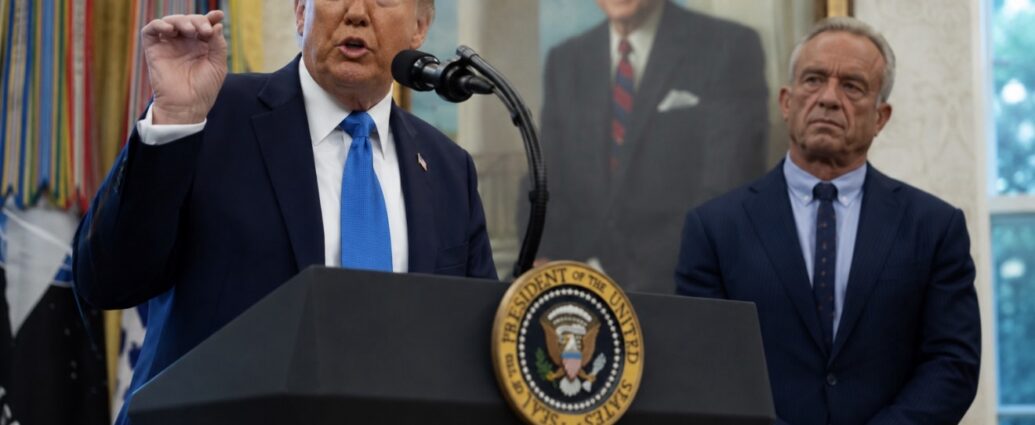
The document itself never uses the word autism; that connection came from Trump’s spoken remarks at the signing rather than the text. Speaking from the Oval Office flanked by health officials including HHS Secretary Robert F. Kennedy Jr., Trump said the administration was reducing the number of shots and spacing them across more visits, and suggested at one point that the MMR shot can be “quite lethal.” The CDC’s own guidance states there is no published scientific evidence showing any benefit to separating the combination MMR into three individual shots, and that receiving the vaccine is much safer than contracting the diseases. Two doses are 97% effective at preventing measles, according to the agency.
The pushback came from the president’s own party as well as the medical establishment. Senator Bill Cassidy, the Louisiana Republican who chairs the Senate Health Committee and is a physician, said breaking up vaccines would mean children need more shots for the same protection, not fewer, and would increase hesitancy. Cassidy cast the deciding vote to confirm Kennedy, saying at the time that Kennedy had promised not to change the childhood schedule. The American College of Physicians called the order part of a pattern of attempting to change vaccine guidance unilaterally rather than through transparent scientific review. American Academy of Pediatrics President Andrew Racine said the order does nothing to support families of children with autism.
This is not the administration’s first attempt. Under Kennedy, the CDC already cut shots covering six of 17 diseases from the schedule, only to have the move blocked in federal court, and at least 28 states have refused to accept the changes and are holding to the earlier recommendations. The judicial stay came in March. The AAP has continued publishing its own schedule, and the American Academy of Family Physicians issued 2026 schedules in March aligned with it.
The commercial stakes reach well past Merck. Manufacturers with meaningful exposure to routine childhood immunization revenue include Pfizer, Moderna, BioNTech, GSK, Sanofi and Merck. Sanofi is among the largest U.S. childhood vaccine suppliers through its DTaP combination products, and its shares were already down 11.2% year to date before the order; Moderna fell 4.28% on the session when Bloomberg first reported the order was under consideration on Aug. 6. The near-term risk for these companies is less about mandates than uptake — public confidence drives volume, and a fragmented schedule requiring more appointments historically produces lower completion rates.
The timing is what makes the disease math uncomfortable. The CDC counted 2,371 confirmed measles cases through July 30 across 34 outbreaks, already exceeding all of 2025 and making this the worst measles year in more than three decades, with Utah’s outbreak topping 500 cases. A national verification committee is reviewing U.S. measles elimination status this month, and the Pan American Health Organization is scheduled to rule in November on whether the country still qualifies as free of endemic transmission — a designation held since 2000.
For parents, there is unlikely to be an immediate change in vaccine access, and the order is expected to draw legal challenges.
JBizNews Desk | Washington
© JBizNews.com All Rights Reserved. Reproduction or distribution without written permission is prohibited.