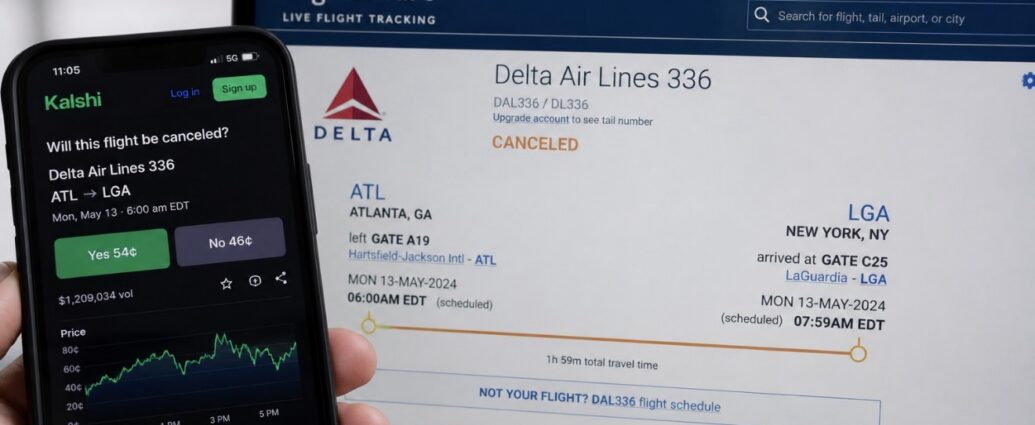
The company whose data tells millions of travelers whether their flight is canceled says it never agreed to let that number settle wagers — and it is asking a federal judge to shut the market down.
FlightAware sued Kalshi and three related companies on Aug. 10 in the U.S. District Court for the Southern District of New York, case number 1:26-cv-06824. The complaint alleges breach of contract, trademark infringement under the Lanham Act, and unfair competition. FlightAware is seeking a temporary restraining order along with preliminary and permanent injunctions barring Kalshi from activities involving the flight tracker, plus unspecified damages and a jury trial.
The dispute turns on how a prediction market gets settled. Every contract needs an agreed source of truth to determine who won. Kalshi launched aviation markets in July letting customers wager on cancellations nationwide and at specific airports, and according to the complaint, those pages named FlightAware the “Primary Source Agency,” displayed its trademark, linked to its website and told traders outcomes were verified from FlightAware. A contract covering U.S. flight cancellations for the week ending Aug. 14 was still live on Kalshi’s site carrying that language when Reuters checked.
FlightAware says it did not learn about the markets until reporters began covering them. Its terms of service specifically bar using its data for commercial or gambling purposes, and Kalshi had accepted those terms when it opened an account. The complaint says Kalshi created a free AeroAPI account, violated the license terms, ignored a cease-and-desist letter, and kept referencing the data for settlement even after adding a disclaimer saying the markets were not endorsed.
Kalshi rejected the allegations that it broke licensing rules or infringed trademarks, arguing its references amounted to nominative fair use. A spokesperson called FlightAware’s objection unfounded because the information is in the public domain. Kalshi has identified U.S. Department of Transportation flight data as an alternative settlement source, and says it has never operated, sponsored or promoted a market letting customers wager on whether individual flights will be delayed or canceled. It has not yet filed a response.
Underneath the contract fight is the argument that made these markets controversial in the first place. FlightAware wrote that there was widespread concern the markets would incentivize unsafe tactics to influence cancellations, threatening public safety and creating potential for major disruption of air travel, and that customers immediately assumed FlightAware was part of it. The complaint raises the mirror-image risk as well: contracts betting a flight leaves on time could give airline or airport workers a reason to rush and cut corners. Kalshi had actually suspended the flight-cancellation listings on July 16, days before trading was to begin, after social media users warned bad actors could disrupt flights to profit, and after FlightAware objected. The contracts covered airport-wide cancellations, with insiders including TSA agents, airport officials and union officials barred from trading.
The legal question is narrower than the safety debate, and that is what makes it consequential for the industry. FlightAware’s case tests whether a prediction market can use a third party’s data and trademark to settle contracts without a commercial agreement — a question that touches every exchange settling wagers on data it does not own. Kalshi has been here before: the NCAA asked it in February to stop using NCAA trademarks in March Madness markets, saying it had not authorized the use.
The suit lands on a company already fighting on several fronts. Kalshi is the largest prediction market in the country, valued at $22 billion in a funding round in May. New York sued at the end of July alleging Kalshi offers sports and event wagers in the state without a gaming license, with similar actions in Wisconsin and Nevada. Courts in Washington and Michigan have moved to stop its sports event contracts, while a Minnesota judge allowed Kalshi and Polymarket to keep operating while litigation proceeds.
Prediction markets have grown rapidly since the 2024 presidential election, when they outperformed pollsters, and now carry contracts spanning sports, elections and geopolitical events. Their rules prohibit insider trading, though the markets have already shown considerable potential for manipulation.
For data companies, the case is a reminder that a licensing term-sheet is now a business asset. Real-time operational data — flight status, weather, delivery tracking, sports statistics — has a second market forming around it, and the suppliers are discovering they may be in it without knowing.
JBizNews Desk | New York
© JBizNews.com All Rights Reserved. Reproduction or distribution without written permission is prohibited.