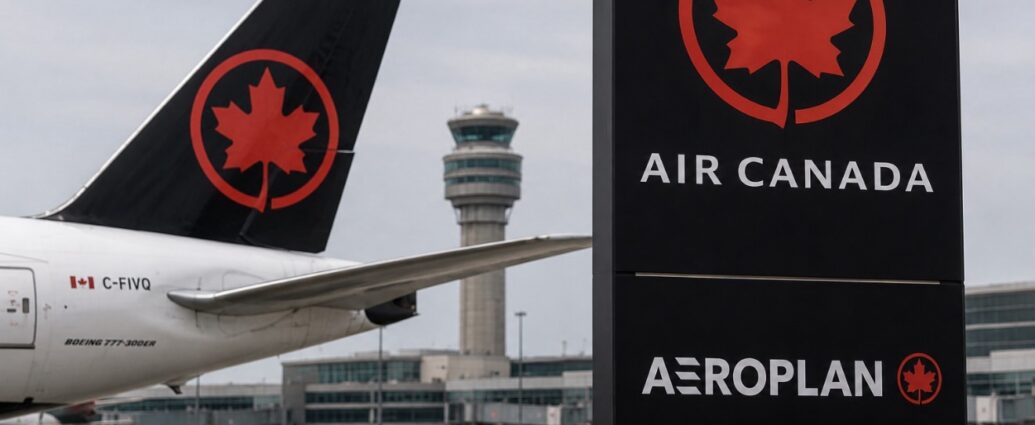
Air Canada sold a quarter of its frequent flyer program on Tuesday, and it did not give up control of anything. An investor group led by Blackstone and La Caisse is paying C$2.5 billion — roughly US$1.8 billion — for a 25 percent non-controlling stake in Aeroplan Inc., a price that values the loyalty program at C$10 billion. Air Canada keeps 75 percent and continues to run Aeroplan’s strategy, operations and day-to-day management.
The reason a points program commands that kind of money has little to do with flying. Airlines sell miles in bulk to banks, hotel chains and retailers, which then hand them out to cardholders and customers. The airline collects cash the moment the points are sold and only delivers a seat later, if the member ever redeems. It is steady, high-margin revenue that does not move with jet fuel or booking cycles — which is exactly what makes it attractive to a buyer like Blackstone and exactly what makes it useful collateral for an airline that needs money.
Aeroplan has more than 10 million active members and lets them earn or redeem across more than 50 airline partners. Alongside Blackstone and La Caisse, the Québec pension manager formerly known as Caisse de dépôt et placement du Québec, the group includes PSP Investments and British Columbia Investment Management Corporation. Settlement is scheduled for August 17.
The cash has a job waiting for it. Air Canada will use the proceeds to repay a US$1.2 billion bond coming due — about C$1.7 billion — cutting gross debt without drawing down its cash balance, with most of the remainder going toward accelerated share buybacks. The airline said it intends to launch a substantial issuer bid for up to C$800 million of its shares, priced through a modified Dutch auction after the Aeroplan settlement and targeted for completion in September.
The structure matters as much as the price. Air Canada holds the right to buy the stake back between the fifth and eighth anniversaries of settlement, at a price set by a formula that delivers the investors a 6.5 percent internal rate of return net of all distributions. Air Canada will keep consolidating Aeroplan in its financial statements, with the outside stake carried as a non-controlling interest in shareholders’ equity. In plain terms, this looks less like selling a business and more like borrowing against one: the airline takes cash today, the investors take a defined return and a slice of distributions, and Air Canada has a marked path to buying the whole program back.
Chief Financial Officer John Di Bert said the deal unlocks value from Aeroplan while the airline retains operational control, and tied it to Air Canada’s pursuit of an investment grade credit rating. Mark Rutledge, a senior managing director at Blackstone, pointed to the firm’s long-running commitment to investing in Canada. Blackstone, the largest alternative asset manager in the world, oversees more than US$1.3 trillion in assets.
Investors had already moved on the news before it was official. Air Canada shares climbed to their highest level since July 2021 after Bloomberg reported Monday that Blackstone was closing in on a minority interest, and Bank of Nova Scotia analyst Konark Gupta upgraded the stock to sector outperform, arguing the price implied a far richer value for the loyalty business than the market had been assigning it.
Air Canada has been down this road before, in the other direction. Aeroplan was separated from the airline after its 2003 bankruptcy protection filing, went public in 2005, and later became Aimia. The relationship soured, and in 2017 Air Canada announced it would not renew its agreement and would build a competing program — sending Aimia’s stock down 63 percent in a single day. Air Canada then led a consortium with TD, CIBC and Visa to buy the program back for $450 million in cash plus the assumption of roughly $1.9 billion in Aeroplan Miles liability. Seven years later, a quarter of that same program is worth C$2.5 billion.
The timing is not accidental. Air Canada reports earnings Wednesday, and Bloomberg Intelligence has projected an 85 percent year-over-year drop in adjusted net profit, with the carrier squeezed by jet fuel prices driven higher by the war in Iran. An airline heading into a weak quarter with a large bond maturity in front of it has every reason to convert its most durable asset into cash without surrendering it — a playbook U.S. carriers wrote during the pandemic, when Delta, United and American all borrowed billions against their own mileage programs rather than sell equity at the bottom.
BofA Securities, Stikeman Elliott and Deloitte advised Air Canada and Aeroplan; Scotiabank, Kirkland & Ellis and Blake, Cassels & Graydon advised Blackstone. The money lands August 17, the buyback follows in September, and the earnings report arrives Wednesday.
JBizNews Desk | New York
© JBizNews.com All Rights Reserved. Reproduction or distribution without written permission is prohibited.