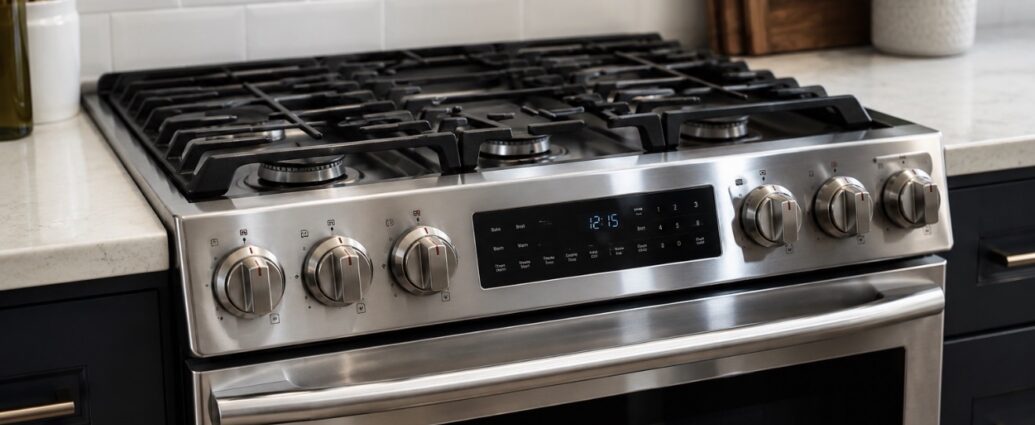
A federal appeals court threw out the Biden administration’s energy efficiency standards for household stoves and ovens on Tuesday, finding that the Energy Department pushed the rules into place without letting the public weigh in first and then refused to pull them back when states objected.
The ruling came from the Fifth U.S. Circuit Court of Appeals in New Orleans, which decided 3-0 in favor of seven Republican-led states — Louisiana, Mississippi, Montana, Nebraska, Tennessee, Texas and Utah — that had challenged the Energy Department’s “direct final rule” for consumer-grade stoves and ovens. The case is State of Mississippi v. Department of Energy.
The dispute is procedural, and the procedure is simple enough to follow. Under the Energy Policy and Conservation Act of 1975, the Energy Department can set efficiency standards for appliances two ways. The ordinary route is to publish a proposal, take public comment, and then finalize it. The shortcut route, called a direct final rule, lets the agency skip advance notice when industry and efficiency groups have already negotiated a consensus standard. That shortcut comes with a condition: the agency must open a 110-day comment window afterward, and if it receives adverse comments that give a reasonable basis to withdraw, it must withdraw the rule within 120 days.
The Energy Department first tried the ordinary route. In 2023 it proposed efficiency standards for cooking appliances that manufacturers argued would function as a ban on gas models, and the proposal never cleared the comment stage. While that rulemaking was pending, manufacturers and efficiency advocates negotiated a revised set of standards and submitted them jointly, and in February 2024 the department issued a direct final rule adopting them for gas and electric stoves. States filed adverse comments during the window that followed. The department concluded that none of them supplied a reasonable basis for withdrawal and let the rule stand.
That, the appeals court said, is where the agency broke the law. Having lost on notice and comment, it went around notice and comment entirely, then treated the after-the-fact comments as a formality rather than the safety valve Congress wrote into the statute. The court held that direct final rules are reserved for genuine consensus regulations, must be withdrawn when objections supply a reasonable basis, and are not final for judicial review until the department follows those requirements.
The consensus claim drew the sharpest language in the opinion. New York, Massachusetts and California had backed the joint statement behind the rule, though they did not formally sign it — and the states that did object were nowhere in it. Judge Andrew Oldham, writing for the panel, noted that the department itself conceded those three states are not a fair cross-section of the country, calling the concession “the understatement of the day.” Oldham also wrote that the department’s reading of the statute made a “mindless hash” of the scheme Congress designed.
For manufacturers and retailers, the practical stakes were never immediate. The regulation would not have taken effect until January 2028, and it was written to cap how much energy kitchen appliances consume and to phase out an older component technology known as linear power supplies. Appliance makers had spent two years designing product roadmaps around a standard they helped negotiate. Those roadmaps now sit on a rule that no longer exists, which cuts both ways: the compliance cost and retooling schedule come off the table, and so does the certainty companies had been planning against.
For consumers, the near-term effect is that the model mix on showroom floors in 2028 will not be narrowed by this rule. Gas ranges that would have been squeezed out under the negotiated thresholds remain available, and the ban on linear power supplies — a low-cost part still used in basic appliance electronics — does not take effect.
The court did not rule that the Energy Department lacks authority to set efficiency standards for cooking products. It sent the matter back to the agency to proceed consistent with the opinion, which leaves the department free to restart the process the conventional way, with a published proposal, a real comment period, and a response to what comes in. Whether it does is a different question. The department is now run under an administration that has spent the past 18 months rolling back appliance efficiency mandates rather than writing new ones, and nothing in the ruling obligates it to try again.
Louisiana Attorney General Liz Murrill, whose office was among the challengers, welcomed the decision, saying the regulations would have left home appliances costlier and less useful for consumers. The Energy Department did not comment on the ruling.
JBizNews Desk | New Orleans
© JBizNews.com All Rights Reserved. Reproduction or distribution without written permission is prohibited.