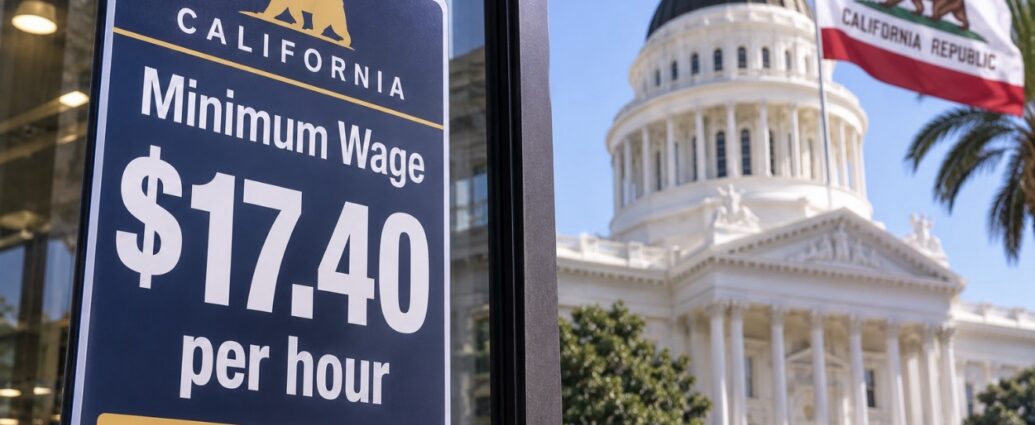
California’s statewide minimum wage climbs to $17.40 an hour on Jan. 1, 2027, a 50-cent increase from the current $16.90, under an adjustment Gov. Gavin Newsom’s office announced on July 31.
No vote was required. The increase happens automatically under California law, which resets the statewide minimum each year to track inflation. That mechanism is the part employers should focus on: the rate moves on a formula, not on a legislative fight, so payroll planning has to assume an increase every January whether or not anything is happening in Sacramento.
The number that will cost California employers more money is not the hourly rate. It is the salaried exemption threshold that moves with it. Effective Jan. 1, 2027, an employee classified as exempt under California’s executive, administrative or professional exemptions must generally be paid at least $72,384 a year, or $1,392 a week — up from $70,304 and $1,352 in 2026. California sets that floor at twice the state minimum wage for full-time work, which means every minimum wage increase pulls the salary test up with it. Any manager or professional sitting below the new figure has to be given a raise or reclassified as hourly and paid overtime. Meeting the salary number alone does not make someone exempt; the job duties still have to qualify.
For hourly employers, the more consequential fact is that $17.40 is a floor and not the rate most California businesses actually pay. Many cities and counties have adopted higher local rates — the City of San Diego is at $17.75 an hour, while unincorporated San Diego County follows the state figure. Emeryville raised its rate to $20.34 an hour in July, and 69 local jurisdictions nationally have set minimums above their state rate, according to the Economic Policy Institute. California also runs separate, higher floors for fast-food and many health care workers. A multi-site operator in the state is administering several different wage rates at once, and the state increase resets only the baseline underneath them.
California will not have the highest wage floor in the country when the new rate lands, despite the framing around the announcement. Washington’s minimum wage rose to $18.40 an hour in July from $17.95. The state’s claim is to the highest statewide minimum among the largest states and well above most, but Washington’s indexed rate is currently higher and adjusts annually as well.
The federal minimum wage remains $7.25 an hour, unchanged since 2009 — the longest stretch without an increase since the federal floor was created in 1938. Bureau of Labor Statistics data show about 1 percent of American workers earn that rate, which is the practical reason the federal number functions more as a political marker than a binding constraint in most labor markets. Where it still binds is in states that have not set their own floor, concentrated in the South and parts of the Midwest.
Newsom framed the increase against Washington’s inaction, saying California had chosen a path that rewards work and that “if you work hard, you deserve a decent paycheck.” His office paired the announcement with state economic figures, citing 3.7 percent annualized real GDP growth in the first quarter of 2026 and more than 131,000 jobs added over the past year. The White House did not comment.
Federal proposals have gone nowhere in both directions. Sen. Josh Hawley of Missouri introduced a bill in June 2025 to raise the federal minimum to $15 an hour; it was referred to committee and never advanced. A separate measure introduced in May would lift it to $25 an hour by 2031. Neither has a path. The administration’s argument on hourly pay rests instead on the tax side — the One Big Beautiful Bill Act eliminated federal tax on tips, overtime and Social Security income, with the White House estimating the tip provision is worth roughly $1,300 a year on average and applying retroactively to 2025 wages for an estimated 6 million tipped workers.
For employers operating across state lines, the compliance point is unchanged and often missed: where state and federal minimums both apply, the higher rate governs. In California that has been the state rate for years, and the gap widens again on Jan. 1.
JBizNews Desk | Sacramento
© JBizNews.com All Rights Reserved. Reproduction or distribution without written permission is prohibited.