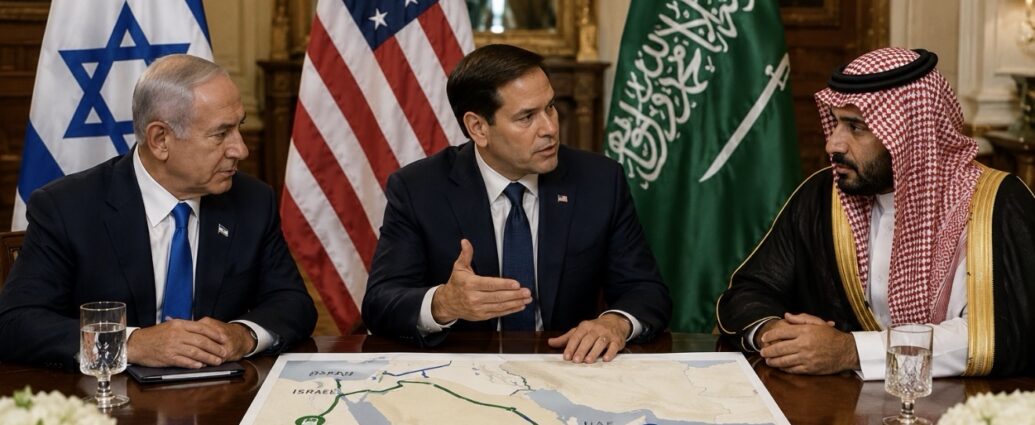
The plan now taking shape across Washington, Jerusalem and Riyadh comes down to a simple piece of geography: build the refineries, ports and pipelines on the far side of the two waterways Iran can shut, so that Gulf oil never has to sail past Iranian guns to reach a buyer.
Those two waterways are the Strait of Hormuz, the single exit from the Persian Gulf, and the Bab el-Mandeb Strait at the mouth of the Red Sea, where Iran-backed Houthi forces in Yemen decide which tankers get through. Since the U.S.-Israeli air campaign against Iran opened on Feb. 28 and Tehran responded by closing Hormuz, both routes have effectively been Iran’s to control. In normal times roughly 20 million barrels of crude, condensate and refined products move through Hormuz every day — about a fifth of global oil consumption and a quarter of all seaborne oil trade — and because the Persian Gulf is an enclosed sea with one exit, producers along its shores cannot simply reroute when that exit is contested.
The first concrete answer is a refinery. MWG Enterprises, a Fort Worth energy development company, has joined with the Patel Family Office and PWS, an affiliate of the long-established Saudi industrial group AHQ, to form MERA Oil, a U.S.-Saudi private consortium now in the final stage of choosing a host country for a $5 billion integrated refinery and energy export corridor. After three years of studying sites around the Gulf, the group has narrowed the field to three locations in Gulf Cooperation Council states positioned outside the Strait of Hormuz, with a preferred host expected to be named before the end of 2026.The complex is designed to refine 200,000 barrels a day, tied to deepwater port berths, large-scale storage for crude and finished fuels, and marine loading facilities
, covering roughly 600 hectares and generating an estimated 3,000 direct and 15,000 indirect jobs. Once the host is confirmed, the project moves into detailed site diligence and engineering, with mechanical completion targeted for late 2029 and commercial operations to follow. The venture was conceived well before the current war — what has changed is that building outside Hormuz has hardened from a hedge into a design specification.
The candidate geography points in one direction. To sit clear of both chokepoints, a site has to front the Gulf of Oman or the Arabian Sea — Fujairah in the United Arab Emirates, or Duqm or Salalah in Oman — where ships load and sail straight into the Indian Ocean with no strait to cross.
That same geography feeds a much larger project Washington has been pushing since the 2023 Group of 20 summit and which stalled once the region went to war: the India–Middle East–Europe Economic Corridor. Its architecture pairs a maritime leg from India’s western ports to the Arabian Peninsula with an overland rail network running north through Saudi Arabia and Jordan to Israel’s Port of Haifa, where short-sea shipping carries goods on to Europe. American planners estimate the corridor could eventually pull roughly 60 percent of container traffic away from Hormuz. The wartime redesign this year anchors the maritime leg in Oman rather than the UAE, so cargo from India comes ashore entirely outside the strait before moving onto the peninsula’s rail grid. Additional links through Egypt and Syria are under discussion, and a bill moving through the U.S. Senate would designate Greece as the corridor’s European entry point.
The more sensitive piece is a pipeline. The concept under discussion would run a crude line overland across the Saudi desert to the Israeli border, where it would tie into the Eilat–Ashkelon pipeline, a 42-inch line laid in 1968 and 1969 to carry oil from the Red Sea to the Mediterranean and bypass the Suez Canal. Israeli Energy Minister Eli Cohen has argued that Gulf producers do not want their export income hostage to Iran or the Houthis, and that an overland route through Israel removes both. Prime Minister Benjamin Netanyahu has publicly backed the idea, framing pipelines running west across the Arabian Peninsula to Israel’s Mediterranean ports as a permanent way around the chokepoints.
The original Eilat–Ashkelon line was built as a joint venture between Israel and Iran under the Shah.
For Washington, the appeal runs past barrels. Infrastructure crossing Saudi and Israeli territory gives American and allied forces a reason and a place to be stationed along it, extends the logic of the Abraham Accords, and shifts control of Gulf energy flows away from Beijing, whose 25-year agreement with Tehran has given China leverage over both straits. It also creates a tripwire: an Iranian strike on a pipeline running through partner territory would be an attack on the alliance itself.
None of it moves a barrel this year. The refinery is a 2029 proposition at the earliest, the corridor needs rail that has not been built, and the pipeline remains a discussion. But the direction is set, and it is the same in every version — permanent infrastructure that makes the Strait of Hormuz optional.
JBizNews Desk | New York
© JBizNews.com All Rights Reserved. Reproduction or distribution without written permission is prohibited.