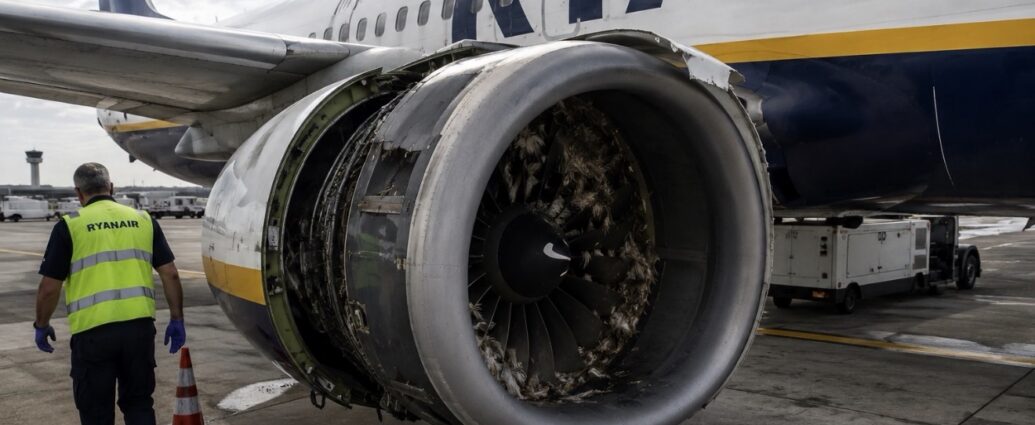
Federal accident investigators said Thursday that they recovered bird remains from the engine of a Ryanair Boeing 737 that lost cabin pressure over Greece last month, after a chunk of that engine tore off in flight and smashed a passenger window with a man sitting next to it.
The finding came in a preliminary report from the National Transportation Safety Board, the independent U.S. agency leading the investigation. Preliminary means exactly that: the agency has laid out what it found, not what caused it. But the discovery points the inquiry toward a scenario the industry has spent eight years and hundreds of millions of dollars trying to design out of the world’s most widely flown jet.
Here is what happened in plain terms. On the morning of July 10, Ryanair Flight 1879 lifted off from Thessaloniki, Greece, bound for Memmingen, Germany. Minutes into the climb, one of the fan blades in the right engine broke off. The blade and the debris behind it were supposed to stay inside the engine casing. They didn’t. Fragments cut into the side of the aircraft in several places and blew out a window in row 11. The passenger in that seat, a 61-year-old Serbian man, was partially pulled through the opening and seriously injured. The cabin lost pressure and the crew turned back for an emergency landing. Of the 155 people aboard, he was the only one hurt.
The bird evidence is what makes the report notable. Investigators found remains, including feathers, on the oil cooler at the front of the engine, on one of the thrust reverser linkages, and at the bottom of the fan case. The material was sent to the Smithsonian Institution’s Feather Identification Lab in Washington, D.C., for analysis. Investigators cautioned that some of what they pulled out was lodged deep inside the engine, and they cannot yet say whether it came from July 10 or from an earlier strike.
That caution matters, because this particular engine had a history. Flight crews reported four suspected bird strikes to the same engine in the 12 months before the accident, and remains were found in two of those cases, though maintenance turned up no damage afterward. The engine, a CFM56-7B built by the joint venture between General Electric of the United States and France’s Safran, had been inspected in May with nothing flagged.
For American readers, the business stakes run through three U.S.-linked names: Boeing, which built the aircraft; GE Aerospace, which is half of the engine venture; and the Federal Aviation Administration, which wrote the rules meant to prevent this outcome. The template is the April 2018 Southwest Airlines accident, in which a fan blade separated on a 737-700, the engine inlet came apart, and a passenger was killed after being partially pulled out a broken window. A similar but non-fatal failure hit another Southwest jet in 2016.
The regulatory response to those two accidents split into two tracks. The first was inspections: repeated ultrasonic and eddy-current checks of fan blade roots, because the fatigue cracks that cause these failures are invisible to the naked eye and can take years to grow. The second was hardware. In March 2025 the agency issued a final rule requiring operators to modify the engine housing on every Boeing 737 NG variant, the 737-800 included, so that a broken blade’s debris stays contained. Airlines were given until July 31, 2028, to finish the work.
Three years of runway on a safety fix is not unusual — the parts have to be manufactured, and jets have to come out of service to receive them. But it means a large share of the global 737 NG fleet is still flying today with the older housing, and the Greek accident is the scenario that retrofit was written to stop.
The fix now moving is on the inspection side. A draft directive published July 31 would expand the fan blade inspection program, adding improved ultrasonic procedures and widening the area of the blade that gets checked, based on updated instructions CFM issued in mid-July. The agency was careful to note that while the Ryanair failure involved this engine model, it has received no information tying that failure to the problem the new inspection rule addresses.Boeing and Ryanair declined to comment Thursday.
A CFM spokesperson said the company is assisting the investigation, and Boeing pointed to the safety board, citing the rules governing crash inquiries. Investigators are still weighing how closely this accident resembles the 2018 Southwest failure, and said that determination remains open.
JBizNews Desk | New York
© JBizNews.com All Rights Reserved. Reproduction or distribution without written permission is prohibited.