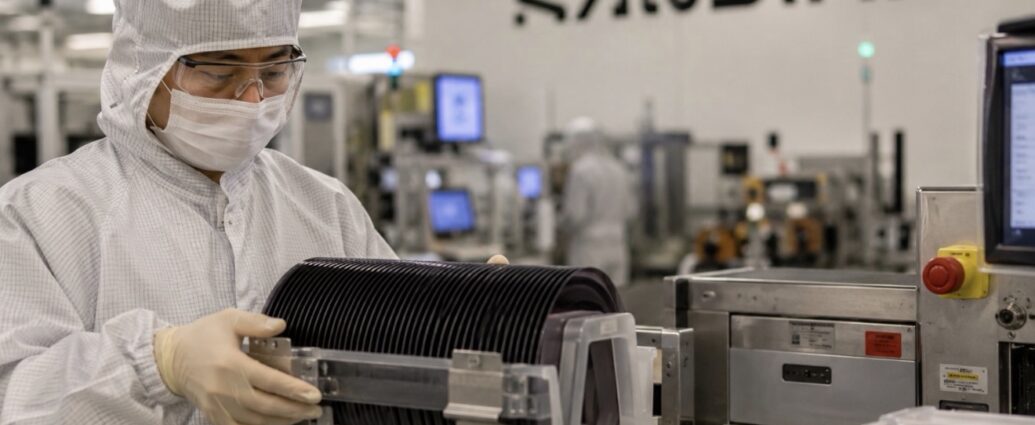
Sandisk’s latest forecast offers one of the clearest signs yet that the artificial-intelligence infrastructure boom is moving far beyond processors and into the storage systems required to keep AI running.
The company expects revenue to grow at a mid-to-high-teens annual rate from fiscal 2028 through 2030, while adjusted gross margins remain around 80%.
The more important number may be how much future production is already spoken for.
Sandisk has signed multi-year agreements with eight large customers, covering roughly 50% of expected memory production in fiscal 2027 and about two-thirds in fiscal 2028. Those agreements average roughly four years, giving the company something memory manufacturers historically lacked: long-term visibility.
That matters because memory has traditionally been one of the semiconductor industry’s most cyclical businesses.
Manufacturers build capacity. Supply eventually outruns demand. Prices fall, margins contract and expansion plans are cut back.
AI is changing that equation.
Large data centers require enormous amounts of NAND flash storage alongside the GPUs doing the actual computing. As Google, Meta, Microsoft, Amazon and other hyperscalers continue expanding AI infrastructure, storage capacity is becoming another potential bottleneck.
The AI trade is therefore broadening.
Nvidia may supply many of the processors, but those chips need servers, networking equipment, power, cooling systems and enormous amounts of storage around them.
Sandisk’s customer agreements suggest large buyers are no longer comfortable waiting until they need additional capacity.
They are reserving it years in advance.
That reduces some of the boom-and-bust risk historically associated with memory producers and gives Sandisk much greater visibility into future demand.
The company also said it intends to return excess cash to shareholders after funding necessary investment, adding another attraction if its unusually high margins prove sustainable.
The same investment cycle is showing up elsewhere in the semiconductor supply chain.
Applied Materials forecast fiscal fourth-quarter revenue of approximately $10.25 billion, above Wall Street expectations, as chipmakers continue spending heavily on equipment needed to manufacture more advanced processors.
The company is also preparing to expand manufacturing capacity enough to potentially double quarterly semiconductor-system output by 2028, with further expansion possible by 2030.
Taken together, the forecasts point to a larger shift.
AI demand is no longer benefiting only the companies designing the most advanced chips.
The spending is moving through the physical infrastructure surrounding them — semiconductor factories, servers, storage, networking, cooling, power generation and data-center construction.
For investors, that creates a much broader AI ecosystem.
For businesses building data centers, it creates a different problem.
The question is increasingly not whether they can afford the equipment.
It is whether enough of it will be available when they need it.
JBizNews Desk | New York
© JBizNews.com All Rights Reserved. Reproduction or distribution without written permission is prohibited.