
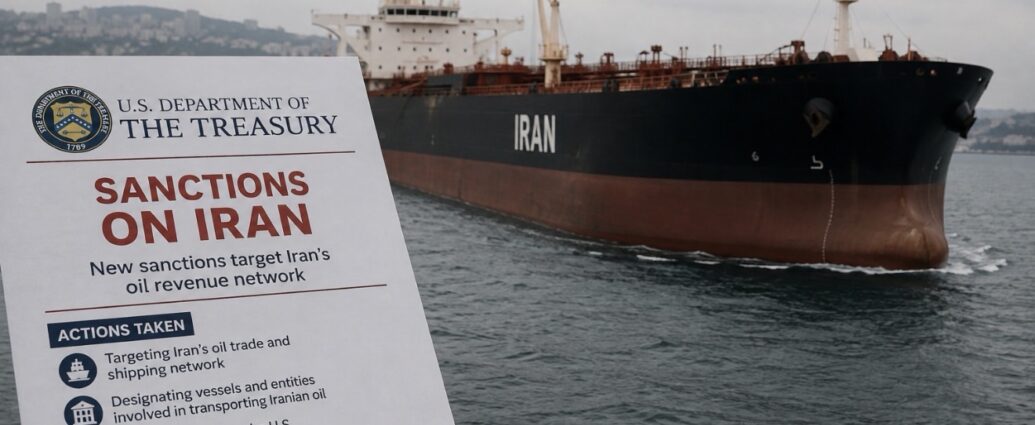
Iran makes its money selling oil. Right now it can barely sell any, because American warships are sitting at the only door out.
Treasury Secretary Scott Bessent said this week the United States is preparing economic measures against Iran “that have never been seen.” He described the plan as “economic isolation like the world has never seen,” combined with the ongoing blockade at the Strait of Hormuz that keeps anything from moving in or out of Iranian ports.
Here is why that hurts. Nearly every barrel Iran sells has to travel through the Strait of Hormuz — a narrow neck of water at the mouth of the Persian Gulf, with Iran on one side. There is no back door. No pipeline that gets around it, no land route big enough to matter. When the U.S. Navy stops ships from reaching Iranian ports, Iran’s main source of income simply stops arriving. And it works the other direction too: the goods Iran needs to import can’t get in either.
Secretary of War Pete Hegseth said Thursday the military can keep it up indefinitely, because the Navy has enough ships to rotate fresh ones in as tired ones come home. One of those swaps is happening now — the carrier USS George Washington is on its way from the Pacific to relieve the USS Abraham Lincoln, which has been at sea since November. The point is not the ships themselves. The point is that the blockade doesn’t have an expiration date built into it.
You can see the pressure landing by watching what Tehran does. Iran announced Thursday it is joining the BRICS New Development Bank, with its central bank governor saying the country wants monetary cooperation with member states. That is a government looking for a new way to move money because the old ways are shut. Iran’s military command, for its part, has declared that no ship may pass through the strait without Tehran’s permission — a statement, not a fact on the water. Traffic through the waterway stays severely constrained and the world is drawing down its oil stockpiles.
Now the part that matters at your kitchen table, because pinching Iran pinches the shipping lane everybody else uses.
Fertilizer prices paid to manufacturers are up more than 20% from a year ago, and nitrogen fertilizer is up 46%, tied to the disruption in that strait. Fertilizer is what farmers put in the ground now to grow what you buy next year, so that number is a preview of future grocery bills. Diesel has passed $7.50 a gallon in some states, and diesel is what moves every product in America from the port to the shelf. Inflation ran 3.4% in July. Before the war started, it was 2.4%. That extra point is roughly what the conflict is costing an average household.
There is a bright spot, and it’s a real one. Oil prices have been falling — crude traded around $81 a barrel Thursday — because traders long ago factored in the blockade. Only news that changes how long it lasts moves the price now, and the market has stopped fearing a sudden shock.
What comes next is the piece Bessent left blank. He didn’t say what the new economic measures are. In practice, “isolation the world has never seen” means going after the workarounds: the buyers still quietly taking Iranian cargo, the shipping companies that move it, and the banks that settle the payments. That is a slower squeeze than a blockade, but a harder one to escape, because it follows the money instead of the ship.
For American families, the honest bottom line is that the pressure campaign is working on Iran and costing us something too. Iran is scrambling for financial lifelines. Americans are paying about a point of extra inflation. Both those things are true at once, and Thursday’s statements from Treasury and the Pentagon say the arrangement holds for a while yet.
JBizNews Desk | Washington, D.C.
© JBizNews.com All Rights Reserved. Reproduction or distribution without written permission is prohibited.




