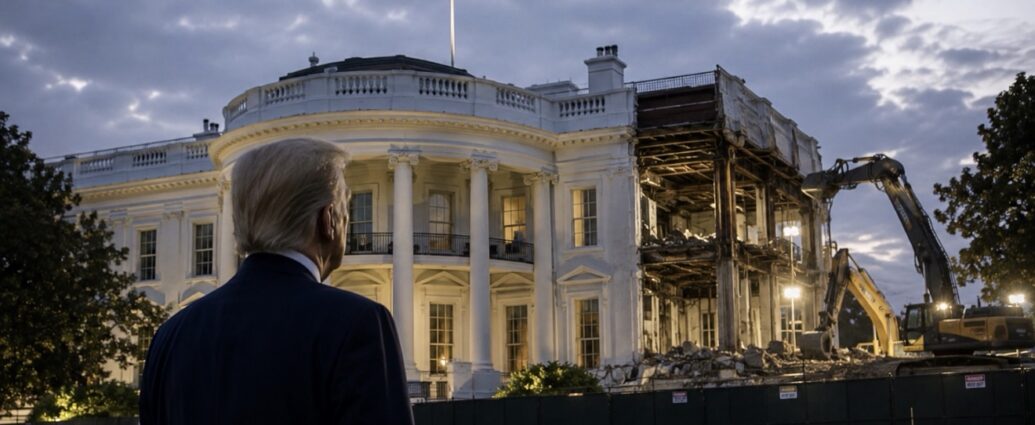
The fight over the new White House ballroom reached the Supreme Court on Friday. President Trump’s lawyers filed an emergency application asking the justices to lift a lower-court order that would halt construction of the $400 million project at the site of the former East Wing, the wing the president had torn down last fall to clear the ground.
Here is what is actually at stake in plain terms. A federal judge said the president cannot keep building without Congress signing off on it. A federal appeals court in Washington, D.C., agreed on Aug. 7, upholding an injunction issued by U.S. District Judge Richard Leon. That appeals court then paused its own decision for 14 days so the administration could take the case to the justices. The practical effect is that the block has not taken hold yet and crews are still working while the Supreme Court decides what to do. The justices have until Aug. 21 to act, and Solicitor General D. John Sauer has asked them to move immediately.
Judge Leon’s order was not a blanket shutdown. He allowed below-ground work on security and medical facilities to continue, while barring the ballroom itself. The administration wants that distinction erased.
The government’s argument leans almost entirely on security rather than on architecture or entertaining. Trump has increasingly cast the ballroom as a matter of national security and military readiness, pointing to what he calls a drone port on the roof. In the filing, Sauer described the site as an integrated military complex vitally required by national security. The application also cites attempts on Trump’s life, and newly characterizes the threat that reportedly caused him to board an alternate aircraft last month as an assassination attempt. Sauer’s broader complaint is that letting the injunction stand would make one district judge the sole authority on what construction is strictly necessary to protect the president, his family, staff and visiting foreign dignitaries.
On the other side is the National Trust for Historic Preservation, which brought the underlying lawsuit. One of the central questions the justices face is whether the Trust has legal standing to sue at all based on its membership — a threshold issue that could end the case without the court ever ruling on whether the president needs congressional approval to rebuild a wing of the White House.
The numbers explain why this is being fought so hard. The ballroom is planned at 90,000 square feet, roughly the footprint of a mid-size suburban shopping center dropped onto the White House grounds, and it carries a $400 million price tag. The cost climbed from an earlier $300 million estimate, and the project is being funded through private donations rather than appropriated money. That funding structure is part of the administration’s case: no taxpayer dollars, therefore, in its telling, no need for Congress to weigh in. The courts have so far not accepted that logic, because the dispute is about authority over the building itself, not about who wrote the check.
The ballroom is not the only project drawing legal fire. Trump’s plans for a golf course, an arch, the Kennedy Center and the Reflecting Pool have also been challenged in court, part of a wider building push reshaping the capital during his second term. For contractors, suppliers and the trades working these sites, the pattern is the real business story: work that starts, gets enjoined, restarts on appeal, and carries the standing risk of a stop-work order landing mid-pour.
There are only two clean ways out of this. The Supreme Court can grant the stay, which would let above-ground work continue while the case is litigated in full, and would effectively hand the president the win for the duration of construction. Or Congress can authorize the project, which is what both lower courts said was required in the first place and which would take the question away from the judiciary entirely. Anything short of one of those leaves a half-built structure on the East Wing site with a court order hanging over it.
Concrete framing and four walls are already standing. Whether they come down, stay put or go up further is now a decision for nine people who never asked to be construction managers, and they have about a week to make it.
JBizNews Desk | Washington, D.C.
© JBizNews.com All Rights Reserved. Reproduction or distribution without written permission is prohibited.