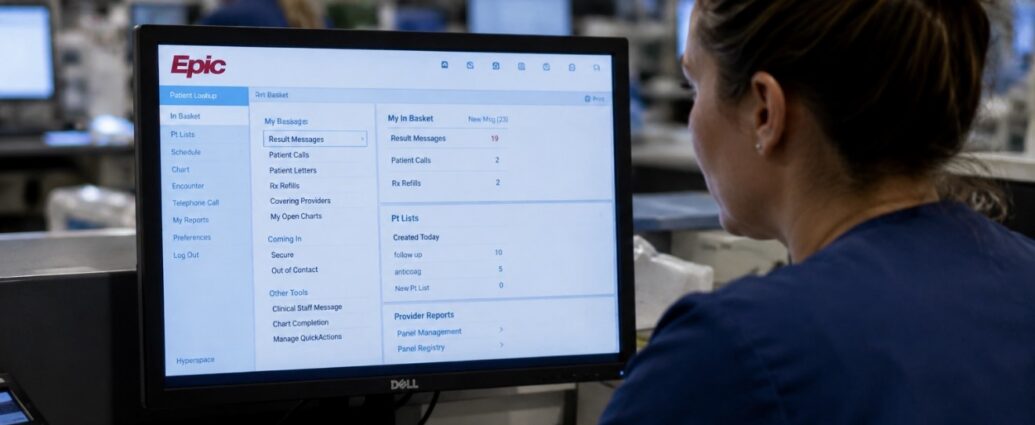
The Federal Trade Commission is investigating Epic Systems, the Wisconsin software company whose programs hold the medical records of most Americans, over whether it uses its size to block competitors from reaching patient data. The probe was reported Friday, Aug. 14, citing people contacted by investigators.
Here is what the fight is actually about. When a patient sees a doctor, that visit gets typed into a records system — and for roughly nine out of ten Americans, that system is Epic’s. Epic also runs MyChart, the portal where patients check test results and message their doctor. Because Epic holds the file, Epic decides which outside companies get to read it: a startup that wants to help an insurer process claims, a rival software firm, a new app a hospital wants to try. Competitors say Epic turns that tap on and off to protect its own business. Epic says it is protecting patient privacy and points to the hundreds of millions of record exchanges its customers complete each month, more than half of them with non-Epic systems.
Federal investigators have sent formal demands for information to other companies in the health technology industry, asking specifically how Epic grants or withholds access to data. The inquiry is early, and it may end without any case being brought. The FTC declined to comment.
State authorities got there first. Texas Attorney General Ken Paxton sued Epic in December 2025 under state antitrust law, arguing the company built a gatekeeping position around patient records and shut out challengers. That complaint put the number at more than 325 million patient charts — more than 90 percent of the country. Epic answered on Jan. 20, 2026, calling the claims baseless and saying it would fight for full dismissal, arguing the state’s six-month investigation turned up nothing improper and that the petition leaned on press clippings and borrowed allegations from a private lawsuit.
Two competitors are already in federal court. Particle Health, a data platform, sued in New York claiming Epic made it commercially impossible to operate in the market for insurer-facing tools. CureIS Healthcare filed its own case. As of May 2026, the court in the Particle case had ordered Epic to hand over documents going back to 2021, widening the discovery that any government investigator can now watch closely.
For patients, the practical stake is portability. If a person switches hospitals, moves to another state, or lands in an emergency room across town, whether the new doctor sees the full chart depends on systems talking to each other. Every blocked connection is a blank space in a record someone is treating from.
For hospital executives and the health companies that sell into them, the stake is leverage. Epic is privately held, took in over $4 billion in revenue in 2024, and rarely loses an account once installed — switching costs run into the hundreds of millions for a large system. A federal case, or even the threat of one, is the first real pressure on that arrangement.
What happens next is the harder question. Antitrust investigations of this kind typically run a year or more before the agency decides whether to sue, and the practical fix regulators tend to reach for is not breaking a company up but forcing it to open its interfaces on published, uniform terms — the same access for a startup as for a partner. Federal interoperability rules already push in that direction, and the Texas and Particle cases could produce court-ordered access requirements sooner than Washington, D.C., does. Epic, for its part, says its interfaces are already open, with a public library of more than 500 programming tools and over 1,500 outside apps using them free of charge.
JBizNews Desk | Washington, D.C.
© JBizNews.com All Rights Reserved. Reproduction or distribution without written permission is prohibited.