
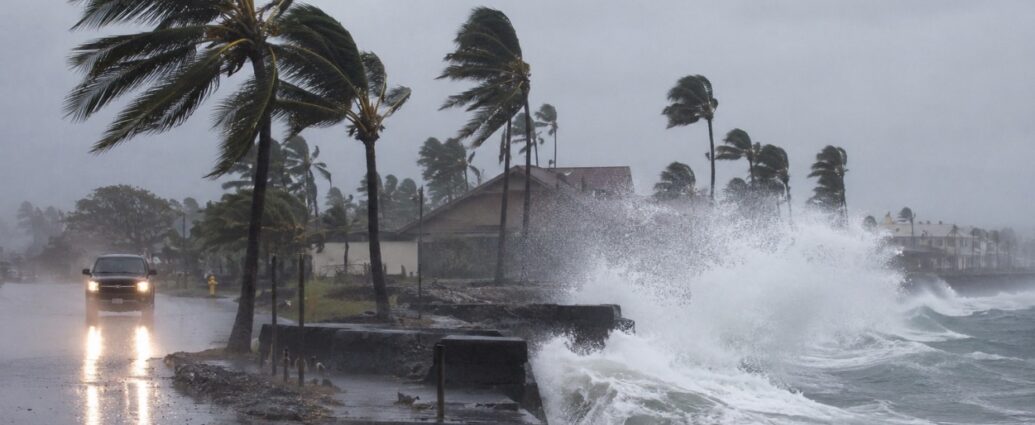
Hawaii spent Saturday bracing for the Big Island’s first direct hurricane strike in 155 years. It may not come. National Hurricane Center forecasters said in their afternoon discussion that Lala was showing a possible new track, leaving it unclear whether the storm will make landfall on the island at all. The damage arrived regardless.
Everything Hawaii sells and nearly everything it buys moves by air or by ship, and this weekend both stopped. Hilo International Airport and Ellison Onizuka Kona International Airport shut down, and commercial ports on the Big Island and in Maui County closed. More than 200 flights across the state were canceled Saturday, according to FlightAware, and Norwegian Cruise Line said some itineraries would be changed.
Lala strengthened into a Category 1 hurricane Saturday with sustained winds of 75 mph. By late evening its eyewall was brushing the southern shore, with maximum winds of 80 mph and the center about 30 miles south-southeast of South Point. The center is forecast to pass south of the smaller islands through Sunday, spreading tropical storm conditions west to Oahu and Kauai. “It doesn’t take landfall to create destruction,” said Vanessa Almanza, a National Weather Service meteorologist in Honolulu.
The power grid proved her point. About 76,000 customers statewide — roughly 15 percent of Hawaii’s electricity users — were dark by Saturday evening, according to PowerOutage.us. Hawaiian Electric said wind-toppled trees brought down poles and structures along a 42-mile stretch of transmission line on the Hamakua coast, and four independent power producers were knocked off the Big Island grid, raising the prospect of load shedding — deliberately cutting power to some customers to keep the rest of the system stable. The utility told one Big Island customer that service might not return until Monday.
Rain is the larger threat to property. Forecasters projected 10 to 20 inches across the Big Island with maximums near 25 inches, 8 to 12 inches on windward Maui and 4 to 8 inches elsewhere in the chain. Nahuku had already recorded 16.18 inches in 24 hours, with Glenwood at 11.94 and Piihonua at 10.09. The Wailuku River in Hilo rose from 3.4 feet Friday night to 16.2 feet by Saturday morning, the U.S. Geological Survey reported. That is water moving down steep volcanic slopes into towns built at the bottom of them.
Gov. Josh Green, citing rainfall of two inches an hour, told residents to shelter in place. He had declared a state of emergency Thursday. Shelters opened, events were canceled, and ranchers were advised to leave cattle in open pasture rather than in structures that might collapse. With outages spreading, the county Department of Water Supply asked island-wide that water be used only for drinking, cooking and bathing.
The repair work is already scoped. Hawaiian Electric has hundreds of crew members deployed and is restoring service where conditions allow, having already brought back more than 20,000 Big Island customers and several hundred in Maui County, though damage assessments must be completed before repair crews go out. Airports and harbors reopen once winds drop below operating thresholds, which for a state that imports the overwhelming majority of its food is the number that determines how fast grocery shelves refill.
JBizNews Desk | Honolulu
© JBizNews.com All Rights Reserved. Reproduction or distribution without written permission is prohibited.




