
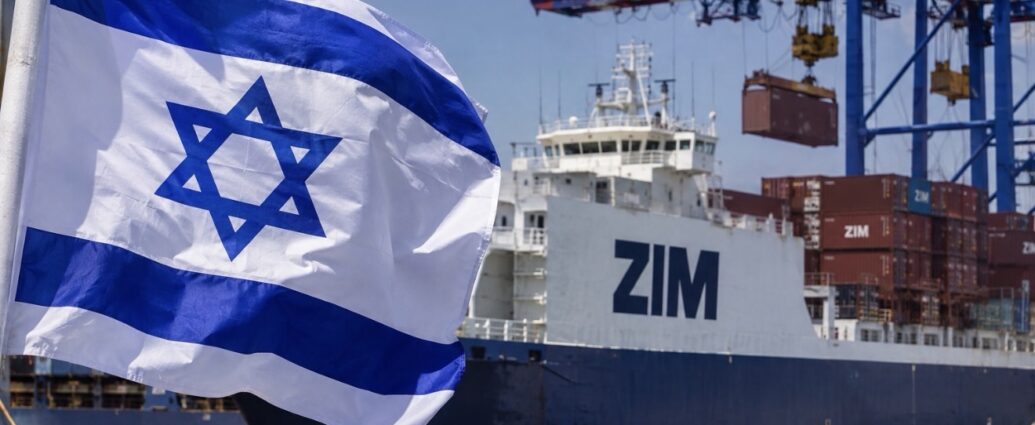
Israel’s largest shipping company is being sold to a German carrier whose shareholders include the sovereign wealth funds of Qatar and Saudi Arabia, and a new poll finds that about two out of every three Israeli Jews want the government to stop it.
The survey, conducted this month by Midgam Consulting and Research and commissioned by the Zim workers’ committee, found that 67.1% of Israel’s Jewish public opposes approving the sale to a buyer with Qatari shareholders. Roughly 57% object specifically because of the Qatari stake, while another 10% oppose the deal under any circumstances. About 30% would approve it only after security reviews, and just 2.4% — fewer than one in 40 — would sign off on it regardless.
What stands out is how little the answer changed from group to group. Opposition ran at 77.2% among religious respondents, 70.2% among secular respondents, 66% among haredi respondents and 60.2% among traditional respondents. Men and women, higher earners and lower earners all landed within a few points of one another. On a subject that usually splits Israeli opinion down predictable lines, this one does not.
The deal behind the numbers was signed in February. Germany’s Hapag-Lloyd agreed to acquire Zim Integrated Shipping Services for about $4.2 billion in cash. Qatar’s sovereign wealth fund holds 12.3% of the German carrier and Saudi Arabia’s Public Investment Fund holds 10.2%. Zim was founded in 1945, is headquartered in Haifa, and was fully government-owned until it was privatized in the early 2000s.
The structure splits the company in two. Hapag-Lloyd takes Zim’s international business — the Asia-to-America routes and the bulk of its chartered fleet. What stays in Israel is a smaller carrier, backed by Israeli private equity firm FIMI, holding 16 vessels, the Haifa headquarters and the shipping lines running to and from Israel.
That smaller company is meant to satisfy a condition the state has held for years. The government’s golden share lets it call up the fleet in an emergency to bring in essential goods such as wheat and fuel, requires a minimum of 11 ships, and blocks any foreign entity from taking sole control.
That is the heart of the objection. Israel imports nearly everything it eats, burns and builds with by sea. In a war, a blockade or a closed shipping lane, the question is not who owns the vessels on paper but who picks up the phone when Jerusalem calls. Zim kept sailing to Israel during periods when foreign carriers rerouted around the region, and that record is why the company is treated as infrastructure rather than as a stock.
Senior officials have already said the current terms do not clear that bar. Defense Minister Israel Katz sided with Defense Ministry officials who reviewed the acquisition and concluded it does not protect Israel’s national security interests, particularly in emergencies. Deputy Minister Almog Cohen separately warned Prime Minister Benjamin Netanyahu against handing over the country’s maritime gateway to a buyer with Qatari and Saudi shareholders.
There is a second worry that gets less attention: whether the Israeli remnant is strong enough to matter. The Israeli Administration of Shipping and Ports has cautioned that without state support, the slimmed-down carrier could be too weak to survive an industry downturn — which would leave Israel with no independent fleet at all.
Zim workers’ committee chairman Oren Caspi said the poll shows the public grasps what is at stake, calling it a struggle over a national interest rather than a labor dispute, and urging the government to block the sale.
The decision now sits with the state. The transaction is expected to close by late 2026 and remains subject to approval by Zim shareholders and regulators, including the State of Israel itself. Jerusalem can approve it, kill it, or approve it only with hard security conditions attached — a bigger guaranteed fleet, firmer emergency call-up rights, and state backing to keep the Israeli carrier solvent. The poll says the public wants the third option at minimum. The government has until the end of the year to answer.
JBizNews Desk | Tel Aviv
© JBizNews.com All Rights Reserved. Reproduction or distribution without written permission is prohibited.




